










Jeena Sikho Caps Government Revenue at 15% Pending Collections
Key highlights
- Jeena Sikho will keep government-funded treatment below 15% of revenue for six months to one year.
- Management illustrated the limit as Rs 15 crore of government business for every Rs 100 crore of revenue.
- Jeena Sikho cited Rs 117 crore of government business in 2025 that brought in Rs 65 crore.
- Management plans to announce four to six government-tied hospitals within two to four months.
powered by IRIS
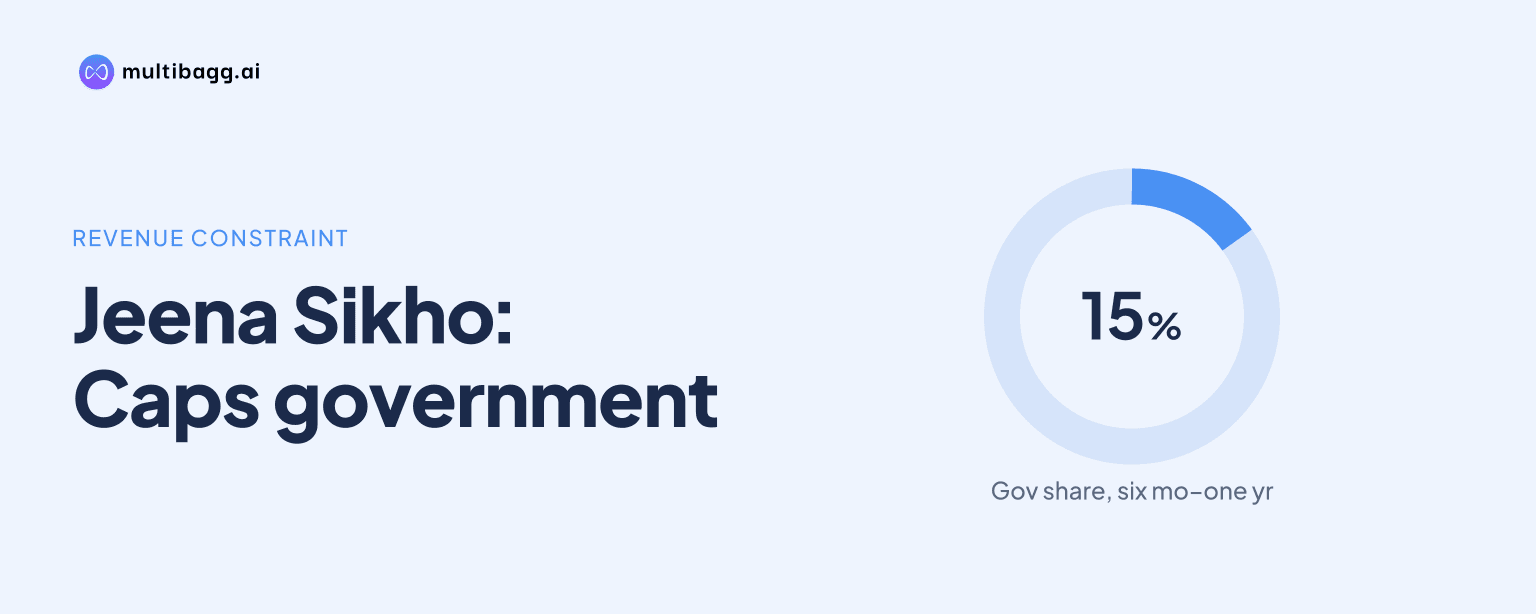
Jeena Sikho plans to keep government-funded treatment below 15% of revenue for six months to one year after management said payments from CAPF, CGHS and ECHS had begun arriving on time, with business from those schemes expected to rise from December through March.
Know Jeena Sikho Lifecare inside out
Results, valuation, peers and who's buying, in one view.
Why is Jeena Sikho restarting government-funded treatment?
Jeena Sikho is restarting selected government-funded treatment because management said payments from the Central Armed Police Forces, or CAPF, Central Government Health Scheme, or CGHS, and Ex-Servicemen Contributory Health Scheme, or ECHS, had started arriving on time. Management said revenue from these channels should increase during December, January, February and March after the company had previously reduced the business because payment timing was uncertain.
The restart is not a broad commitment to restore the segment immediately. Management said Jeena Sikho would keep government-funded treatment below 15% of total revenue for an initial six months to one year, and would consider raising exposure only when payments were intact and received on time. The policy makes collection regularity, rather than patient volume alone, the stated condition for expansion.
Management illustrated the ceiling with a simple example: at Rs 100 crore of revenue, government business would be Rs 15 crore. It also said the company would not take the segment up to the full 15% while it was still assessing payment behaviour. The 15% figure is therefore an upper limit, not management's stated near-term revenue target.
How will Jeena Sikho balance government work with private treatment?
Jeena Sikho plans to use smaller Panchakarma packages alongside government-linked care to increase patient volumes without depending on a single payment source. Management said treatments for blood pressure, diabetes, thyroid and joint pain can fall within Panchakarma, and cited patient payments of Rs 20,000, Rs 25,000 and Rs 30,000 for such packages, with health-insurance claims also available in some cases.
Management said the experiment reduced margins but generated learning about patient demand and insurance eligibility. It had earlier offered half-rate schemes for Ayushman cardholders at smaller hospitals and launched preventive packages, which reduced ticket size and shortened stays. Those measures were intended to introduce Panchakarma to patients who did not previously know the service, according to management.
Jeena Sikho cited a government-set rate of Rs 8,400 and separately referred to an Ayushman rate range of Rs 8,400 to Rs 9,400. The call did not provide a standalone revenue, cost or earnings calculation for the government-funded segment. It supports the existence of a revenue cap and government treatment rates, but not a segment-level profitability forecast.
What collection issue led Jeena Sikho to cap government revenue?
Jeena Sikho said it had closed government business because payments were not coming, and management cited Rs 117 crore of government business in 2025 that brought in Rs 65 crore. The transcript does not reconcile the two figures or specify their exact accounting relationship, but management explicitly linked its reduced exposure to payment collection.
Management said retaining Rs 117 crore of government business would still have required Rs 80 crore of spending on the Panchakarma business. It questioned the purpose of retaining such revenue if borrowings increased, indicating that cash conversion and receivables, rather than reported sales alone, shaped the decision to restrict government exposure.
The call also disclosed estimated credit loss, or ECL, provisions, which are provisions for amounts expected not to be collected. Jeena Sikho's finance executive said the company recorded Rs 3 crore of ECL in the quarter and about Rs 20 crore to Rs 21 crore for the full year. These provisions were not identified as government receivables, so they cannot be assigned to the government business specifically.
Got a follow-up? Ask IRIS
Where does Jeena Sikho plan to use government tie-ups?
Jeena Sikho plans to announce four to six hospitals tied up with the government within two to four months, according to management. It said these arrangements would use an earlier model that had been paused while the company waited for policy clarity and better payment timing, and described the model's expenses as lower.
Management said it already had 20 hospitals tied up but had neither announced nor taken them over. The proposed four to six new announcements would be in markets where Jeena Sikho has less established operations, including southern India, Madhya Pradesh, Bihar, Bengal and Tamil Nadu. The source does not state that all 20 existing tie-ups will proceed.
Jeena Sikho said it currently has three small hospitals in Chennai, Hyderabad and Bangalore. Management's stated objective in the newer geographies is to increase sales, patient numbers and hospital presence. While the next planned hospital announcements are government-linked, the company also described a broader geographic expansion effort rather than an exclusive reliance on government-funded care.
Can day care and private packages support Jeena Sikho's growth plan?
Jeena Sikho is using day care and lower-priced packages to increase treatment volumes outside longer inpatient stays. Management said it reduced the length of stay for some patients and converted treatment to day care, which lowered ticket size. It reported 30,919 combined in-patient department, or IPD, and day-care patients in Quarter 1, rising to 32,182 in Quarter 2.
The mix changed within that combined total. IPD patient numbers declined to 10,980 in Quarter 2 from 11,500 in Quarter 1, while day-care patients rose to 21,200 from 19,419. Management said day care involved similar therapies but fewer admission-related costs, such as overnight nursing, and that health insurers had begun allowing claims for day care.
Management said it aims to restore average revenue per occupied bed to Rs 8,200 to Rs 8,300 over the next two to three quarters, after a fall from Rs 8,400 to about Rs 7,300 or Rs 7,400. It attributed the decline to the Ayushman cardholder scheme and shorter preventive packages. Management also guided for 25% to 30% growth in the following year and said it aimed to maintain earnings before interest, taxes, depreciation and amortisation, or EBITDA, of 35% to 40% from the fourth quarter.
Conclusion
Jeena Sikho's 15% ceiling shows that the planned revival of government-funded treatment is conditional on collections, not merely on the availability of patients or tie-up hospitals. The company is pairing that restraint with smaller Panchakarma packages, day-care delivery and geographic expansion, while management seeks to rebuild average revenue per occupied bed after the shift toward shorter, lower-priced treatments.
The next disclosed markers are management's expectation that CAPF, CGHS and ECHS business will rise from December through March, and its plan to announce four to six government-tied hospitals within two to four months. Payment performance during the six-month to one-year monitoring period, the proposed recovery in average revenue per occupied bed to Rs 8,200 to Rs 8,300, and the stated 35% to 40% EBITDA target from the fourth quarter are the key measures management has put forward.