










Jeena Sikho Q2 EBITDA margin falls to 31% on higher costs
Key highlights
- Jeena Sikho reported Q2 FY27 revenue from operations of Rs 235 crore, up 24% year-on-year.
- Q2 FY27 EBITDA margin was 31%, compared with 48% in Q2 FY26 and 41% in Q1 FY27.
- Operating expenses rose 83% year-on-year, including a Rs 13.4 crore increase in advertising and promotion expense.
- Q2 FY27 OPD and consultation customers rose 174% year-on-year to 7.1 lakh.
powered by IRIS
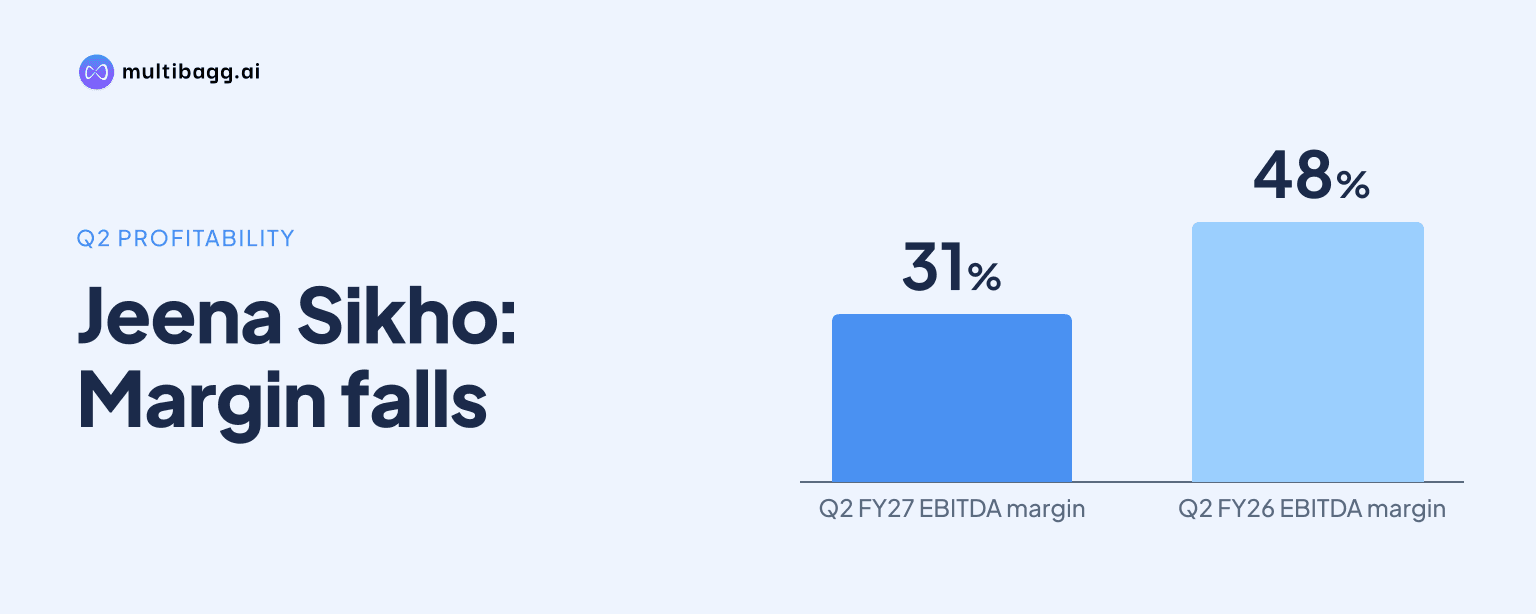
Jeena Sikho Lifecare Limited reported a 31% EBITDA margin in Q2 FY27 ended September 30, 2026, down from 48% a year earlier, as operating expenses rose 83% year-on-year for product launches, brand promotion, hiring, centres and technology, while gross margin remained 88%.
Know Jeena Sikho Lifecare inside out
Results, valuation, peers and who's buying, in one view.
Why did Jeena Sikho’s Q2 FY27 EBITDA margin decline?
Jeena Sikho said the margin decline resulted from higher operating expenses rather than a reported change in gross profitability. Revenue from operations rose 24% year-on-year and 5% quarter-on-quarter to Rs 235 crore in Q2 FY27, while EBITDA was Rs 72 crore. The 31% margin was 17 percentage points below Q2 FY26's 48% and 10 percentage points below Q1 FY27's 41%.
The chief financial officer said Q2 FY27 gross margin was 88%, close to the company's stated structural level of about 89%. Operating expenses increased 83% year-on-year as Jeena Sikho invested in new product launches, doctors, staff, centres and technology. Management therefore described the margin movement as the effect of deliberate operating expenditure rather than weaker gross margin.
Advertisement and promotion expense increased by Rs 13.4 crore year-on-year, driven by brand-building aimed at younger customers, including a campaign on a popular television platform. Employee-benefit expense increased by Rs 4.1 crore because of additional manpower and market-talent hiring. Management said these H1 expenses could produce operating leverage in H2 as utilisation rises, without setting a quantified cost-reduction target.
How did Jeena Sikho’s product-led acquisition experiment affect results?
Jeena Sikho said its product-led acquisition experiment widened customer reach in Q2 FY27 but reduced ticket size and did not generate equivalent sales immediately. The company launched 10 products from July 2026 and additional kits from September 2026. Management said e-commerce patient volume nearly doubled as it sought to use products as an entry point before converting customers to Panchakarma and other services.
The consultation funnel expanded. Outpatient department, or OPD, and consultation customers reached 7.1 lakh in Q2 FY27, up 174% year-on-year, while OPD volume rose 14% to 1.59 lakh. Inpatient department, or IPD, patients were 10,980 in Q2 FY27, also up 14% year-on-year, and reached 22,480 in H1 FY27.
Management said lower-margin customers increased funnel volume but sales declined, and its focus on preventive care reduced revenue, ticket size and patient footfall relative to the earlier treatment-led approach. It said the next-quarter approach would combine prevention and treatment. That reset is material because the customer-acquisition spending contributed to the 83% rise in operating expenses.
Jeena Sikho also changed its e-commerce advertising approach in November 2026. Management said it stopped a product campaign with return on advertising spend, or ROAS, of four times and retained campaigns with ROAS of six to seven times. E-commerce reach rose from 2.63 lakh people in the previous quarter to 4.63 lakh in Q2 FY27, which management intends to use for later Panchakarma conversion.
Got a follow-up? Ask IRIS
What did Jeena Sikho report for revenue, occupancy and capacity?
Jeena Sikho reported H1 FY27 revenue from operations of Rs 460 crore, up 26% year-on-year, EBITDA of Rs 164 crore and an EBITDA margin of 36%. Profit after tax was Rs 102 crore in H1 FY27, compared with Rs 36 crore in Q2 FY27. The H1 margin being 5 percentage points above the Q2 margin indicates that the expense increase was more pronounced during the second quarter.
Occupancy was 55% in Q2 FY27 and 57% in H1 FY27, although management said Q2 occupancy was lower than in the preceding quarter. It linked part of the movement to higher daycare patient numbers and nearly doubled e-commerce volume. Jeena Sikho had 62 hospitals, 60 clinics and daycare centres, about 2,424 operational beds and operations in 23 states at the time of the November 16, 2026 call.
Jeena Sikho added three clinics in Q2 FY27 and said 460 beds were in the pipeline. Management said it had slowed bed expansion over the prior two quarters while awaiting developments in the government AYUSH scheme, while retaining a three-to-five-year goal of 7,000 to 10,000 beds. That makes the planned use of existing capacity as important as additions to the network.
Pune Hospital received Panchakarma accreditation in September 2026, valid until July 2029, and Raipur Hospital received accreditation on October 1, 2026, valid until August 2029. Jeena Sikho also signed its first wellness resort in Himachal Pradesh, with 108 rooms and 24 villas expected within a year. Management said the resort was scheduled to launch on December 15.
What is Jeena Sikho changing after Q2 margin pressure?
Jeena Sikho said it had changed its product, service and advertising plans, with management expecting a larger effect in Q4 FY27 than Q3 FY27. The managing director cited three to four days of Diwali-related service disruption in Q3 and said operational changes would take 15 to 20 days to take effect. Management maintained its FY27 growth guidance but did not give a revised numerical annual revenue or profit target during the call.
Management said it plans to deliver 20% to 25% growth and maintain EBITDA margin between 35% and 40% by March 31. This is management's stated target, rather than an achieved result. New packages for diabetes, blood pressure, lung problems, joint pain and eye conditions were scheduled to start in hospitals from December 2026.
A further potential channel is government-funded business through Portal 2.0, which management said began after Diwali. Jeena Sikho said government business had represented Rs 117 crore, or 25%, in 2025 before falling to 4% in 2026 because payments were delayed. Management expects payments under the resumed process in two to four months but said it would cap government business at 15% of total business.
Management also cited planned 150-bed Ahmedabad and 150-bed Lucknow hospital openings in December 2026 or January 2027, alongside a new eye hospital and a joint-pain protocol. These projects, together with 460 pipeline beds, increase the importance of occupancy and patient conversion in determining whether marketing and hiring expenditure creates the operating leverage management expects.
Conclusion
Jeena Sikho’s Q2 FY27 performance showed stable gross profitability but lower operating profitability: gross margin was 88%, while EBITDA margin fell to 31% as operating expenses rose 83% year-on-year. Revenue increased 24%, consultation customers rose 174% to 7.1 lakh and e-commerce reach expanded, but lower ticket sizes and acquisition spending limited near-term margins.
The next developments to watch are management’s planned December 2026 disease-specific packages, the Ahmedabad and Lucknow hospital openings expected in December or January, and whether Portal 2.0 resumes government-funded admissions with payments in the stated two-to-four-month period. Management has also set a 35% to 40% EBITDA-margin objective by March 31 and said the more visible effect of its changes should come in Q4 FY27.