










Jiffy GMV rises 29% as EBITDA loss narrows to ₹4.4 crore
Key highlights
- Jiffy’s GMV-Online rose 29.2% year on year to ₹68 crore in Q2 FY27.
- Jiffy’s Q2 FY27 EBITDA loss narrowed to ₹4.4 crore from ₹11.9 crore a year earlier.
- Jiffy’s revenue from operations increased 39.4% year on year to ₹8.8 crore in Q2 FY27.
- Repeat customers accounted for 80% of Jiffy orders in Q2 FY27, up from 61% in Q1 FY26.
powered by IRIS
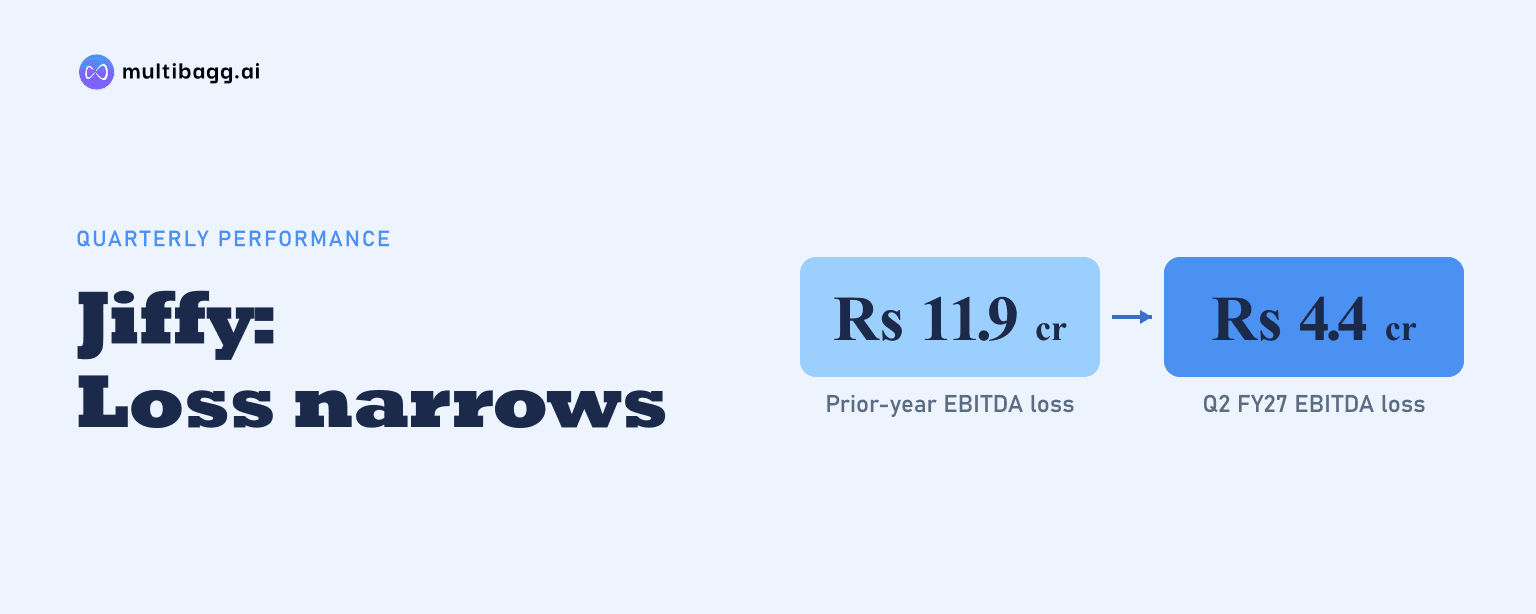
Jiffy reported online gross merchandise value of ₹68 crore in Q2 FY27, up 29.2% year on year, while its EBITDA loss narrowed to ₹4.4 crore from ₹11.9 crore in Q2 FY26. The presentation attributes the lower loss to reduced year-on-year marketing expenses, alongside higher online GMV and revenue from operations.
Know Spencers Retail inside out
Results, valuation, peers and who's buying, in one view.
How did Jiffy’s GMV perform in Q2 FY27?
Jiffy’s online gross merchandise value, or GMV, increased 29.2% year on year and 14.5% quarter on quarter to ₹68 crore in the three months ended 30 September 2026. Online GMV was ₹52 crore in the three months ended 30 September 2025 and ₹59 crore in the preceding quarter ended 30 June 2026.
Jiffy’s two disclosed GMV lines moved in opposite directions during the quarter. GMV-Online rose by ₹16 crore from Q2 FY26, while GMV-PD fell 22.3% year on year to ₹20 crore from ₹26 crore and declined from ₹21 crore in Q1 FY27. The reported online GMV increase was therefore not matched by GMV-PD.
What narrowed Jiffy’s EBITDA loss?
Jiffy’s EBITDA loss narrowed by ₹7.5 crore year on year to ₹4.4 crore in Q2 FY27, compared with a ₹11.9 crore loss in Q2 FY26. It also narrowed by ₹1.6 crore from the ₹6 crore loss recorded in Q1 FY27. Jiffy’s presentation says lower year-on-year marketing expenses reduced the loss from about ₹12 crore to about ₹4 crore.
Reported other expenses declined 28% year on year to ₹11.2 crore from ₹15.5 crore and fell 6% from ₹12 crore in Q1 FY27. The financial statement does not provide marketing expense as a separate line item, so it does not quantify the marketing reduction independently. Employee expenses fell 25% year on year to ₹2 crore from ₹2.7 crore, although they increased from ₹1.9 crore in the preceding quarter.
Jiffy’s EBITDA margin improved to negative 49.4% in Q2 FY27 from negative 187% in Q2 FY26 and negative 76.3% in Q1 FY27. Revenue rose by ₹2.5 crore year on year to ₹8.8 crore, while the EBITDA loss reduced by ₹7.5 crore. EBITDA remained negative at the end of the September 2026 quarter.
How did Jiffy’s revenue and pre-tax loss change?
Jiffy’s revenue from operations rose 39.4% year on year to ₹8.8 crore in Q2 FY27, exceeding the 29.2% growth rate in GMV-Online. Revenue was ₹6.3 crore in Q2 FY26 and ₹7.9 crore in Q1 FY27, representing 12.3% quarter-on-quarter growth. The presentation provides the GMV and revenue figures but does not explain their relationship.
Jiffy’s profit before tax, or PBT, loss narrowed to ₹5.2 crore from ₹12.4 crore a year earlier and ₹6.8 crore in Q1 FY27. PBT margin improved to negative 59.2% from negative 196% in Q2 FY26. Depreciation was unchanged year on year at Rs 30 lakh, while finance costs increased to Rs 60 lakh from Rs 30 lakh.
The ₹5.2 crore PBT loss was also reported as the loss after tax because the statement showed no tax expense in the quarter. For the six months ended 30 September 2026, revenue reached ₹16.7 crore versus ₹11.9 crore a year earlier, while the EBITDA loss narrowed to ₹10.4 crore from ₹22.6 crore.
Got a follow-up? Ask IRIS
Are Jiffy customers returning more often?
Jiffy reported that repeat customers accounted for 80% of orders in Q2 FY27, up from 61% in Q1 FY26. The 19-percentage-point increase coincided with Order Net Promoter Score, or NPS, rising to +85 from +67 over the same six-quarter period.
Order NPS rose in every quarter shown, increasing from +67 in Q1 FY26 to +75 in Q2 FY26, +80 in Q3 FY26, +83 in Q4 FY26, +84 in Q1 FY27 and +85 in Q2 FY27. Jiffy’s quarterly customer rating also increased from 4.28 to 4.64, a gain of 0.36 points.
Jiffy links customer-experience gains with customer stickiness, but the presentation does not disclose customer counts, order frequency, acquisition cost or retention cohorts. The 80% repeat-order share therefore shows a higher contribution from repeat customers, without providing a full customer-unit-economics calculation.
What does Jiffy’s first-half performance show?
Jiffy’s GMV-Online reached ₹127 crore in the six months ended 30 September 2026, compared with ₹93 crore in the corresponding prior-year period. GMV-PD moved the other way, declining to ₹42 crore from ₹52 crore. Online GMV therefore increased by ₹34 crore while the other disclosed GMV category decreased by ₹10 crore.
Jiffy’s first-half EBITDA loss was ₹10.4 crore, or negative 62.1% of revenue, compared with a ₹22.6 crore loss and negative 190% margin a year earlier. Its first-half PBT loss narrowed to ₹12 crore from ₹23.8 crore, although finance costs doubled to ₹1.2 crore from Rs 60 lakh.
The presentation does not disclose an EBITDA break-even target, a future marketing budget or a timetable for profitability. It does show that first-half revenue grew to ₹16.7 crore from ₹11.9 crore while both quarterly and first-half EBITDA losses declined, leaving future expense and GMV trends central to the reported trajectory.
Conclusion
Jiffy’s Q2 FY27 figures combine 29.2% online GMV growth to ₹68 crore with a 63% year-on-year reduction in EBITDA loss to ₹4.4 crore. Revenue growth of 39.4%, lower reported other expenses and an 80% repeat-order share occurred alongside a 22.3% decline in GMV-PD to ₹20 crore.
The next disclosures will clarify whether Jiffy can sustain lower losses while GMV-PD remains below its ₹26 crore level in Q2 FY26 and finance costs have risen to Rs 60 lakh from Rs 30 lakh. The presentation sets no profitability target or break-even timetable, leaving quarterly GMV, revenue, other expenses and EBITDA as the disclosed measures to watch.