










Spencer’s lifts Q2 EBITDA margin to 4.2% as sales rise 7.1%
Key highlights
- Spencer’s Q2 revenue rose 7.1% year on year to Rs 402.8 crore.
- Spencer’s Q2 EBITDA increased to Rs 16.9 crore from Rs 12.7 crore.
- Spencer’s EBITDA margin rose to 4.2% from 3.4% in Q2 of the prior year.
- Spencer’s reported Q2 gross margin was 17.8%, or 19.0% without the accounting reclassification.
powered by IRIS
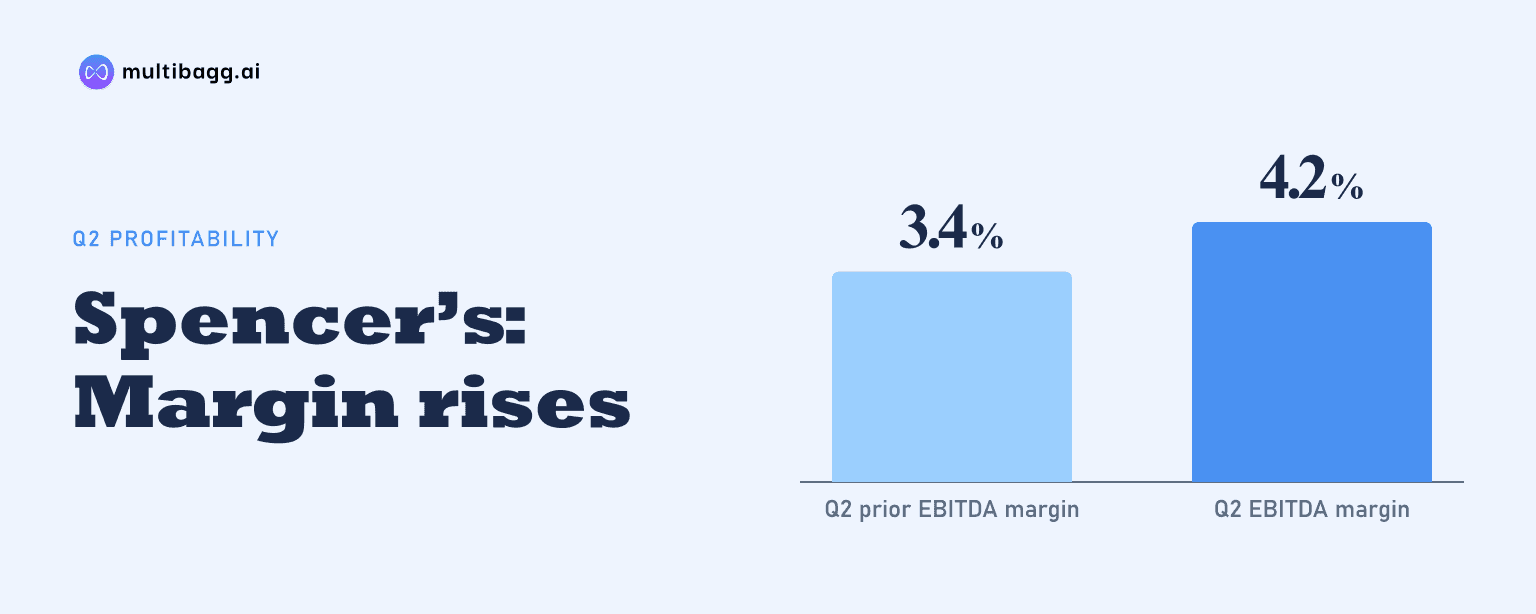
Spencer’s (standalone) lifted EBITDA margin to 4.2% in the three months ended 30 September 2026 from 3.4% a year earlier, as revenue from operations rose 7.1% to Rs 402.8 crore and employee plus other expenses declined. Reported gross margin fell to 17.8%, partly reflecting a membership-accounting reclassification.
Know Spencers Retail inside out
Results, valuation, peers and who's buying, in one view.
How did Spencer’s sales and EBITDA change in Q2?
Spencer’s increased revenue from operations by 7.1% year on year to Rs 402.8 crore in Q2 ended 30 September 2026, while earnings before interest, tax, depreciation and amortisation (EBITDA) rose to Rs 16.9 crore from Rs 12.7 crore. EBITDA margin increased by 83 basis points, where one basis point equals one-hundredth of a percentage point, to 4.2% from 3.4%.
The quarter was lower sequentially on both revenue and operating profit. Revenue declined 1% from Rs 407.9 crore in Q1, while EBITDA fell from Rs 17.9 crore and margin moved down 20 basis points from 4.4%. The presentation nevertheless attributes the year-on-year EBITDA improvement to sales growth and cost control.
For the six months ended 30 September 2026, Spencer’s revenue rose to Rs 810.8 crore from Rs 722.5 crore in the prior-year half. EBITDA increased to Rs 34.7 crore from Rs 27.3 crore, lifting the half-year EBITDA margin to 4.3% from 3.8%. This means the Q2 improvement was accompanied by higher first-half revenue and margin.
Why did Spencer’s reported gross margin decline?
Spencer’s reported gross margin of 17.8% in Q2, down 178 basis points from 19.6% a year earlier and 38 basis points from 18.2% in Q1. The presentation says Q2 is not like-for-like because of an accounting treatment for membership, and reports a 19.0% Q2 margin without that reclassification.
The reclassification-adjusted Q2 figure of 19.0% was also below the presentation’s adjusted Q1 figure of 19.2%. It narrowed the difference from the reported 17.8%, but the source does not disclose an adjusted Q2 FY26 comparison. Therefore, an adjusted year-on-year gross-margin change cannot be calculated from the presentation.
Gross margin in rupee terms was Rs 71.7 crore, compared with Rs 73.7 crore in the prior-year quarter and Rs 74.2 crore in Q1. Cost of goods sold rose 9% year on year to Rs 331.1 crore, exceeding revenue growth of 7.1%. For the first half, gross margin increased in value to Rs 145.9 crore from Rs 139.8 crore, but the percentage declined to 18.0% from 19.3%.
Got a follow-up? Ask IRIS
What costs supported Spencer’s Q2 EBITDA margin?
Spencer’s reduced employee and other expenses enough to offset the lower reported gross margin at the EBITDA level. Employee expenses declined 21% year on year to Rs 18.6 crore from Rs 23.4 crore, while other expenses fell 9% to Rs 37.1 crore from Rs 40.7 crore. Their combined total was Rs 55.7 crore, versus Rs 64.1 crore a year earlier.
Sequentially, employee expenses decreased from Rs 21.2 crore in Q1, but other expenses rose from Rs 36.2 crore. This left combined employee and other expenses at Rs 57.4 crore in Q1, compared with Rs 55.7 crore in Q2. The presentation’s summary rounds Q2 operating expenses to Rs 56 crore and the prior-year amount to Rs 64 crore.
Other income declined to Rs 90 lakh in Q2 from Rs 3.1 crore a year earlier, a 72% reduction. Even so, EBITDA increased by Rs 4.2 crore because revenue grew by Rs 26.5 crore and employee plus other expenses fell by Rs 8.4 crore. The operating-profit improvement therefore did not depend on higher other income.
For the first half, employee expenses reduced to Rs 39.8 crore from Rs 44.6 crore and other expenses fell to Rs 73.3 crore from Rs 78.9 crore. Other income dropped to Rs 2 crore from Rs 11.1 crore, while EBITDA still rose by Rs 7.4 crore. The presentation shows that the lower expense base accompanied the higher half-year EBITDA.
Did higher EBITDA translate into lower Q2 losses for Spencer’s?
No. Spencer’s reported loss before tax and loss after tax of Rs 37 crore in Q2, compared with Rs 33.7 crore in the year-earlier quarter, despite EBITDA of Rs 16.9 crore. Depreciation rose to Rs 14.7 crore from Rs 14.1 crore, while finance costs increased to Rs 39.2 crore from Rs 32.3 crore.
The pre-tax loss margin was negative 9.2%, compared with negative 8.9% a year earlier and negative 8.3% in Q1. Finance costs were Rs 37.5 crore in Q1, making the Q2 amount Rs 1.7 crore higher sequentially. The presentation does not state the underlying reasons for the higher finance cost.
For the six months ended 30 September 2026, loss before tax and loss after tax were each Rs 71.1 crore, compared with Rs 64.8 crore in the prior-year half. EBITDA rose by Rs 7.4 crore, but finance costs rose by Rs 12.9 crore to Rs 76.7 crore and depreciation increased by Rs 80 lakh to Rs 29.2 crore.
Spencer’s had 90 stores at 30 September 2026, unchanged from 30 September 2025, although it added one store in each half-year period. Total trading area at exit was 7.52 lakh square feet, compared with 7.73 lakh square feet a year earlier. The presentation does not provide a store-opening target or formal profitability guidance.
Conclusion
Spencer’s separated operating progress from bottom-line performance in Q2. Revenue growth of 7.1%, lower employee expenses and lower other expenses lifted EBITDA margin by 83 basis points to 4.2%, despite a reported gross-margin decline and lower other income. Higher finance costs and depreciation, however, contributed to a larger quarterly loss after tax.
The next results will show whether Spencer’s can sustain revenue growth and the lower expense base while gross margin remains affected by the membership-accounting treatment. Finance costs, which reached Rs 39.2 crore in Q2 and Rs 76.7 crore in the first half, remain the disclosed factor to watch in assessing whether EBITDA improvement can reduce reported losses.