










Jindal Supreme sees double-digit margin at 80% utilisation
Key highlights
- Jindal Supreme reported 65.5% capacity utilisation in H1 FY27, up from 61.6% in FY26.
- Management expects utilisation of about 70% in Q3 FY27, 75% in Q4 FY27 and 80% in Q1 FY28.
- H1 FY27 EBITDA rose 64% year on year to Rs 30.70 crore, with EBITDA margin at 7.5%.
- Q2 FY27 EBITDA margin expanded to 7.8% from 4.8% in Q2 FY26.
powered by IRIS
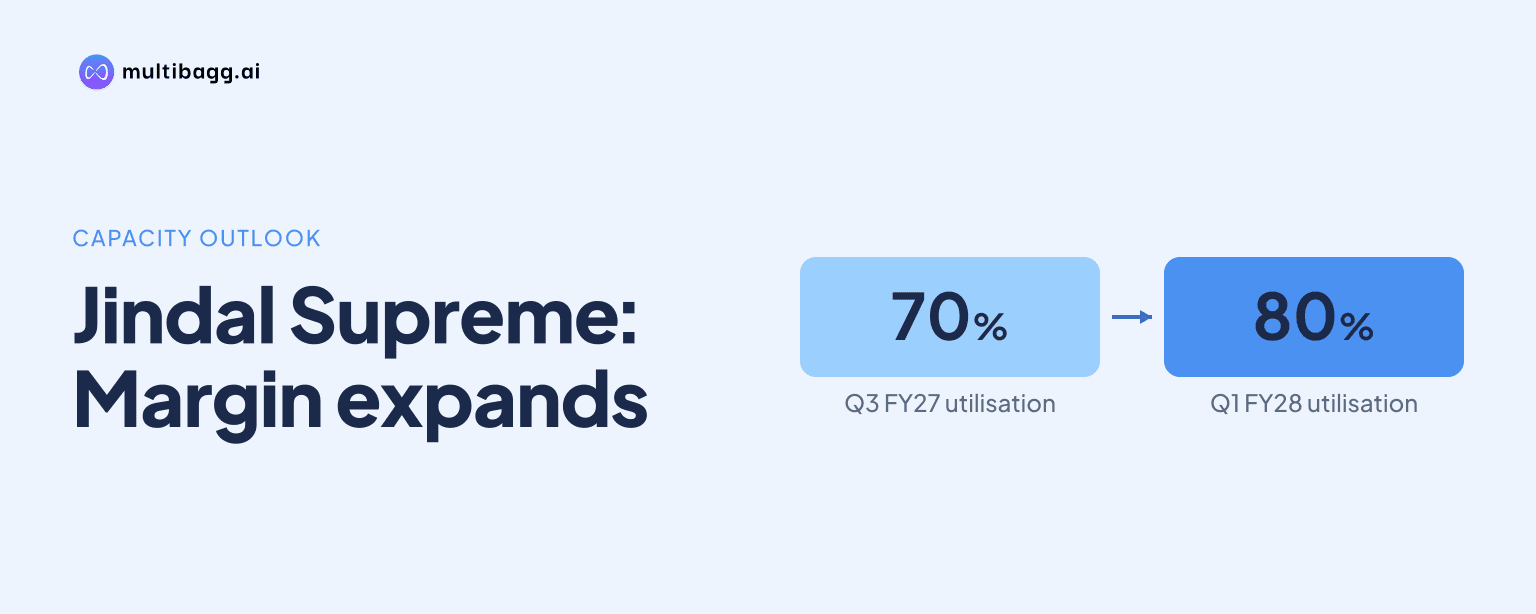
Jindal Supreme (India) Limited said it targets a double-digit earnings before interest, tax, depreciation and amortisation (EBITDA) margin when capacity utilisation reaches about 80% in Q1 FY28, versus 65.5% utilisation and a 7.5% EBITDA margin in H1 FY27. Management linked the proposed improvement to greater fixed-cost absorption, higher-value products and newly commissioned capacity.
Know Jindal Supreme (India) inside out
Results, valuation, peers and who's buying, in one view.
When does Jindal Supreme expect to reach 80% utilisation?
Jindal Supreme expects overall capacity utilisation to rise from about 65% currently to around 70% in Q3 FY27, 75% in Q4 FY27 and 80% in Q1 FY28, according to management. Management described 80% as the optimum operating level for the industry, rather than providing an assurance of reported output.
The H1 FY27 starting point was 65.5%, compared with 61.6% in FY26. Black pipes operated at 70%, galvanised iron, or GI, pipes at 65%, crash barriers at 56%, and GI tubular poles at 45%, showing that the ramp requires increased output from the newer pole and crash-barrier businesses as well as established pipe lines.
GI tubular poles, launched in April FY25, had increased utilisation from about 15% in their first year to 45% in H1 FY27. Management said the pole category could reach 80% to 85% utilisation by Q4 FY27, supported by uses in streetlighting and telecom towers, including projects in hilly areas.
The additional galvanising line with 18,000 tonnes of annual capacity began commercial production at the end of October 2026, management said. The line is designed for crash barriers and was expected to add volume from December, while management also said metal-beam crash-barrier capacity had doubled to 48,000 tonnes annually from 24,000 tonnes.
What EBITDA margin is Jindal Supreme targeting?
Jindal Supreme is targeting a double-digit EBITDA margin only after it reaches about 80% utilisation, which management expects mostly by Q1 FY28. Management called the present 7% to 8% EBITDA-margin range achievable over a longer period, while characterising the double-digit level as a target rather than issued financial guidance.
The Q2 FY27 result provides the latest reported margin comparison. Revenue from operations increased 36% year on year to Rs 216.22 crore, while EBITDA rose 122% to Rs 16.94 crore. EBITDA margin therefore expanded to 7.8% from 4.8% in Q2 FY26, a gain of 3 percentage points.
For H1 FY27, revenue grew 23% year on year to Rs 407.16 crore and EBITDA rose 64% to Rs 30.70 crore, producing a 7.5% margin. Profit after tax increased 72% to Rs 18.19 crore and its margin was 4.5%; management called this the company’s strongest half-year performance and said H1 is normally slower than H2 because Q2 includes monsoon and festival periods.
Got a follow-up? Ask IRIS
How would higher utilisation improve Jindal Supreme’s margin?
Jindal Supreme said a move from about 65% to 80% utilisation would spread fixed costs over a larger production volume, while variable costs would fluctuate with output. Management specifically said this operating leverage, alongside new products, should increase EBITDA per tonne as output rises.
Reported EBITDA per tonne was Rs 5,800 in H1 FY27, up from Rs 2,100 a year earlier. Management attributed the increase to better capacity utilisation, fixed-cost absorption and a higher share of value-added products, which it reported at 57% in the opening remarks and 57.5% in the finance presentation, compared with 49% a year earlier.
Steel prices are not presented by management as a permanent margin driver. Jindal Supreme said it is a re-roller that generally passes steel-price changes on to customers with an approximately two-week lag; it also said selling prices are adjusted downward when steel prices decline.
Sales channels could also affect the mix. Dealers contributed about 20% of revenue in H1 FY27, while the balance included engineering, procurement and construction companies, crash-barrier contractors and other pipe customers. Management said direct institutional sales generate better margins than dealer-network sales, but did not quantify the difference.
Which products and projects support the margin plan?
Jindal Supreme identified tubular poles and crash barriers as its principal H2 FY27 growth drivers, after GI tubular poles and black tubular poles led H1 growth and margins. Alongside the 18,000-tonne galvanising addition, management said solar structures would enter production in Q4 FY27 and nuts and bolts for towers, poles and crash barriers had been introduced.
Management said nuts and bolts have low tonnage but higher value addition, and could partly replace externally sourced bolts used in the company’s crash-barrier and pole sales. Total installed capacity was about 171,000 tonnes annually in H1 FY27, and management said capacity including the galvanising and solar-structure additions would be about 200,000 tonnes by the end of FY27.
A fifth galvanising line is planned with rated capacity of 24,000 tonnes annually. Management initially said it would be operational in Q4 FY28, but later said it could be ready by Q2 of the next financial year, leaving the call without a consistent commissioning date for that line.
Management guided for FY27 revenue of Rs 850 crore to Rs 900 crore and EBITDA of about Rs 60 crore. It estimated a 40:60 H1-to-H2 sales split, citing seasonality and added capacity, so delivery of the forecast depends on the ramp in poles, crash barriers and galvanising.
Conclusion
Jindal Supreme’s stated route to a double-digit EBITDA margin is operational rather than based on a steel-price assumption: lift utilisation from 65.5% in H1 FY27 to about 80%, increase fixed-cost absorption and sell more value-added products. The Q2 FY27 margin increase to 7.8% from 4.8% and the H1 EBITDA-per-tonne increase to Rs 5,800 from Rs 2,100 show the reported improvement preceding that target.
The next indicators are the December 2026 volume ramp from the new galvanising line, solar-structure production in Q4 FY27, and progress toward management’s Rs 850 crore to Rs 900 crore FY27 revenue guidance. Management is also conducting due diligence for land in Chhattisgarh for a proposed first-phase Rs 150 crore project, targeted for production by March 2028 and to be funded through internal accruals and debt.