










Jindal Supreme adds solar structures and nuts-and-bolts
Key highlights
- Jindal Supreme expects ground-mounted solar-structure production to begin in Q4 FY27.
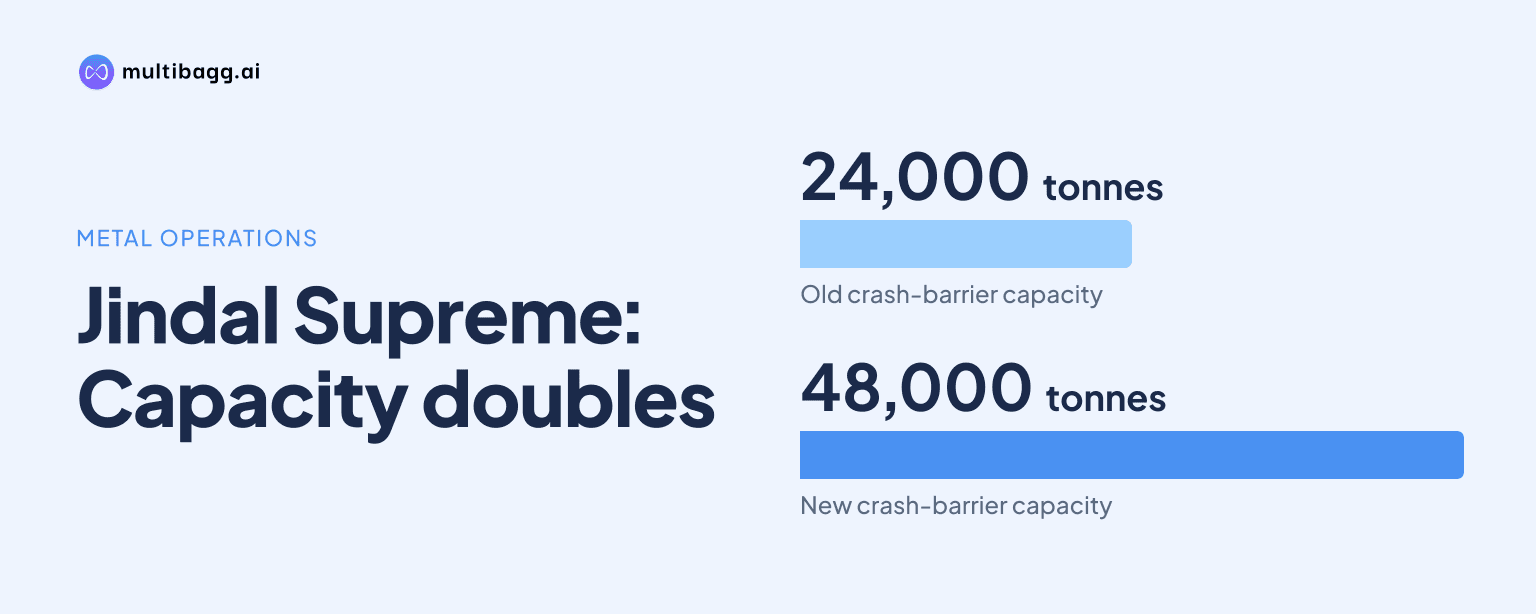
- Jindal Supreme doubled metal beam crash-barrier capacity to 48,000 tonnes per annum from 24,000 tonnes per annum.
- Jindal Supreme's H1 FY27 revenue rose 23% year on year to Rs 407.16 crore.
- Jindal Supreme's H1 FY27 EBITDA increased 64% year on year to Rs 30.70 crore, with a 7.5% margin.
powered by IRIS
Jindal Supreme (India) Limited is introducing ground-mounted solar structures and nuts-and-bolts manufacturing, with solar-structure production planned for Q4 FY27. The expansion follows the doubling of metal beam crash-barrier capacity to 48,000 tonnes per annum from 24,000 tonnes and comes after H1 FY27 revenue rose 23% year on year to Rs 407.16 crore.
Know Jindal Supreme (India) inside out
Results, valuation, peers and who's buying, in one view.
What new products is Jindal Supreme introducing?
Jindal Supreme is adding ground-mounted solar structures and nuts and bolts as its fifth and sixth product categories. Management said on November 17, 2026 that capital expenditure for solar structures had already been undertaken and that production should begin in Q4 FY27.
Jindal Supreme said its new nuts and bolts will be used in fixing towers, poles and crash barriers. The product therefore has uses alongside the company’s existing GI tubular poles and metal beam crash barriers, while solar structures target ground-mounted solar installations. Management did not disclose capacity, capital expenditure or expected revenue from either new category.
The additions broaden the four established categories of black pipes, galvanized pipes, metal beam crash barriers and GI tubular poles. Jindal Supreme operates from a 16-acre facility in Hisar, Haryana, with total installed capacity of about 171,000 tonnes per annum across its existing product range.
How has Jindal Supreme expanded crash-barrier and galvanizing capacity?
Jindal Supreme has doubled metal beam crash-barrier capacity to 48,000 tonnes per annum from 24,000 tonnes per annum after commissioning an additional line. Management said the new line had achieved commercial production by the November 2026 earnings call.
The additional galvanizing line adds 18,000 tonnes per annum and takes total galvanizing capacity to 63,000 tonnes per annum. Management said this line is specifically designed for galvanizing crash barriers, had started production and should support higher volumes from the month following the call.
Jindal Supreme is also undertaking capital expenditure for a fifth galvanizing line with rated capacity of about 24,000 tonnes per annum. Management expects that line to be operational in Q4 FY28, a year after the planned start of solar-structure production. No investment amount or interim commissioning target was disclosed for the fifth line.
Why is Jindal Supreme adding these product categories?
Jindal Supreme is adding solar structures and nuts and bolts while seeking to increase its share of value-added products. Management said value-added products accounted for 57% of H1 FY27 output, compared with 49% in the prior-year period, and identified the shift in product mix as the main reason for margin improvement.
EBITDA, or earnings before interest, tax, depreciation and amortisation, per tonne increased to Rs 5,800 in H1 FY27 from Rs 2,100 in the prior-year period. Management attributed the increase to a 57.5% value-added-product share, 65.46% capacity utilisation and fixed-cost absorption over higher volumes. It did not disclose separate margins or per-tonne economics for solar structures or nuts and bolts.
The GI tubular-pole category illustrates the ramp-up management is pursuing in newer products. The pole line, started in April FY25, reached 45% utilisation in H1 FY27, compared with about 15% after its launch in the previous year, according to management. Jindal Supreme said poles are used in streetlights and telecom towers, particularly in hilly areas.
Got a follow-up? Ask IRIS
What changed in Jindal Supreme’s H1 FY27 financial performance?
Jindal Supreme reported H1 FY27 revenue of Rs 407.16 crore, up 23% year on year, while EBITDA increased 64% to Rs 30.70 crore. Profit after tax rose 72% to Rs 18.19 crore, with EBITDA margin at 7.5% and profit-after-tax margin at 4.5%.
Capacity utilisation improved to 65.5% in H1 FY27 from 61.6% in FY26. Black pipes had 70% utilisation, GI pipes 65%, crash barriers 56% and tubular poles 45%, meaning black pipes remained the most utilised disclosed category while the pole business continued to ramp up.
Q2 FY27 revenue rose 36% to Rs 216.22 crore from Rs 158.84 crore in Q2 FY26. EBITDA increased 122% to Rs 16.94 crore and the margin expanded to 7.8% from 4.8%, while profit after tax rose 132% to Rs 9.91 crore and margin increased to 4.6% from 2.7%.
Jindal Supreme raised Rs 99.89 crore through a fresh IPO issue in FY27 and had used Rs 71 crore for repayment of borrowings as of the call date. Debt to equity fell to 0.48 in H1 FY27 from 1.2 times in FY26 and 2.1 times in FY24, while cash stood at Rs 38.47 crore as of September 30, 2026.
What is Jindal Supreme targeting in the next periods?
Jindal Supreme is targeting overall capacity utilisation of 75% to 80% and a value-added-product mix of 70% to 75% during H2 FY27, according to management. Management subsequently indicated a progression to about 70% utilisation in Q3, 75% in Q4 and 80% in Q1; these are management targets rather than reported results.
Management guided for FY27 revenue of Rs 850 crore to Rs 900 crore and EBITDA of about Rs 60 crore. It did not assign those targets among pipes, barriers, poles, solar structures or nuts and bolts, so the expected financial contribution from the new products was not specified.
Working capital remains an execution issue in H2 FY27. Net working-capital days increased to 64 in H1 FY27 from 57 in FY26, while management’s target is 45 to 50 days. Management said higher inventory in response to steel-price increases and receivables rising to Rs 42 crore from Rs 33 crore a year earlier contributed to negative operating cash flow of about Rs 6 crore to Rs 7 crore.
Jindal Supreme also said it would prioritise sales per dealer rather than add dealers from its Hisar facility. The dealer network increased to 53 from 34, dealer contribution reached about 20% of revenue, and management said no single customer contributed more than 5% of total revenue.
Conclusion
Jindal Supreme’s solar-structure and nuts-and-bolts additions extend its range into ground-mounted solar equipment and components used with towers, poles and crash barriers. The move coincides with higher value-added-product share, crash-barrier capacity doubling to 48,000 tonnes per annum, and H1 FY27 EBITDA growth of 64% to Rs 30.70 crore.
The next disclosed milestones are the planned Q4 FY27 start of solar-structure production, the ramp-up of the new 18,000-tonne galvanizing line and management’s utilisation target of about 75% in Q4. Management also targets working-capital days of 45 to 50 and expects its fifth galvanizing line, adding about 24,000 tonnes per annum, to operate in Q4 FY28.