










JK Lakshmi Cement replaces Patratu in 4.6 mt eastern plan
Key highlights
- JK Lakshmi retained a 4.6-million-tonne eastern expansion after moving Patratu capacity to Mejia.
- The revised split is 1.6 million tonnes at Durg, 1.5 million tonnes at Madhubani and 1.5 million tonnes at Mejia.
- Durg is targeted for completion by March 2028, with more than 50% of civil work complete.
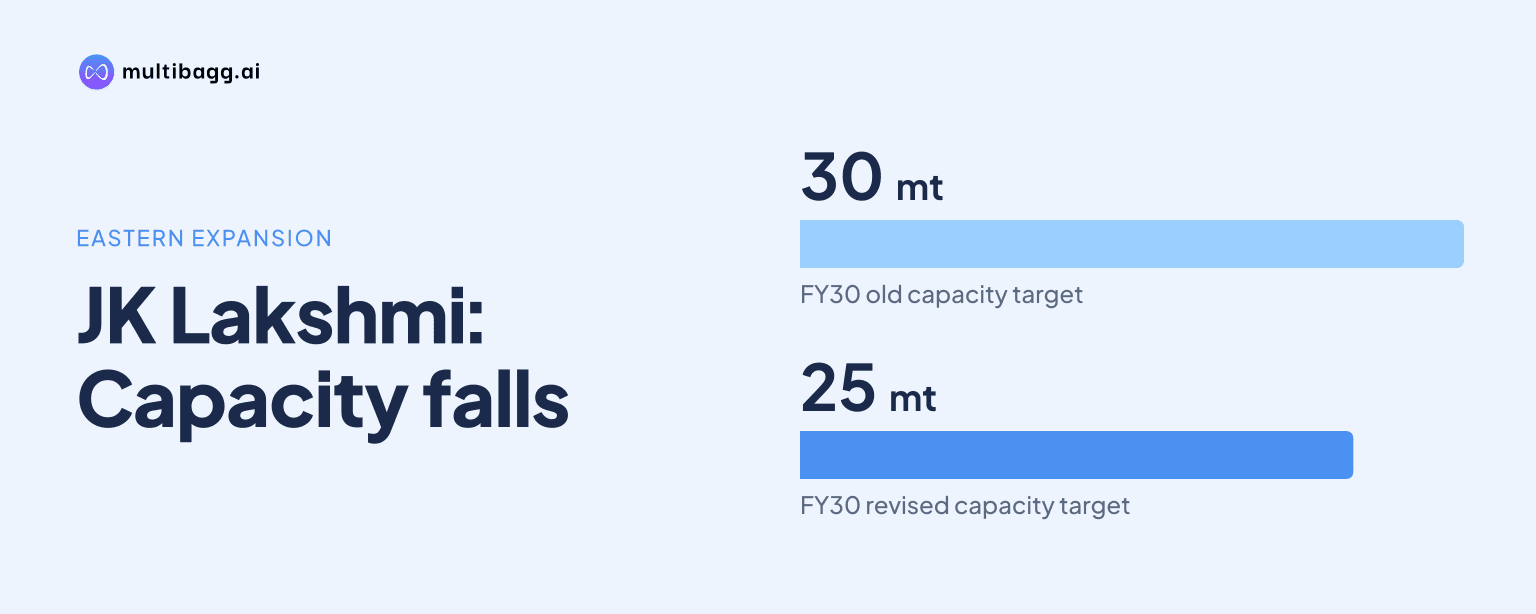
- JK Lakshmi reduced its fiscal year 2030 capacity target to 25 million tonnes from 30 million tonnes.
powered by IRIS
JK Lakshmi Cement has replaced its delayed Patratu proposal with a 1.5-million-tonne project at Mejia in West Bengal, while retaining a 4.6-million-tonne eastern expansion. Management cited land-acquisition costs and delays under Jharkhand’s Chota Nagpur Tenancy Act, while saying Mejia already has land and clearances in place.
Know JK Lakshmi Cement inside out
Results, valuation, peers and who's buying, in one view.
What has JK Lakshmi changed in its eastern expansion?
JK Lakshmi has moved the Patratu component of its eastern expansion to Mejia while keeping the planned addition at 4.6 million tonnes. Management gave the revised capacity split as 1.6 million tonnes at Durg, 1.5 million tonnes at Madhubani and 1.5 million tonnes at Mejia. The decision changes the location of the planned expansion rather than its stated total size.
JK Lakshmi said the change followed challenges at Patratu in Jharkhand, whereas the Mejia site in West Bengal already has land available and necessary clearances. Management also identified a possible operational linkage between Mejia and its proposed Northeast facility, saying clinker from the Northeast could potentially be supplied into West Bengal. The call did not provide a capital-cost figure for the Mejia project.
The 4.6-million-tonne configuration differs from a separate answer on the call that described 2.5 million tonnes arriving around fiscal years 2029 and 2030, comprising 1.5 million tonnes in the Northeast and 1 million tonnes at Mejia. Management later specified Mejia at 1.5 million tonnes within the 4.6-million-tonne eastern split. It did not reconcile the difference between the 1 million-tonne and 1.5 million-tonne Mejia references during the call.
Why did JK Lakshmi replace Patratu with Mejia?
JK Lakshmi replaced Patratu because land acquisition and regulatory matters in Jharkhand were delaying the project and raising costs, according to management. It specifically cited the Chota Nagpur Tenancy Act as an issue affecting the proposed site. Management said these land-related challenges made it necessary to reconfigure capacity across the three locations.
Mejia was selected because land and clearances are already available, which management said should make it quicker to execute than Patratu and Raebareli. This is a stated execution rationale, not a disclosed completion date for Mejia. Management did not disclose civil-work progress, equipment orders, or a commissioning milestone specifically for the West Bengal project.
The switch also positions Mejia alongside an emerging Northeast plan. Management said it was in the process of ordering equipment for the Northeast plant and separately described that facility as a 1.5-million-tonne project. Its stated potential to move clinker from the Northeast into West Bengal provides the operational logic management attached to the revised location.
Got a follow-up? Ask IRIS
What is the construction status of Durg and Madhubani?
JK Lakshmi said Durg is on track for completion by March 2028, with 2.3 million tonnes of clinker capacity and 1.6 million tonnes of cement capacity. More than 50% of civil work was complete, while fabrication was about 20% to 25% complete. Management said the company completed below-ground work before the monsoon, allowing work to progress faster afterward.
The Durg construction scope includes clinker and cement silos, a preheater and a waste-heat recovery system, or WHRS. Management said those civil structures were above ground and that civil and mechanical contractors had been mobilised. Durg’s 1.6-million-tonne cement addition is the largest individual component in the disclosed 4.6-million-tonne split, although its 2.3-million-tonne clinker figure is a separate measure.
At Madhubani, JK Lakshmi said all clearances were in place and 80% of piling work had been completed. The company is using pile foundations because of the site’s soil conditions and said work on a multi-compartment silo was also under way. Madhubani accounts for 1.5 million tonnes in the revised eastern capacity allocation, equal to Mejia’s stated allocation.
Management also reported progress at Prayagraj, where environmental and other clearances were in place, the boundary wall was complete, equipment had been ordered and contractors mobilised. A temporary power connection was also available. JK Lakshmi said Durg, Madhubani and Prayagraj were progressing concurrently and would be completed by March 2028 at the latest, but did not assign Prayagraj a capacity within the later Durg-Madhubani-Mejia split.
How does the revised plan fit JK Lakshmi’s capacity target?
JK Lakshmi said its capacity was 18 million tonnes and that the 4.6-million-tonne eastern expansion would increase it to 22.6 million tonnes. Management referred to fiscal year 2027 when discussing the 18-million-tonne base and said some external references had instead used 16.5 million tonnes. The 4.6-million-tonne addition is therefore central to the step from 18 million tonnes to 22.6 million tonnes.
JK Lakshmi has reduced its fiscal year 2030 capacity target to 25 million tonnes from an earlier 30 million tonnes. Management said the revised pace was intended to maintain balance-sheet discipline and avoid net debt to earnings before interest, tax, depreciation and amortisation, or EBITDA, exceeding its stated prudential level of 3.5. It said it would not pursue expansion at the cost of over-leveraging.
The remaining gap between 22.6 million tonnes after the eastern expansion and the 25-million-tonne fiscal year 2030 target is 2.4 million tonnes. Management’s separate description of a 1.5-million-tonne Northeast project and a 1 million-tonne Mejia project totals 2.5 million tonnes, but the timing was described as potentially varying by three to four months. That sequencing remains important because management did not provide a single reconciled timetable for every capacity reference.
Conclusion
JK Lakshmi’s decision removes Patratu from the current eastern expansion plan without reducing the stated 4.6-million-tonne addition. The replacement rests on disclosed differences in site readiness: Patratu faced Jharkhand land and regulatory obstacles, while Mejia has available land and clearances. Durg has more than 50% of civil work complete, while Madhubani has completed 80% of piling.
The next markers are progress toward the March 2028 completion target for Durg, Madhubani and Prayagraj, as well as equipment ordering for the 1.5-million-tonne Northeast plant. Management will also need to clarify the differing Mejia capacity references of 1 million tonnes and 1.5 million tonnes, and how project timing supports its 25-million-tonne fiscal year 2030 target.