










JLR ends China local production and pivots to luxury imports
Key highlights
- JLR China volume fell from 101,000 vehicles in FY24 to 58,000 in FY26, a 43% decline.
- JLR local China production ceased in June 2026.
- Local brands held 70% of China's passenger-vehicle market in Q3 2026, versus 41% in 2021.
- China passenger-vehicle exports are forecast to rise from 5.8 million in 2025 to 9.5 million in 2026.
powered by IRIS
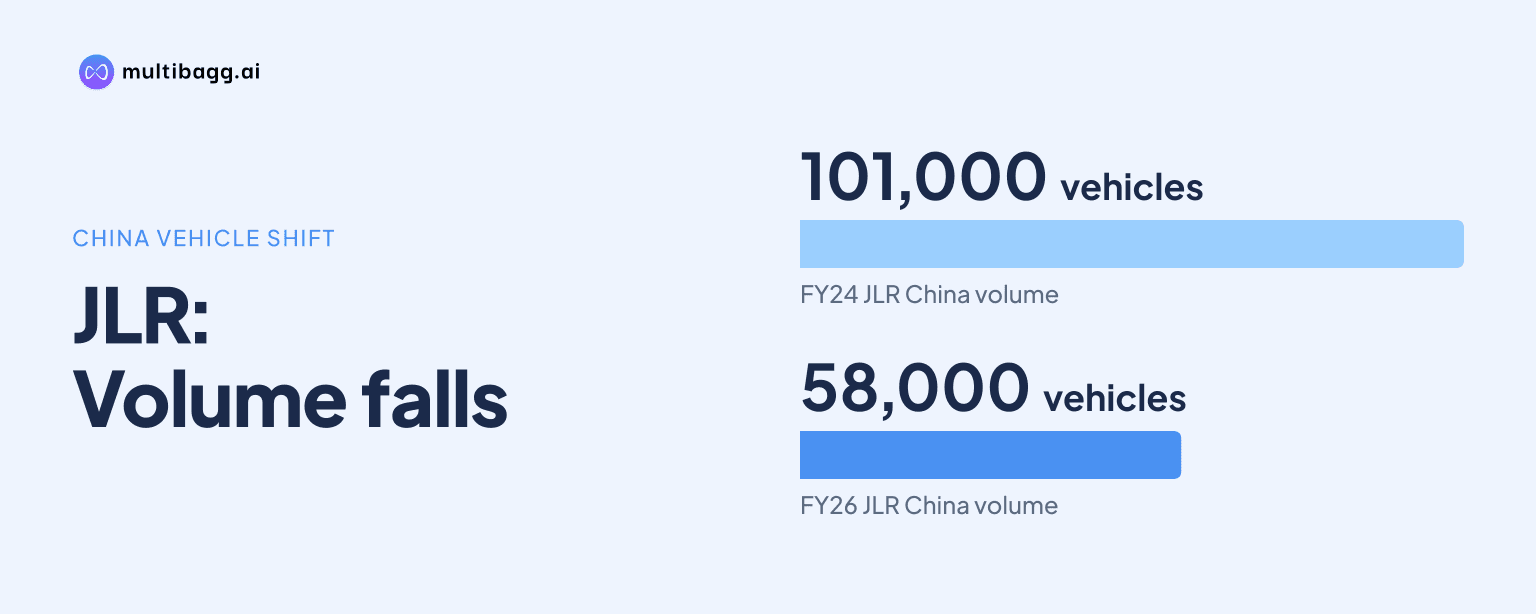
Jaguar Land Rover Automotive plc ended local production in China in June 2026 and is resetting the market around high-value luxury imports after total China volumes fell to 58,000 in FY26 from 101,000 in FY24, a 43% decline. JLR says the model will protect scarcity through value over volume.
Know Tata Motors Passenger Vehicles inside out
Results, valuation, peers and who's buying, in one view.
Why did JLR reset its China strategy?
JLR reset its China strategy because local brands have taken a substantially larger share of the domestic passenger-vehicle market while JLR's own local and imported volumes have contracted. Local brands accounted for 70% of the China passenger-vehicle market in Q3 2026, compared with 30% for global brands. That is a further shift from 2025, when local brands held 64% and global brands 36%.
The presentation places this market shift alongside the end of JLR's local manufacturing model. Local production ceased in June 2026, ending the historical joint-venture internal-combustion-engine production approach. JLR's stated replacement is a purely high-value luxury import model, rather than a plan to restore China volume through locally produced vehicles.
China's competitive setting also extends beyond domestic sales. JLR says competition is intensifying both in the local market and through growth in exports from China, putting pressure on established original equipment manufacturers and export markets. Chinese electric-vehicle brands increased their European market share from 2.4% in 2024 to 7.4% in 2025, a gain of 5 percentage points in one year.
How far did JLR China volume decline?
JLR's China volume fell to 58,000 vehicles in FY26, down 43,000 vehicles, or 43%, from 101,000 in FY24. The decline was sharper in locally produced vehicles than in imports: local volume declined to 23,000 units in FY26 from 48,000 in FY24, while imported volume declined to 35,000 from 53,000.
From the FY24 peak to FY26, local production volume fell 52%, compared with a 34% fall in imported vehicles. The composition consequently changed: imports represented about 60% of JLR's 58,000 China vehicles in FY26, versus about 52% of the 101,000 vehicles in FY24. The revised strategy formalises an import-led position after local production ended in June 2026.
The longer comparison shows that total volume was 95,000 units in FY22, rose modestly to 96,000 in FY23 and 101,000 in FY24, then fell to 81,000 in FY25 and 58,000 in FY26. Over the four years from FY22 to FY26, locally produced volume fell from 54,000 to 23,000 units, while imports fell from 41,000 to 35,000 units. The source does not provide China revenue, pricing or profitability figures for those periods.
Got a follow-up? Ask IRIS
What is changing in China's auto market?
China's passenger-vehicle market has moved decisively toward local brands, whose share increased from 41% in 2021 to 64% in 2025 and then 70% in Q3 2026. Global brands moved in the opposite direction, from 59% in 2021 to 36% in 2025 and 30% in Q3 2026. JLR describes the local-brand share increase from 2021 to 2025 as 56%.
The source's market data also show a contrast between domestic sales and exports. Domestic passenger-vehicle sales rose from 21.3 million in 2021 to 23.6 million in 2024, edged down to 23.5 million in 2025 and are shown at 18.9 million for 2026 forecast. Passenger-vehicle exports increased each year from 1.6 million in 2021 to 5.8 million in 2025, with 9.5 million forecast for 2026.
That export forecast would make China the number-one auto exporter ahead of Japan, according to the presentation. The projected increase from 5.8 million exports in 2025 to about 9.5 million in 2026 is 3.7 million vehicles. JLR identifies this export drive, together with domestic competition, as a source of pressure on established manufacturers in both China and their established export markets.
How will JLR operate its China import model?
JLR plans to operate China through high-value luxury imports, a value-over-volume approach, and a right-sized dealer network. The aim of the value-over-volume model is to protect scarcity rather than seek to replace the 43,000-unit total-volume decline recorded between FY24 and FY26. This is a strategic response plan disclosed by JLR, not a volume or revenue target for China.
JLR also plans to use bespoke commissions to address ultra-high-net-worth customers. The presentation does not quantify the intended number of bespoke commissions, dealer locations, import volumes or the timing of any sales recovery. It says JLR will continue to monitor developments in China and prepare response plans, leaving those operating measures as the key disclosed mechanisms following June 2026.
The China reset sits alongside a wider JLR focus on double-digit revenue growth across Range Rover, Defender, Discovery and Jaguar. Separately, JLR aims to return break-even volumes towards 300,000 within two years, supported by launch excellence, ex-works performance, warranty, cost efficiencies and process excellence. The presentation does not allocate the 300,000-volume objective by region or state a China contribution.
Conclusion
JLR's reset aligns its China model with a market in which local brands held 70% of passenger-vehicle sales in Q3 2026 and Chinese passenger-vehicle exports are forecast to reach 9.5 million in 2026. The strategy prioritises imported luxury vehicles, dealer-network sizing and bespoke commissions instead of local joint-venture internal-combustion-engine production.
The next items to watch are JLR's execution of its high-value import, dealer-network and bespoke-commission plans, as the company has not disclosed China-specific volume or financial targets. Investors can also assess progress against JLR's wider goal of returning break-even volumes towards 300,000 within two years and its stated plan to keep monitoring developments in China.