










Tata Passenger Vehicles EV mix reaches 23% as margin falls
Key highlights
- TMPV's average monthly total offtake rose 40% year on year to 67,200 units in Q2 FY27.
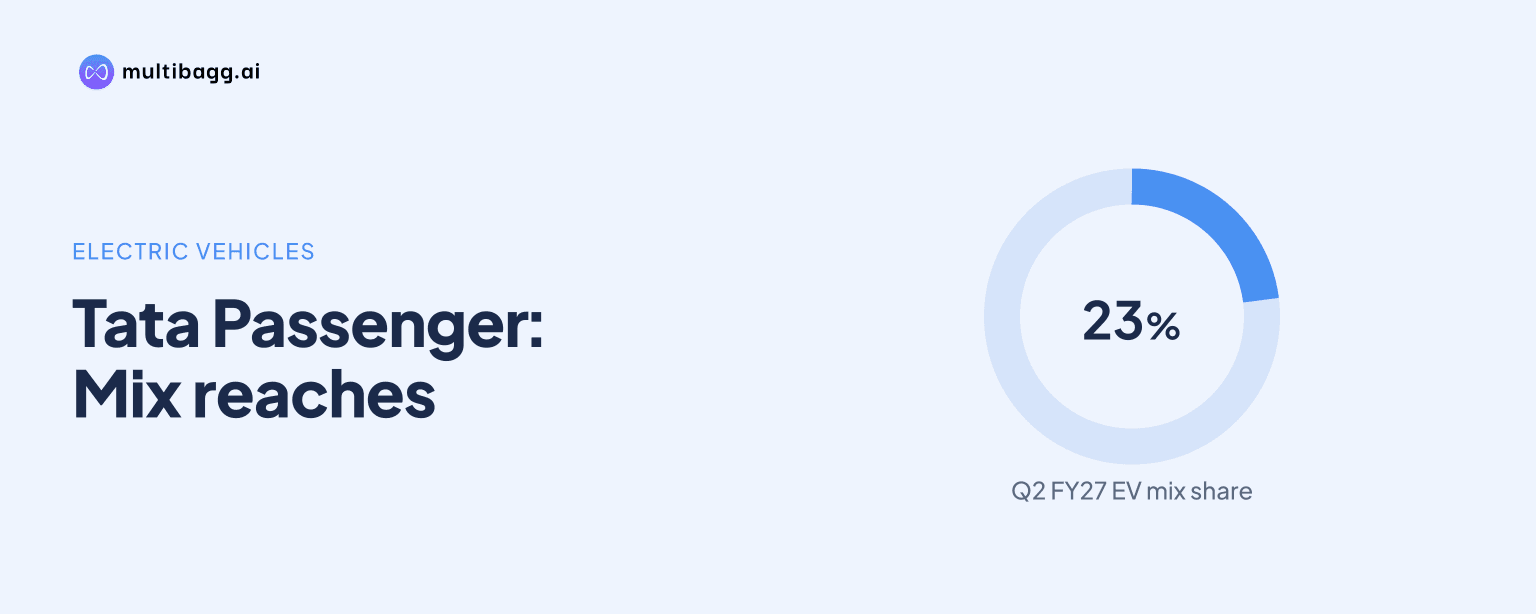
- TMPV's EV mix increased to 23% in Q2 FY27 from 19% in Q1 FY27.
- TMPV's Q2 FY27 revenue rose 51.1% year on year to Rs 20,400 crore, while EBITDA margin was 4.0%.
- TMPV generated Rs 1,945 crore of free cash flow in H1 FY27, supported by Rs 2,729 crore of working-capital movement.
powered by IRIS
Tata Passenger Vehicles (TMPV) lifted its electric-vehicle, or EV, mix to 23% in Q2 FY27, but earnings before interest, tax, depreciation and amortisation (EBITDA) margin fell 180 basis points year on year to 4.0% as Rs 544 crore of variable-cost pressure outweighed volume, pricing and Production Linked Incentive (PLI) accruals in the quarter-on-quarter bridge.
Know Tata Motors Passenger Vehicles inside out
Results, valuation, peers and who's buying, in one view.
How fast did TMPV grow in Q2 FY27?
TMPV grew faster than the domestic passenger-vehicle market in Q2 FY27, with average monthly offtake including international business rising 40% year on year to 67,200 units from 48,200 units in Q2 FY26. Quarterly wholesales reached 201,600 units, compared with 182,300 units in Q1 FY27 and 144,500 units a year earlier.
The wider passenger-vehicle industry recorded 1.4 million units in Q2 FY27, up 29% year on year, against TMPV's 40% increase. TMPV's Vahan registration market share was 14.3%, unchanged from Q1 FY27 but above 13.6% in FY26 and 13.2% in FY25. Vahan is the registration portal powered by the National Informatics Centre; its FY25 data excluded Telangana registrations because the state was not then included in the reporting.
New and refreshed products were part of the demand pipeline. TMPV said the Sierra and Sierra.ev reached 70,000 units since January 2026, while production capacity was being added. The Punch and Punch.ev facelift made Punch the number-one SUV since its January 2026 launch, according to the presentation, and the Aeris recorded 4,000 units in its first month as TMPV scaled production.
What changed in TMPV's powertrain mix?
TMPV's EV mix increased to 23% in Q2 FY27, from 19% in Q1 FY27, 14% in FY26 and 11% in FY25. Petrol's share declined to 37% from 42% in Q1 FY27 and 51% in FY25, while compressed natural gas, or CNG, rose to 28%; diesel represented 12% of the Q2 mix.
EV offtake averaged 15,700 units a month in Q2 FY27, up 90% from 8,300 units in Q2 FY26 and above 11,500 units in Q1 FY27. TMPV's Vahan EV market share increased by about 380 basis points quarter on quarter to 42.8%, from 39.0% in Q1 FY27. Its Vahan EV penetration reached 24.0%, compared with industry penetration of 8.0%.
The presentation linked higher EV volumes to demand for the product range and to further capacity additions. Punch.ev was the first EV cited by TMPV to cross 5,000 monthly units and was the number-one EV model in October 2026. TMPV also said the Sierra nameplate is available with internal-combustion-engine and EV powertrains, although supply-side constraints for EVs remained an industry challenge in Q2 FY27.
Got a follow-up? Ask IRIS
Why did TMPV's margin decline despite higher revenue?
TMPV's Q2 FY27 revenue increased 51.1% year on year to Rs 20,400 crore from Rs 13,500 crore, and rose from Rs 17,900 crore in Q1 FY27. EBITDA margin nevertheless fell to 4.0% from 5.8% in Q2 FY26 and 4.3% in Q1 FY27. TMPV attributed the year-on-year compression to elevated commodity and foreign-exchange costs.
The Q2 FY27 analytical profit bridge shows variable costs reduced profit before tax before exceptional items by Rs 544 crore. Volume and mix added Rs 106 crore, PLI added Rs 203 crore and pricing added Rs 161 crore, while fixed costs added Rs 156 crore. Depreciation and amortisation reduced profit by Rs 37 crore, and interest, joint ventures and other items reduced it by Rs 32 crore, leaving Rs 25 crore in the bridge versus Rs 12 crore in Q1 FY27.
For H1 FY27, revenue rose 57.4% to Rs 38,400 crore from Rs 24,400 crore in H1 FY26, while EBITDA margin declined 90 basis points to 4.1% from 5.0%. Earnings before interest and tax margin improved to negative 0.4% from negative 1.1%, but reported profit before tax before exceptional items was at break-even in both half-year periods. PLI included in the figures was Rs 516 crore in Q2 FY27, compared with Rs 125 crore in Q2 FY26.
What did TMPV's investment spending and cash flow show?
TMPV generated Rs 1,945 crore of free cash flow in H1 FY27, with favourable working-capital movements of Rs 2,729 crore offsetting investment spending of Rs 3,130 crore. Cash profit after tax was Rs 2,255 crore, including Rs 402 crore of profit before tax before exceptional items and Rs 1,605 crore of non-cash and other items.
The working-capital movement included Rs 3,716 crore from payables and acceptances, Rs 1,298 crore from inventories, Rs 52 crore from trade receivables and Rs 363 crore from other items. Tax absorbed Rs 248 crore and net finance expenses and dividends were Rs 91 crore. The free-cash-flow calculation covers the domestic business, including corporate and interest costs not allocated to the passenger-vehicle segment.
H1 FY27 investment spending was below Rs 3,338 crore in H1 FY26, although TMPV said spending would increase gradually for its next growth phase. Capitalised research and development declined to Rs 1,008 crore from Rs 1,394 crore, while expensed research and development was unchanged at Rs 454 crore. Capital and other investment increased to Rs 1,668 crore from Rs 1,490 crore.
Conclusion
TMPV combined 40% year-on-year offtake growth, a 23% EV mix and 42.8% Vahan EV market share in Q2 FY27. Revenue rose to Rs 20,400 crore, but the 4.0% EBITDA margin shows that commodity and foreign-exchange costs absorbed the benefits of higher volumes, pricing, PLI accruals and fixed-cost actions. H1 free cash flow of Rs 1,945 crore also relied on Rs 2,729 crore of favourable working-capital changes.
The next measure is H2 FY27 execution of TMPV's plan to expand internal and supplier capacity, especially for EVs, while pursuing calibrated price actions, accelerated cost reductions and expedited PLI accruals. Management expects demand to remain sustained in H2 FY27, although growth may moderate on a high base and commodity pressure is expected to remain adverse in Q3 FY27.