










JLR’s EBIT margin fell to 1.1% despite revenue growth
Key highlights
- JLR’s Q2 FY27 revenue rose 20.3% year on year to £589.4 crore.
- JLR’s adjusted EBIT margin declined to 1.1% in Q2 FY27 from 2.8% in Q1 FY27.
- Volume and mix reduced JLR’s Q2 profit before tax before exceptional items by £7.7 crore.
- JLR reported negative Q2 FY27 free cash flow of £54 crore and FY27 year-to-date net debt of £420 crore.
powered by IRIS
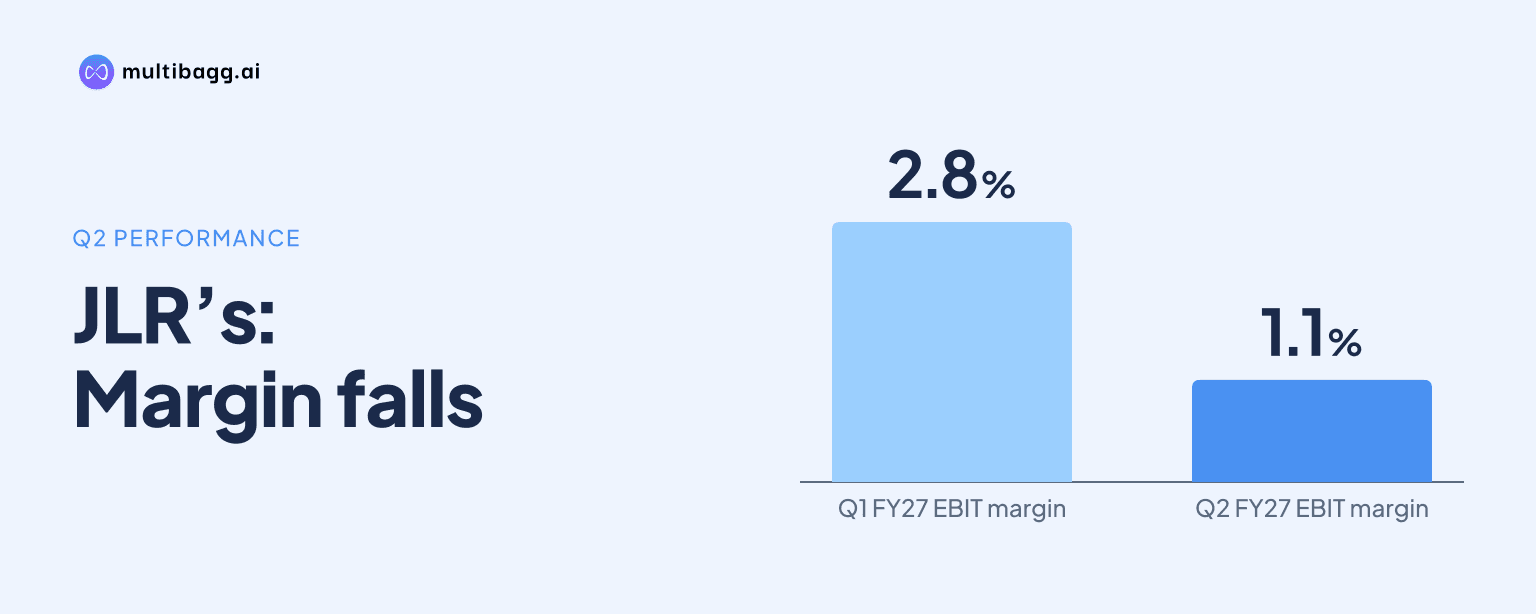
Jaguar Land Rover Automotive PLC reported a 1.1% adjusted earnings before interest and tax margin in Q2 FY27, down from 2.8% in Q1 FY27, despite revenue rising 20.3% year on year to £589.4 crore. JLR attributed the sequential profit decline principally to adverse market and model mix, which reduced profit before tax before exceptional items by £7.7 crore.
Know Tata Motors Passenger Vehicles inside out
Results, valuation, peers and who's buying, in one view.
Why did JLR’s EBIT margin decline in Q2 FY27?
JLR’s adjusted EBIT margin fell by 170 basis points quarter on quarter to 1.1% because volume and mix, pricing and foreign-exchange effects outweighed lower contribution costs. Profit before tax before exceptional items declined from £10.9 crore in Q1 FY27 to £60 lakh in Q2 FY27, a reduction of £10.3 crore. A basis point is one-hundredth of a percentage point, so the margin movement was 1.7 percentage points.
The largest factor in the profit bridge was a £7.7 crore reduction from volume and mix, comprising a £10.7 crore adverse item partly offset by £3 crore classified as other volume and mix. Net pricing reduced profit by a further £3.3 crore as the presentation’s VME measure moved from 7.6% to 8.2%. The presentation does not define VME, while describing the overall pressure as adverse market and model mix.
Foreign exchange and commodities together cut quarterly profit by £1.8 crore. That net figure included a £2.3 crore negative effect from realised foreign-exchange derivatives and a £1.3 crore foreign-exchange revaluation cost, partly offset by £80 lakh of operational foreign exchange and £1 crore from unrealised commodity derivatives. Contribution costs added £2.5 crore, including a £3 crore warranty benefit, while structural costs were net neutral.
Which volumes and markets shaped JLR’s quarter?
JLR wholesales rose 24.7% year on year and 4.0% quarter on quarter to 82,500 units in Q2 FY27, but retail sales fell 7.5% year on year to 79,000 units. Revenue of £589.4 crore was £99.4 crore above Q2 FY26 but £7.9 crore below Q1 FY27. The difference between higher wholesales and lower retail volumes occurred alongside the company’s stated adverse market and model mix.
Range Rover was JLR’s largest brand by Q2 wholesale volume at 45,100 units, up from 38,800 a year earlier and 44,700 in Q1 FY27. Defender increased to 30,000 units from 21,300 a year earlier and 29,200 sequentially, while Discovery rose to 6,700 units from 4,600 in both comparison quarters. Jaguar wholesales remained at 800 units following the wind-down of previous Jaguar models ahead of the Jaguar Type 01 launch.
North America remained about one-third of total wholesales, at 27,100 units in Q2 FY27 versus 27,200 in Q1 FY27. UK volume increased to 21,000 from 16,300, Europe reached 13,200 from 12,500, and Overseas markets rose to 11,300 from 9,500. These gains were partly offset by China, where volume declined to 6,100 units from 8,700, and the Middle East and North Africa region, where wholesales fell to 3,700 from 5,100 amid disruption.
Got a follow-up? Ask IRIS
How did JLR’s profit and cash flow compare with earlier periods?
JLR remained profitable before tax and exceptional items in Q2 FY27, but its £60 lakh result was substantially below £10.9 crore in Q1 FY27 and above the £48.5 crore loss recorded in Q2 FY26. The year-on-year comparison reflects recovery from the cyber incident in Q2 FY26, according to the presentation. For the first half, profit before tax before exceptional items was £11.5 crore, compared with a £13.4 crore loss a year earlier.
Adjusted earnings before interest, tax, depreciation and amortisation margin was 6.6% in Q2 FY27, down from 8.1% in Q1 FY27 but above negative 1.6% in Q2 FY26. First-half adjusted EBIT margin was 2.0%, compared with negative 1.4% in the prior-year first half, while first-half revenue increased 3.2% to £1,186.7 crore. The period comparisons show year-on-year operating improvement, although the latest quarter weakened sequentially.
Free cash flow was negative £54 crore in Q2 FY27, compared with negative £99.8 crore in Q1 FY27 and negative £79.1 crore in Q2 FY26. JLR said the quarterly cash outflow was largely caused by lower profitability and working-capital movements typical of its fiscal second quarter. First-half free cash flow was negative £153.8 crore after £176.6 crore of total product and other investment and a £72.4 crore working-capital and accruals outflow.
What is JLR spending and planning in FY27?
JLR spent £176.6 crore on investment in the first half of FY27 and revised its full-year investment target to about £340 crore, which management said would save around £30 crore against plan. First-half total engineering investment was £131.1 crore, including £93.2 crore of capitalised engineering and £37.9 crore of expensed engineering. Capital investment was £45.5 crore, versus £42.7 crore in the prior-year first half.
The company reported a Q2 cash balance of £180 crore and total liquidity of £600 crore. That liquidity included £170 crore of undrawn revolving credit facilities, £150 crore of an undrawn UK Export Finance-backed facility and a new £100 crore syndicated term loan signed on 29 September 2026. These disclosed facilities provide the stated liquidity position but do not alter the reported quarterly free-cash outflow.
JLR reported net debt of £420 crore for FY27 year to date, compared with £180 crore in FY26 year to date. The wider Tata Motors passenger-vehicles presentation said consolidated net debt was likely to peak in FY27 and that the group remained committed to deleveraging. For JLR specifically, the source provides the £420 crore net-debt figure but no separate timetable for a reduction.
Conclusion
JLR’s Q2 FY27 results combined a 20.3% year-on-year revenue increase and 24.7% wholesale growth with a sequential margin decline to 1.1%. The bridge quantifies the change: £7.7 crore of volume-and-mix pressure, £3.3 crore of net-pricing pressure and £1.8 crore of foreign-exchange and commodity costs reduced profit, while a £2.5 crore contribution-cost benefit only partly offset them.
The next disclosed markers are delivery against the revised FY27 investment target of about £340 crore and the expected £30 crore saving against plan, alongside the planned Jaguar Type 01 launch after the wind-down of previous Jaguar production. JLR’s regional wholesale pattern, including UK and Overseas gains against lower China volumes and Middle East disruption, and FY27 year-to-date net debt of £420 crore remain relevant disclosed measures to watch.