










JLR Revises FY27 Margin to 2-3%, Forecasts £125 Crore Outflow
Key highlights
- JLR revised FY27 guidance to a 2-3% adjusted EBIT margin and about £125 crore of free-cash outflow.
- JLR recorded £53 crore of exceptional items and £54 crore of free-cash outflow in Q2 FY27.
- Q2 FY27 revenue rose 20.3% year on year to £589.4 crore, while adjusted EBIT margin was 1.1%.
- JLR had £600 crore of liquidity at September 30, 2026, including a new £100 crore term loan.
powered by IRIS
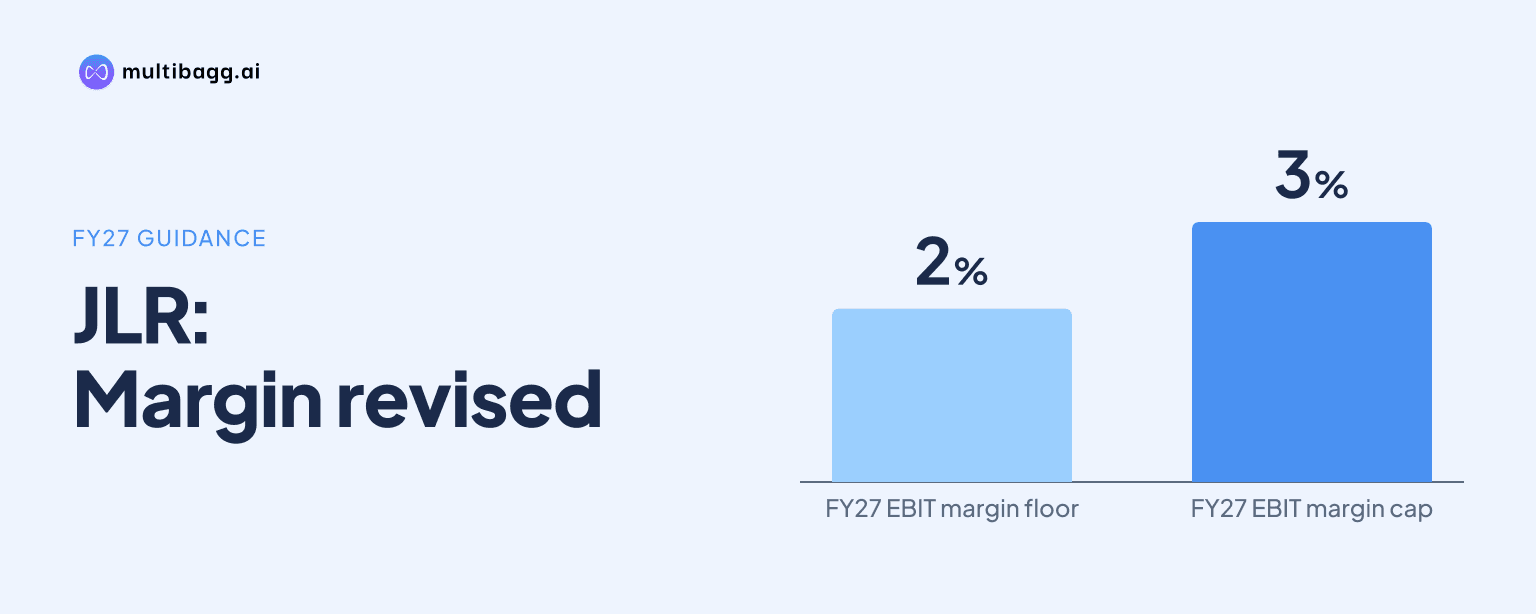
Jaguar Land Rover (JLR) revised its FY27 outlook on November 13, 2026 to an adjusted EBIT margin of 2-3% and free-cash outflow of about £125 crore, after recognising £53 crore of exceptional items in Q2 FY27. JLR reported a 1.1% Q2 adjusted EBIT margin and £54 crore free-cash outflow.
Know Tata Motors Passenger Vehicles inside out
Results, valuation, peers and who's buying, in one view.
What is JLR's revised FY27 guidance?
JLR now expects an adjusted earnings before interest and tax (EBIT) margin of 2-3% in FY27 and free-cash outflow of about £125 crore. The company disclosed the revised outlook alongside its Q2 FY27 results, citing ongoing market challenges, geopolitical risks and exceptional costs recognised in the September quarter.
The announcement does not disclose JLR's previous full-year margin or cash-flow targets, so the extent of the revision cannot be calculated from this filing. The new 2-3% adjusted EBIT margin range compares with JLR's reported 2.0% adjusted EBIT margin in H1 FY27 and 1.1% in Q2 FY27, when adverse market and model mix affected profitability.
The cash-flow outlook follows a £54 crore free-cash outflow in Q2 FY27. JLR had £180 crore of closing cash at September 30, 2026, while total liquidity was £600 crore, including undrawn facilities and a new £100 crore syndicated term loan signed on September 29, 2026.
Why did JLR revise its FY27 outlook?
JLR revised its FY27 outlook because it faced ongoing market challenges and geopolitical risks while recording £53 crore of exceptional items in Q2 FY27. The exceptional charge reflected restructuring activities, including employee separation costs, write-downs of intangible assets under development and write-downs of assets.
Operating profitability also weakened sequentially because of adverse market and model mix. JLR's profit before tax and exceptional items was £60 lakh in Q2 FY27, compared with £11.5 crore for H1 FY27, indicating that the September-quarter contribution was below the result generated during the first quarter of the financial year.
Commodity costs remain a disclosed pressure point. JLR identified global geopolitical volatility, luxury-segment demand trends, the pace of electric-vehicle adoption and commodity costs as key factors to monitor, while Tata Motors Passenger Vehicles Limited said adverse mix and persistent commodity pressures weighed on the group's margins in Q2 FY27.
How did JLR perform in Q2 and H1 FY27?
JLR generated revenue of £589.4 crore in Q2 FY27, up 20.3% year on year, and £1,186.7 crore in H1 FY27, up 3.2% year on year. Its 1.1% Q2 adjusted EBIT margin was lower than the 2.0% H1 margin, despite the stronger year-on-year quarterly revenue comparison.
Profit before tax and exceptional items returned to profit against the prior-year periods. Q2 FY27 profit before tax and exceptional items was £60 lakh, compared with a £48.5 crore loss a year earlier; H1 FY27 profit was £11.5 crore, against a £13.4 crore loss in the comparable prior-year half.
JLR said wholesale volumes grew quarter on quarter in the UK and Overseas markets, offsetting reductions in China and the Middle East. Year-on-year volume improvement was significant because the comparable FY26 periods were affected by a cyber incident, meaning the 20.3% Q2 revenue increase also reflects recovery from that disruption.
Got a follow-up? Ask IRIS
What funding does JLR have after the Q2 cash outflow?
JLR had total liquidity of £600 crore at September 30, 2026, consisting of £180 crore of cash, an undrawn £170 crore revolving credit facility, an undrawn £150 crore UK Export Finance guaranteed commercial loan and a new £100 crore syndicated term loan. The term loan was signed one day before the September 30 quarter-end, on September 29, 2026.
The £54 crore Q2 FY27 free-cash outflow is the reported quarterly position underlying JLR's forecast of about £125 crore of FY27 outflow. The filing does not give a cash-flow forecast by remaining quarter, so it does not establish how the expected full-year outflow will be distributed through the second half.
JLR's liquidity resources sit alongside a planned investment programme of £1,500 crore to £1,800 crore, of which £1,150 crore has been invested since 2024. The company linked this programme to its product development plans, rather than setting out a separate funding allocation for each future vehicle launch.
Which launches and savings actions does JLR plan next?
JLR has unveiled Range Rover Electric, Range Rover Sport Electric and Jaguar Type 01, with deliveries of the three Solihull-built luxury electric vehicles slated to begin from early 2027. The launches form part of the £1,500 crore to £1,800 crore planned investment programme disclosed with the Q2 FY27 results.
JLR also plans to launch Range Rover GT and an all-new electric Defender product next year. Both vehicles are to be built in Halewood, UK, on the Electric Modular Architecture, while the source does not provide production-volume or revenue targets for either model.
Management said the Enterprise Missions programme remains on track to deliver £170 crore of savings over the next two years. The stated mechanisms are simplification of the business and improved operational performance, with the programme intended to support continuing investment and reduce breakeven volumes towards 300,000 units.
Chief Executive Officer PB Balaji said JLR was pursuing US growth plans alongside the Enterprise Missions programme and the product-launch cycle. Those plans are forward-looking: the reported Q2 FY27 outcome was a 1.1% adjusted EBIT margin, £60 lakh of pre-exceptional profit before tax and £54 crore of free-cash outflow.
Conclusion
JLR's revised FY27 outlook places near-term attention on a 2-3% adjusted EBIT margin and about £125 crore of free-cash outflow after a quarter containing £53 crore of exceptional costs. Revenue rose 20.3% year on year to £589.4 crore in Q2 FY27, but the 1.1% adjusted EBIT margin and £54 crore cash outflow show the effect of adverse mix, commodity costs and restructuring charges.
The next disclosed milestones are early-2027 deliveries of Range Rover Electric, Range Rover Sport Electric and Jaguar Type 01, followed by the planned launch next year of Range Rover GT and an electric Defender. JLR also plans to pursue £170 crore of Enterprise Missions savings over two years and reduce breakeven volumes towards 300,000 units.