










Tata Motors Passenger Vehicles Limited posts ₹5,500 crore Q2 loss
Key highlights
- Tata Motors Passenger Vehicles Limited reported a ₹5,500 crore consolidated loss after tax in Q2 FY27.
- TMPVL recorded ₹6,700 crore of exceptional items, including ₹3,800 crore of employee-separation provisions.
- TMPVL's consolidated revenue rose 34% year on year to ₹96,920 crore in Q2 FY27.
- TMPVL's consolidated net debt was ₹50,800 crore at September 30, 2026.
powered by IRIS
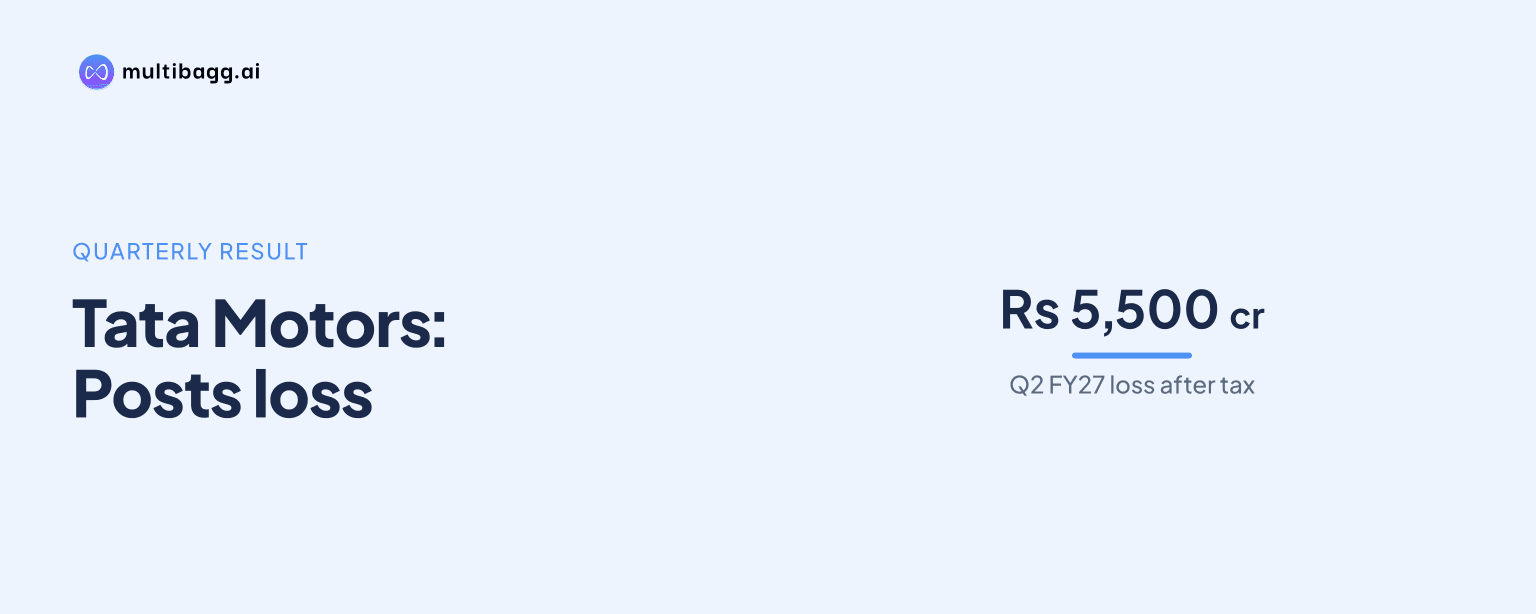
Tata Motors Passenger Vehicles Limited reported a consolidated loss after tax of ₹5,500 crore for Q2 FY27, as ₹6,700 crore of exceptional employee-separation and asset-impairment charges outweighed 34% year-on-year revenue growth to ₹96,920 crore for the quarter ended September 30, 2026. Pre-exceptional profit before tax was ₹403 crore.
Know Tata Motors Passenger Vehicles inside out
Results, valuation, peers and who's buying, in one view.
Why did TMPVL report a Q2 FY27 loss?
TMPVL reported a Q2 FY27 loss because exceptional items of ₹6,700 crore turned profit before tax before exceptional items of ₹403 crore into a reported loss before tax of ₹6,300 crore. The exceptional amount primarily comprised ₹3,800 crore of provisions for employee-separation costs and ₹2,900 crore of asset impairments.
The reported loss after tax was ₹5,500 crore following recognition of a deferred tax asset. In contrast, consolidated profit before tax before exceptional items, described by TMPVL as PBT (bei), improved by ₹5,865 crore year on year to ₹403 crore in the quarter ended September 30, 2026.
How did TMPVL's revenue and operating margins change?
TMPVL's consolidated revenue rose 34% year on year to ₹96,920 crore in Q2 FY27, while earnings before interest, tax, depreciation and amortisation, or EBITDA, margin increased 630 basis points to 6.2%. Earnings before interest and tax, or EBIT, margin increased 790 basis points to 1.1%; one basis point equals one-hundredth of a percentage point.
TMPVL said the year-on-year margin improvement mainly reflected Jaguar Land Rover's recovery from a cyber incident in the comparable prior-year quarter. Sequentially, however, the company said adverse mix and continuing commodity-cost pressures affected margins in Q2 FY27.
For H1 FY27, TMPVL reported consolidated revenue of ₹1,92,719 crore, up 20.4% year on year. H1 EBITDA margin was 6.8%, up 210 basis points, EBIT margin was 1.7%, up 300 basis points, and PBT (bei) was ₹2,009 crore, up ₹3,521 crore.
Which businesses drove TMPVL's Q2 revenue growth?
Tata Passenger Vehicles recorded its highest quarterly revenue of ₹20,423 crore in Q2 FY27, up 50.9% year on year and faster than TMPVL's 34% consolidated growth. The domestic business reported 40% volume growth and 90% growth in electric-vehicle, or EV, volumes.
Tata Passenger Vehicles' margin trend differed from its revenue trend in Q2 FY27. EBITDA margin was 4.0%, down 180 basis points year on year, while EBIT margin was negative 0.3%, down 50 basis points; PBT (bei) was ₹25 crore, down ₹131 crore year on year amid commodity and foreign-exchange pressures.
Jaguar Land Rover reported Q2 revenue of £5.9 billion, up 20.3% year on year, with EBITDA margin of 6.6%, up 820 basis points, and EBIT margin of 1.1%, up 970 basis points. Its PBT (bei) was £6 million, compared with a loss of £485 million a year earlier, although adverse market and model mix affected sequential performance.
Tata Passenger Vehicles entered Q3 with record monthly volume of 75,400 units in October 2026. Its Vahan market share was 14.3% in Q2 FY27 and EV Vahan market share was 43%, while EVs accounted for 23% and compressed natural gas vehicles for 28% of the alternative-powertrain mix.
Got a follow-up? Ask IRIS
What cash flow and debt did TMPVL report?
TMPVL reported consolidated free cash flow outflow of ₹6,300 crore for Q2 FY27, compared with positive free cash flow in the prior-year period. Consolidated net debt stood at ₹50,800 crore at September 30, 2026, after the quarter's cash outflow.
Tata Passenger Vehicles generated positive free cash flow of ₹825 crore in Q2 FY27 and ₹1,945 crore in H1 FY27. It ended September with cash of ₹11,000 crore and gross debt of ₹3,100 crore, resulting in net cash of ₹7,900 crore.
Jaguar Land Rover reported free cash outflow of £540 million in Q2 FY27 and closing cash of £1.8 billion. Total liquidity was £6.0 billion at September 30, 2026, including an undrawn £1.7 billion revolving credit facility, an undrawn £1.5 billion UK Export Finance-guaranteed loan and a £1.0 billion syndicated term loan signed on September 29, 2026.
What is TMPVL watching after the Q2 result?
TMPVL identified geopolitical volatility, luxury-segment demand, the pace of EV adoption and commodity costs as key matters to monitor after Q2 FY27. Management said Tata Passenger Vehicles plans to pursue growth while seeking margin improvement through cost reductions and calibrated pricing actions.
For Jaguar Land Rover, TMPVL said its near-term priorities are generating sales momentum from new EV launches and demonstrating progress under Enterprise Missions. The plan targets £1.7 billion of savings over two years and reducing breakeven volumes towards 300,000 units; Jaguar Land Rover has invested £11.5 billion since 2024 under a planned £15 billion to £18 billion programme.
Jaguar Land Rover revised its full-year guidance to adjusted EBIT margin of 2% to 3% and free cash outflow of about £1.25 billion, citing market challenges, geopolitical risks and the exceptional costs recognised in Q2 FY27. Deliveries of Range Rover Electric, Range Rover Sport Electric and Jaguar Type 01 are slated to start in early 2027.
Conclusion
TMPVL's Q2 FY27 results show that higher revenue and a return to positive pre-exceptional profit did not offset the scale of restructuring-related and asset-impairment charges. Revenue increased 34% to ₹96,920 crore and PBT (bei) reached ₹403 crore, but ₹6,700 crore of exceptional items produced a ₹5,500 crore loss after tax.
The next results will indicate whether Tata Passenger Vehicles can improve its 4.0% EBITDA margin while sustaining growth, and whether Jaguar Land Rover meets its revised 2% to 3% adjusted EBIT-margin guidance. TMPVL also disclosed early-2027 deliveries for three new Jaguar Land Rover EVs and a two-year £1.7 billion Enterprise Missions savings target as milestones to watch.