










Tata PV EV volumes rise 90% as Q2 EBITDA margin falls
Key highlights
- Tata PV reported Q2 FY27 revenue of Rs 2.0423 lakh crore, up 50.9% year on year.
- Tata PV’s Q2 FY27 EV volumes rose 90% year on year, while total volumes increased 40%.
- Tata PV’s Q2 FY27 EBITDA margin was 4.0%, down 180 basis points year on year.
- Tata PV reported Q2 FY27 free cash flow of Rs 825 crore and net cash of Rs 7,900 crore at September 30, 2026.
powered by IRIS
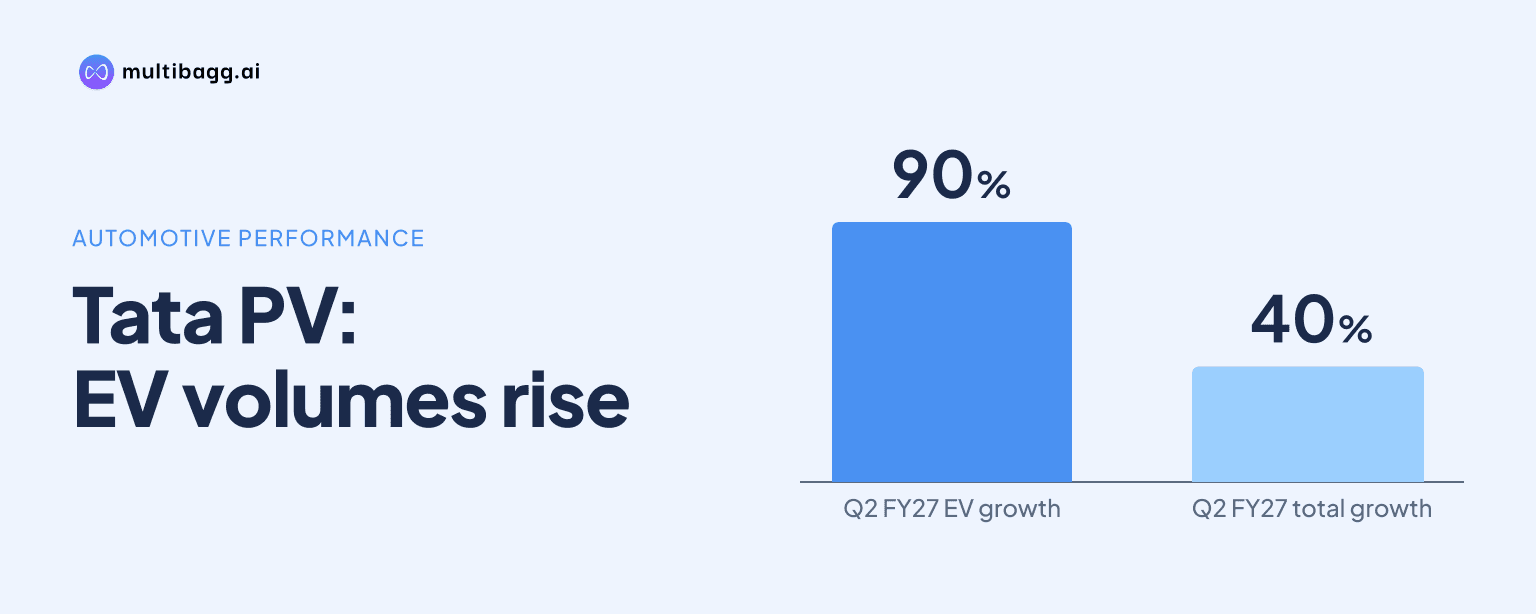
Tata Motors Passenger Vehicles Limited reported 90% year-on-year growth in electric-vehicle volumes in Q2 FY27, but its earnings before interest, tax, depreciation and amortisation margin fell 180 basis points to 4.0% as commodity and foreign-exchange costs compressed profitability. Revenue reached a record Rs 2.0423 lakh crore, up 50.9%.
Know Tata Motors Passenger Vehicles inside out
Results, valuation, peers and who's buying, in one view.
How fast did Tata PV grow in Q2 FY27?
Tata PV grew total vehicle volumes by 40% year on year in Q2 FY27, while quarterly sales exceeded 2 lakh units. The company said robust demand across its portfolio drove growth that significantly outperformed the industry, although the announcement did not provide an industry volume-growth figure. Revenue increased faster than volumes, rising 50.9% year on year to its highest quarterly level of Rs 2.0423 lakh crore.
The six-month result also showed continued expansion. Tata PV reported H1 FY27 revenue of Rs 3.8352 lakh crore, up 57.1% year on year, compared with Rs 2.0423 lakh crore in Q2 FY27 alone. October 2026 volumes reached a record 75,400 units, according to the company, providing the latest reported sales marker as it entered Q3.
Tata PV’s revenue growth was part of a broader group result, but the reporting scopes differ. Tata Motors Passenger Vehicles Limited reported consolidated Q2 FY27 revenue of Rs 9.692 lakh crore, up 34.0%, while Tata PV represented the domestic passenger-vehicle business and delivered its highest-ever quarterly revenue. The consolidated business also includes Jaguar Land Rover.
What drove Tata PV’s electric-vehicle growth?
Tata PV’s electric-vehicle, or EV, volumes increased 90% year on year in Q2 FY27, compared with 40% growth in total vehicle volumes. The company said EV growth contributed a 380-basis-point quarter-on-quarter increase in market share. A basis point is one-hundredth of a percentage point, so the reported change equals 3.8 percentage points.
Tata PV held a 43% EV Vahan market share in Q2 FY27 despite new entrants and increased competition, while its overall Vahan market share was 14.3%. The company retained the number-two overall position. The 43% EV share was therefore 28.7 percentage points above its reported overall market share, illustrating the greater concentration of its position in electric vehicles.
Alternative powertrains crossed 50% penetration in Q2 FY27, Tata PV said. EVs accounted for 23% penetration and compressed natural gas, or CNG, accounted for 28%. The company also extended Battery-as-a-Service, or BaaS, across its entire EV portfolio, without disclosing associated customer uptake, pricing or financial effects.
Which products and commercial actions did Tata PV report?
Tata PV launched the all-new Tata Aeris in Q2 FY27 and said it was receiving a strong market response, though it provided no booking or model-volume figures. It also introduced the Curvv Series X, Sierra Legend Series and Sierra #Dark edition. These product actions followed launches in Q1 and coincided with the 90% increase in EV volumes reported for the quarter.
Outside India, Tata PV launched the Tata Osprey in South Africa, identifying it as the model known internationally as the Tata Nexon. The company also signed a memorandum of understanding to provide Stellantis with access to its advanced product technology and vehicle architecture for global products. The announcement did not disclose financial terms, programme timing, product names or expected revenue from the arrangement.
Tata PV additionally unveiled Tata.Cars as its consumer-facing global brand identity, alongside the “Nothing’s Too Far” brand promise. The company’s October 2026 record of 75,400 units followed these Q2 portfolio actions, but the filing does not attribute that monthly volume to any individual launch, powertrain or geography.
Got a follow-up? Ask IRIS
Why did Tata PV’s margin decline despite record revenue?
Tata PV’s EBITDA margin was 4.0% in Q2 FY27, down 180 basis points year on year, despite 50.9% revenue growth. Its earnings before interest and tax, or EBIT, margin was negative 0.3%, down 50 basis points year on year. Tata PV attributed the margin compression to adverse commodity costs and foreign-exchange, or FX, effects.
The margin pressure persisted in the first half. H1 FY27 EBITDA margin was 4.1%, down 90 basis points year on year, while EBIT margin was negative 0.4%, an improvement of 70 basis points. This means the Q2 EBITDA decline was steeper than the H1 decline, whereas the EBIT comparison improved over the six-month period.
Profit before tax before exceptional items was Rs 25 crore in Q2 FY27, which Tata PV described as breakeven, and was Rs 131 crore lower year on year. H1 FY27 profit before tax before exceptional items was Rs 37 crore, up Rs 4 crore year on year. Management said it responded to steep commodity-cost pressures through calibrated pricing and focused cost actions, without quantifying either measure.
Tata PV’s Q2 EBITDA margin of 4.0% was below the consolidated margin of 6.2%, while its negative 0.3% EBIT margin compared with consolidated EBIT margin of 1.1%. Jaguar Land Rover reported a 6.6% Q2 EBITDA margin. The comparison reflects separate business performance within Tata Motors Passenger Vehicles Limited’s consolidated result rather than a like-for-like domestic passenger-vehicle measure.
What cash position did Tata PV report?
Tata PV reported positive free cash flow of Rs 825 crore in Q2 FY27 and Rs 1,945 crore in H1 FY27. Its closing cash balance was Rs 1.1 lakh crore at September 30, 2026, and gross debt was Rs 3,100 crore. These figures resulted in reported net cash of Rs 7,900 crore at the quarter end.
The domestic business’s positive Q2 free cash flow contrasts with Tata Motors Passenger Vehicles Limited’s consolidated free-cash outflow of Rs 6,300 crore. Consolidated net debt was Rs 5.08 lakh crore at September 30, 2026. Tata PV’s cash figures should therefore be read as domestic-business measures, while the consolidated figures include Jaguar Land Rover.
Management said its near-term domestic priorities are sustaining industry-beating growth, capitalising on growing EV penetration, ramping production capacity and strengthening profitability. The company did not provide a production-capacity target, a margin target or a timetable for the Stellantis technology and architecture arrangement in its Q2 FY27 announcement.
Conclusion
Tata PV paired a record Rs 2.0423 lakh crore of Q2 FY27 revenue and 40% volume growth with 90% EV-volume growth and a 43% EV Vahan market share. However, commodity and FX pressures reduced EBITDA margin to 4.0%, down 180 basis points, and left profit before tax before exceptional items at Rs 25 crore.
The next disclosures to watch are management’s stated actions on calibrated pricing, cost reductions, production-capacity ramp-up and profitability. October 2026 volumes of 75,400 units set the latest reported operating benchmark, while the filing leaves the timing and financial implications of the Stellantis agreement unresolved.