










Jubilant Targets 4,000 Drug-Discovery FTE Capacity by FY30
Key highlights
- Jubilant plans to expand drug-discovery capacity from 1,000 FTEs in FY25 to 4,000 FTEs in FY30.
- Jubilant has allocated USD 15 crore of phased capex and management expects return on capital employed above 20%.
- Jubilant's drug-discovery revenue rose 11% year on year to Rs 180 crore in Q2 FY27.
- Jubilant says the Pierre Fabre partnership expands its mAb and ADC addressable market by USD 140 crore.
powered by IRIS
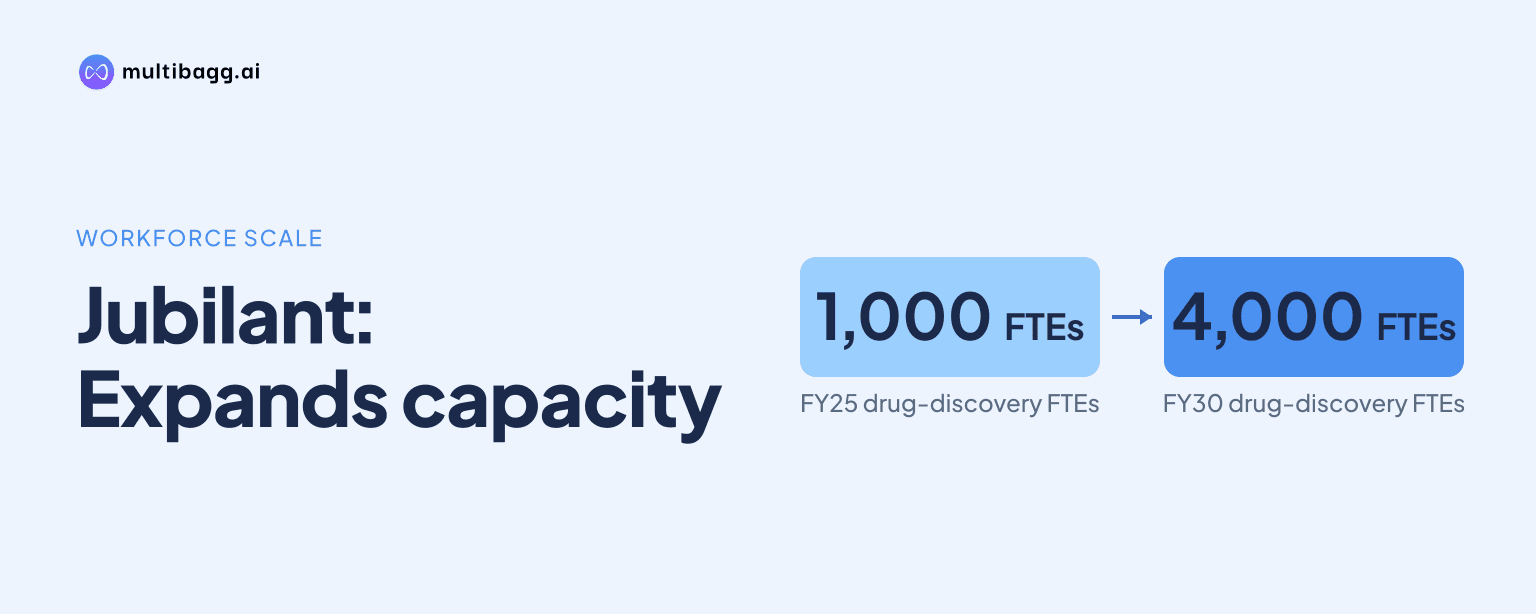
Jubilant Pharmova plans to expand drug-discovery capacity to 4,000 full-time equivalents (FTEs) by FY30 from 1,000 FTEs in FY25, supported by phased capital expenditure of USD 15 crore. The expansion covers existing Greater Noida and Bengaluru sites plus a new Devanahalli, Bengaluru location, with management expecting return on capital employed above 20%.
Know Jubilant Pharmova inside out
Results, valuation, peers and who's buying, in one view.
What is Jubilant's FY30 drug-discovery capacity plan?
Jubilant plans to increase drug-discovery capacity fourfold to 4,000 FTEs by FY30, from 1,000 FTEs in FY25. Its interim capacity target is 2,000 FTEs in FY28, meaning the company intends to add 1,000 FTEs by FY28 and a further 2,000 FTEs by FY30.
Jubilant has allocated total capital expenditure of USD 15 crore for phased expansion at Greater Noida and Bengaluru and at the new Devanahalli site in Bengaluru. Management expects return on capital employed above 20%, but the presentation does not provide a site-level allocation, annual capital-expenditure schedule or annual hiring plan for the FY25-to-FY30 programme.
Why is Jubilant expanding drug-discovery services?
Jubilant is positioning the expansion against a drug-discovery-services market that management estimates will rise from USD 800 crore in 2023 to USD 1,000 crore in 2028. Management identifies friendshoring, the Biosecure Act, and rising demand for antibody-drug conjugates (ADCs) and oligonucleotides as drivers of drug-discovery demand.
Jubilant says the Biosecure Act becomes law in the United States and states that federal agencies must not contract with a biotechnology company of concern. Its disclosed response is to add large-pharma customers, expand its European footprint and introduce ADC, monoclonal antibody and biologics platforms alongside its existing chemistry offering.
About one-third of Jubilant's revenue comes from large-pharma accounts, according to the presentation. The company also describes itself as an Indian leader in integrated drug discovery, with more than 100 programmes and a big-pharma strategic partnership, while seeking a multifold increase in European revenue.
What infrastructure will support Jubilant's expansion?
Jubilant's Integrated Drug Discovery Center in Bengaluru has about 400 scientists and more than 120 integrated drug-discovery programmes. The centre covers target identification through pre-clinical candidate selection and includes structural biology, computer-aided drug design, in-vitro and in-vivo biology, drug metabolism, pharmacokinetics and toxicology.
Jubilant's Chemistry Innovation Research Center in Delhi NCR has about 750 scientists across six centres of excellence. Its stated capabilities include synthetic, medicinal, analytical and computational chemistry, as well as work in degraders, peptides, lipids, solid-state chemistry, library synthesis, photoredox chemistry and carbohydrates.
Jubilant also has a Centre of Excellence for Biologics and ADCs in St. Julien, France, with about 35 scientists. The facility provides an ADC full-discovery loop, biologics and immune-oncology expertise, antibody engineering, linker chemistry and payload conjugation, adding a European scientific base to the planned Indian capacity increase.
Got a follow-up? Ask IRIS
How has Jubilant's drug-discovery business performed in FY27?
Jubilant reported drug-discovery revenue of Rs 180 crore in Q2 FY27, up 11% from Rs 162 crore in Q2 FY26. Earnings before interest, tax, depreciation and amortisation (EBITDA) increased to Rs 36 crore from Rs 33 crore, but EBITDA margin declined by 50 basis points to 20% as project mix changed.
For H1 FY27, Jubilant's revenue rose 10% to Rs 354 crore from Rs 323 crore in H1 FY26, while EBITDA increased 25% to Rs 81 crore from Rs 65 crore. The presentation attributes the revenue increase to biotech customers, and H1 EBITDA margin rose 280 basis points to 23%, unlike the year-on-year decline in the Q2 margin.
What are Jubilant's FY30 revenue and margin objectives?
Jubilant targets drug-discovery revenue of about three times FY24 revenue by FY30 and EBITDA margin above 25%. FY24 revenue was Rs 449 crore with a 24% EBITDA margin, providing the base for management's stated FY30 revenue objective.
Jubilant's revenue increased to Rs 570 crore in FY25 and Rs 654 crore in FY26, while EBITDA margin was 24% in FY25 and 23% in FY26. Its trailing 12-month revenue was Rs 684 crore with a 24% EBITDA margin, which is Rs 235 crore above FY24 revenue but still below management's stated margin objective of more than 25%.
The 4,000-FTE capacity plan is the operating mechanism Jubilant has disclosed to support the FY30 revenue ambition. The presentation does not quantify revenue per FTE, the proportion of capacity expected to be filled by large-pharma customers, or the expected contribution from ADC and biologics work.
How does the Pierre Fabre partnership change Jubilant's offering?
Jubilant says its strategic partnership with Pierre Fabre expands its total addressable market by USD 140 crore in monoclonal antibodies and ADCs. The company says the integration is complete, adding a strategic European footprint and deeper ADC domain expertise.
Jubilant is investing in a business-development team following completion of the integration. It describes the partnership as supporting a cost-effective delivery model, while its St. Julien centre's 35 scientists provide capabilities in biologics, immune oncology, antibody engineering and conjugation chemistry.
The presentation does not disclose Pierre Fabre partnership revenue, customer numbers or a timetable for converting the USD 140 crore addressable-market expansion into sales. It does, however, link the partnership's biologics and ADC capabilities to the plan to build European presence and serve large-pharma customers.
Conclusion
Jubilant's FY30 programme combines a rise from 1,000 FTEs in FY25 to 4,000 FTEs, USD 15 crore of planned capital expenditure and a broader biologics and ADC offering. The business reported Rs 180 crore of revenue in Q2 FY27 and Rs 354 crore in H1 FY27, while H1 EBITDA margin increased to 23% despite a Q2 decline to 20%.
The next disclosed operating milestone is 2,000 FTEs in FY28, followed by 4,000 FTEs in FY30. Investors can watch progress on the phased expansion, management's expected return on capital employed above 20%, the investment in the business-development team and movement toward the FY30 targets of roughly three times FY24 revenue and EBITDA margin above 25%.