










Jubilant Pharmova targets US$80-90 million per Spokane line
Key highlights
- Jubilant Pharmova generated approximately US$20 million from Spokane Line 3 in Q2 FY2027.
- Management targets US$80 million to US$90 million of annual peak revenue from each Spokane line.
- Line 3 has more than 13 tech-transfer projects across more than five customers.
- Jubilant Pharmova reported 23 active customer proposals for Spokane Line 4 capacity.
powered by IRIS
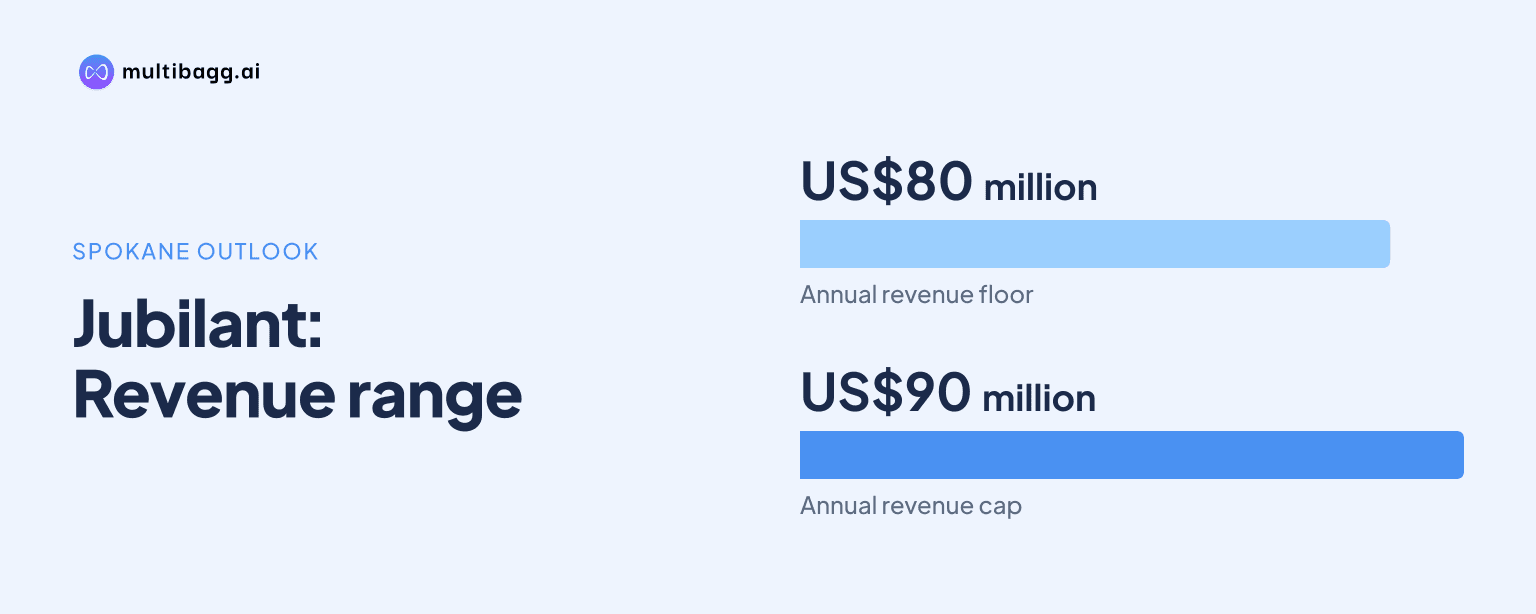
In Q2 FY2027, Jubilant Pharmova Limited generated approximately US$20 million from Spokane Line 3, and management expects each Spokane sterile-injectables line to reach US$80 million to US$90 million of peak annual revenue. Management expects Line 3 to approach full utilisation in FY2028, while commercial production becomes more significant in FY2029.
Know Jubilant Pharmova inside out
Results, valuation, peers and who's buying, in one view.
How much revenue is Spokane Line 3 producing?
Jubilant Pharmova said Spokane Line 3 generated approximately US$20 million in Q2 FY2027, supported by more than 13 product tech-transfer projects for more than five customers. On an annualised basis, that quarterly revenue equates to about US$80 million, near the lower end of management's US$80 million to US$90 million annual peak-revenue range.
Management expects double-digit revenue growth from Line 3 in the second half of FY2027 and into FY2028. Chris Preti, chief executive of CDMO Sterile Injectables, cited demand for US isolator capacity, industry consolidation and geopolitical uncertainty. Spokane also received Voluntary Action Indicated, or VAI, status, and the company said its first Line 3 product was approved without a pre-approval inspection.
When will Line 3 move into commercial production?
Jubilant Pharmova expects FY2028 revenue on Line 3 to include both tech-transfer and commercial work, while commercial production should become significant in FY2029. Management said Line 3 should be close to full utilisation in FY2028, when it expects margin improvement to begin appearing.
The timing matters because tech transfers require additional project-management and process-engineering labour. Chief Financial Officer Ashish Mukkirwar said these roles raise costs during the transfer phase. Commercial production should use a more optimised cost structure, so management expects gradual margin improvement in FY2028 rather than an immediate step-up when revenue approaches the US$80 million to US$90 million target.
Jubilant Pharmova did not disclose a Line 3 operating margin, the number of products already in commercial manufacture, or a date for the first commercial batch. It did say that FY2028 would remain a mixed year for tech-transfer and commercial revenue, making the production mix, rather than capacity alone, central to the expected margin change in FY2029.
Why are Line 3 margins lower during tech transfers?
Jubilant Pharmova said tech-transfer margins are lower because staffing needs are higher before Line 3 costs are fully absorbed. The company is transferring more than 13 projects and needs more project-management and process-engineering personnel, creating short-term cost pressure while Line 3 revenue grows.
Management expects commercial manufacturing to carry a more optimised cost structure on a broadly similar revenue base. Its FY2028 margin case therefore relies less on revenue rising substantially above the US$20 million Q2 FY2027 level and more on transferred products moving into recurring commercial production with lower labour intensity.
The sterile-injectables ramp is occurring alongside pressures elsewhere in the group. Jubilant Pharmova reported Q2 FY2027 revenue of Rs 2,370 crore, up 21% year on year, EBITDA of Rs 255 crore and profit after tax of Rs 31 crore. For H1 FY2027, EBITDA was Rs 523 crore on revenue of Rs 4,599 crore, while management cited unavailable high-margin SPECT radiopharma products and Montreal remediation costs for lower year-on-year EBITDA margins.
Got a follow-up? Ask IRIS
What is the timeline and demand outlook for Line 4?
Jubilant Pharmova expects to begin tech transfers for one or two Line 4 projects in Q4 FY2027, following completion of the line build-out and a major media-fill qualification step. The company reported 23 active customer proposals for Line 4 capacity and expects further customer signings and tech-transfer work during FY2028.
Management said it is applying lessons from Line 3, including qualification work, more than five customers and more than 13 projects, to the new line. Preti said management expects Line 4, like Line 3, to reach US$80 million to US$90 million of peak revenue within one-and-a-half to two years, although the company did not disclose signed Line 4 contracts or expected initial revenue.
Jubilant Pharmova has not provided Line 4 margin guidance. Mukkirwar said the impact will depend on customer traction and that management would provide more specific guidance after receiving more requests for proposals and visibility in the second half of FY2027. The 23 active proposals establish demand interest, but contract conversion and cost absorption remain unresolved.
How does the Spokane ramp fit Jubilant Pharmova's capital plan?
Jubilant Pharmova expects capital expenditure of about Rs 1,800 crore to Rs 1,900 crore in FY2027, declining to around Rs 1,000 crore in FY2028. Management said Line 4 and PET installation should be completed by the end of FY2027 or early FY2028, while Ruby-Fill capacity expansion remains another major capital-spending item.
Management expects Line 3, Line 4 and PET pharmacies to start contributing commercialised revenue from FY2028. On that basis, it maintained its objective of reaching net debt of zero by the end of FY2030. The company expects net debt to be close to Rs 4,000 crore at the end of FY2027 and said it does not expect that figure to rise in FY2028 if operations proceed as planned.
The capital plan also sits beside continuing costs at Montreal. Jubilant Pharmova said Montreal lost more than Rs 80 crore in Q2 FY2027 and around Rs 157 crore in H1 FY2027, combining remediation expenditure and operating costs without third-party revenue. Management expects the H2 FY2027 Montreal burn to be lower than in H1, but did not give a quarterly estimate.
Conclusion
The Spokane programme is shifting from a transfer-led ramp toward commercial manufacturing. More than 13 Line 3 projects across more than five customers provide the current revenue base, while management's FY2028 and FY2029 timeline indicates that margin improvement should follow only as commercial work takes a larger share of the line's activity.
Investors should watch for the first one or two Line 4 tech transfers in Q4 FY2027, customer conversions from the 23 active Line 4 proposals, and the FY2028 guidance management said it would provide in a future analyst call. Montreal remediation spending and the planned reduction in FY2028 capital expenditure to around Rs 1,000 crore will also affect the broader cash-flow outcome.