










Jubilant plans nine US PET sites with over USD 60 million
Key highlights
- Jubilant plans to expand US PET manufacturing from 3 sites to 9 sites by FY28.
- Jubilant will invest more than USD 60 million through internal accruals and long-term credit.
- Jubilant reported H1 FY27 radiopharmacy revenue of Rs 1,367 crore and EBITDA of Rs 17 crore.
- Jubilant targets an FY30 radiopharmacy EBITDA margin of about 7% to 8%, versus 1% in TTM.
powered by IRIS
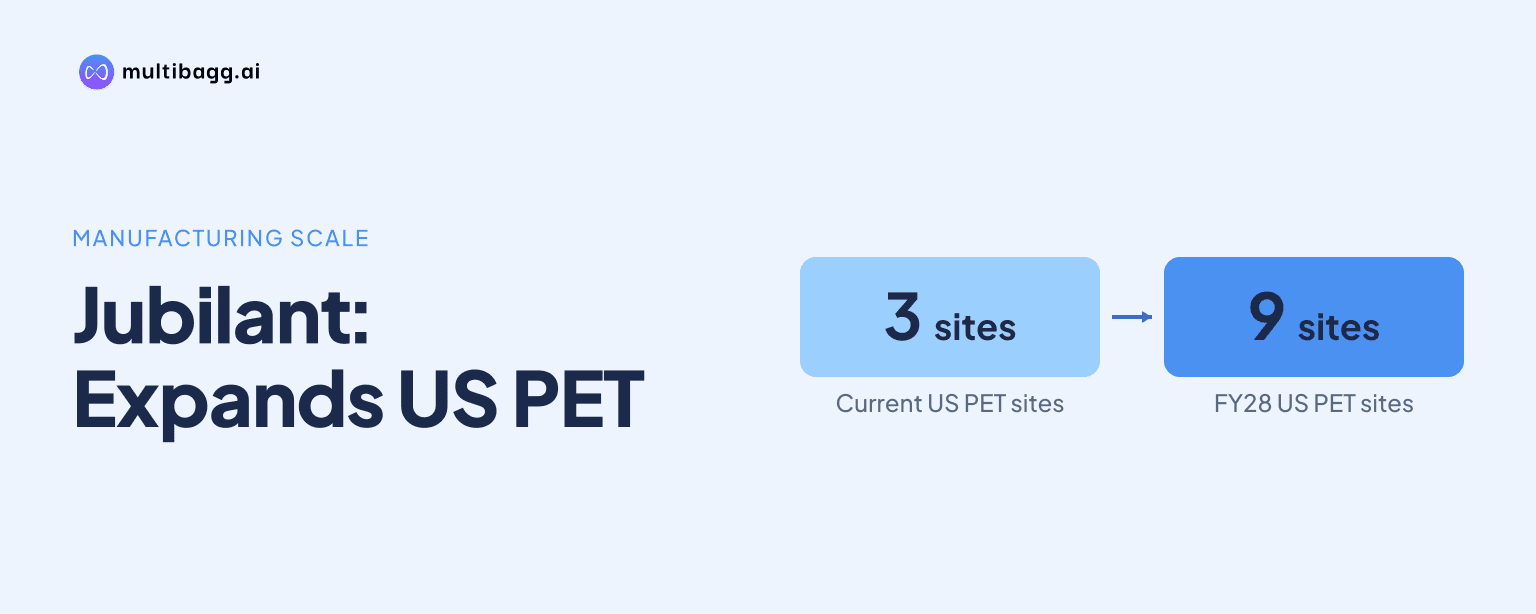
Jubilant Pharmova plans to take its United States (US) positron emission tomography (PET) manufacturing network from three to nine sites, fully operational by FY28, through investment of more than USD 60 million. Jubilant has secured a leading PET product distribution contract for the facilities and links the expansion to its FY30 radiopharmacy margin plan.
Know Jubilant Pharmova inside out
Results, valuation, peers and who's buying, in one view.
Why is Jubilant expanding its US PET manufacturing network?
Jubilant is expanding its PET manufacturing network to support long-term contracts with PET radiopharmaceutical manufacturers and to add six sites to its existing base of three. The presentation identifies increasing demand for novel PET products as a radiopharmacy growth driver, alongside an emerging radioisotope landscape including gallium-68, copper-64, lutetium-177 and actinium-225.
The six-site project sits within a US network of 45 radiopharmacies serving about 1,800 hospitals and holding a 20% volume market share, according to Jubilant. The network delivers six customised doses every minute and reports more than 99% on-time deliveries through route optimisation using artificial intelligence, a relevant operating mechanism for products with short half-lives and just-in-time ordering.
Jubilant also says its radiopharmacy network is compliant with United States Pharmacopeia 825, or USP 825, requirements. Its stated network advantage is the combination of single-photon emission computed tomography (SPECT) manufacturing and radiopharmacy operations, while its presentation says therapeutic-product distribution is preferred from radiopharmacies.
How much will Jubilant invest and when will the sites operate?
Jubilant plans to invest more than USD 60 million in the six additional PET manufacturing facilities, taking its network from three sites to nine. The facilities are scheduled to be fully operational by FY28, and Jubilant says it will fund the programme through internal accruals and long-term credit.
Jubilant says it has secured a distribution contract for a leading PET product for the new manufacturing facilities. The presentation does not name the product, distribution counterparty, site locations or capital allocation by facility, but it identifies six new PET sites on the US network map and states that the larger network is intended to enable long-term manufacturer contracts.
The funding plan is disclosed alongside the FY28 operating target rather than a detailed capital schedule. As a result, the stated evidence is the investment threshold of more than USD 60 million, the use of internal accruals and long-term credit, and the planned addition of six sites to the three already operating.
What makes the US radiopharmacy market difficult to enter?
Jubilant describes the US market as consolidated and calls its 45-site network the country’s second-largest radiopharmacy network. Its market comparison shows one participant with more than 160 radiopharmacies, compared with 41, 31, 42 and 14 for four other listed participants; Jubilant is shown with both SPECT pharmacies and PET manufacturing capability.
Jubilant cites site-level licensing from the Nuclear Regulatory Commission, plus state, local and hospital requirements for transportation and use, as a regulatory barrier. The company also points to the need for a robust supply chain because of short product half-lives and customer preference for just-in-time orders rather than large bulk orders.
Skilled staffing is another stated constraint: authorised nuclear pharmacists require at least 4,000 hours of training or experience in nuclear pharmacy practice, alongside examinations. Jubilant also identifies complex care coordination across hospital departments, which adds an operating requirement beyond the 45 radiopharmacy locations and PET manufacturing assets.
Got a follow-up? Ask IRIS
How has Jubilant’s radiopharmacy financial performance changed?
Jubilant’s radiopharmacy revenue rose year on year in Q2 FY27 and H1 FY27, while earnings before interest, tax, depreciation and amortisation (EBITDA) declined in both periods. Q2 FY27 revenue was Rs 667 crore, 10% above Rs 607 crore in Q2 FY26, while EBITDA decreased 36% to Rs 5 crore from Rs 8 crore.
For H1 FY27, revenue increased 14% to Rs 1,367 crore from Rs 1,204 crore, but EBITDA fell 6% to Rs 17 crore from Rs 18 crore. Jubilant attributes the revenue increase to higher volumes from certain PET products, while competitive pressure in SPECT radiopharmacies reduced EBITDA and lowered the reported H1 margin by 30 basis points to 1%.
The quarter-to-quarter comparison also shows revenue of Rs 700 crore in Q1 FY27 falling to Rs 667 crore in Q2 FY27, while EBITDA declined from Rs 12 crore to Rs 5 crore. This followed the same 1% EBITDA margin in Q2 FY27 as in H1 FY27, compared with 2% in Q1 FY27.
What revenue and margin outcome does Jubilant target by FY30?
Jubilant’s Radiopharmacy Vision 2030 targets revenue at two times FY24 revenue and an EBITDA margin of about 7% to 8% by FY30. The FY24 base was revenue of Rs 2,050 crore and an EBITDA margin of 3%, while the latest trailing 12-month period, or TTM, showed revenue of Rs 2,675 crore and a 1% margin.
The figures presented show radiopharmacy revenue rising from Rs 2,050 crore in FY24 to Rs 2,314 crore in FY25 and Rs 2,512 crore in FY26 before reaching Rs 2,675 crore in TTM. Over the same sequence, the reported EBITDA margin moved from 3% in FY24 to 1% in FY25, remained 1% in FY26 and stayed at 1% in TTM.
Management links the FY30 plan to the six new PET manufacturing facilities, stating that growth and margins are expected to improve as they become operational. This is a management target, not a reported result: the presentation does not provide a yearly revenue or margin bridge from the FY28 site completion target to the FY30 objective.
Conclusion
Jubilant’s US programme combines more than USD 60 million of planned investment, six new PET manufacturing facilities and a secured PET product distribution contract with a 45-radiopharmacy network serving about 1,800 hospitals. The financial comparison gives the context for management’s plan: H1 FY27 revenue rose to Rs 1,367 crore, but EBITDA declined to Rs 17 crore and the margin was 1% amid stated SPECT competition.
The next disclosed milestone is full operation of all six new PET facilities by FY28, funded by internal accruals and long-term credit. Management’s longer-term benchmark is FY30 radiopharmacy revenue at twice the FY24 level of Rs 2,050 crore and an EBITDA margin of about 7% to 8%, versus the 1% TTM margin presented.