










Karamtara Engineering Limited Q2 revenue rises 62% to ₹1,647 crore
Key highlights
- Karamtara reported Q2 FY27 revenue from operations of ₹1,646.7 crore, up 62% year on year.
- Karamtara's Q2 FY27 profit after tax was ₹94.61 crore, up 37% year on year.
- Karamtara reported consolidated Q2 FY27 EBITDA of ₹196.21 crore and an EBITDA margin of 11.9%.
- Karamtara made its November 6, 2026 Q2 FY27 earnings-call recording available on its website.
powered by IRIS
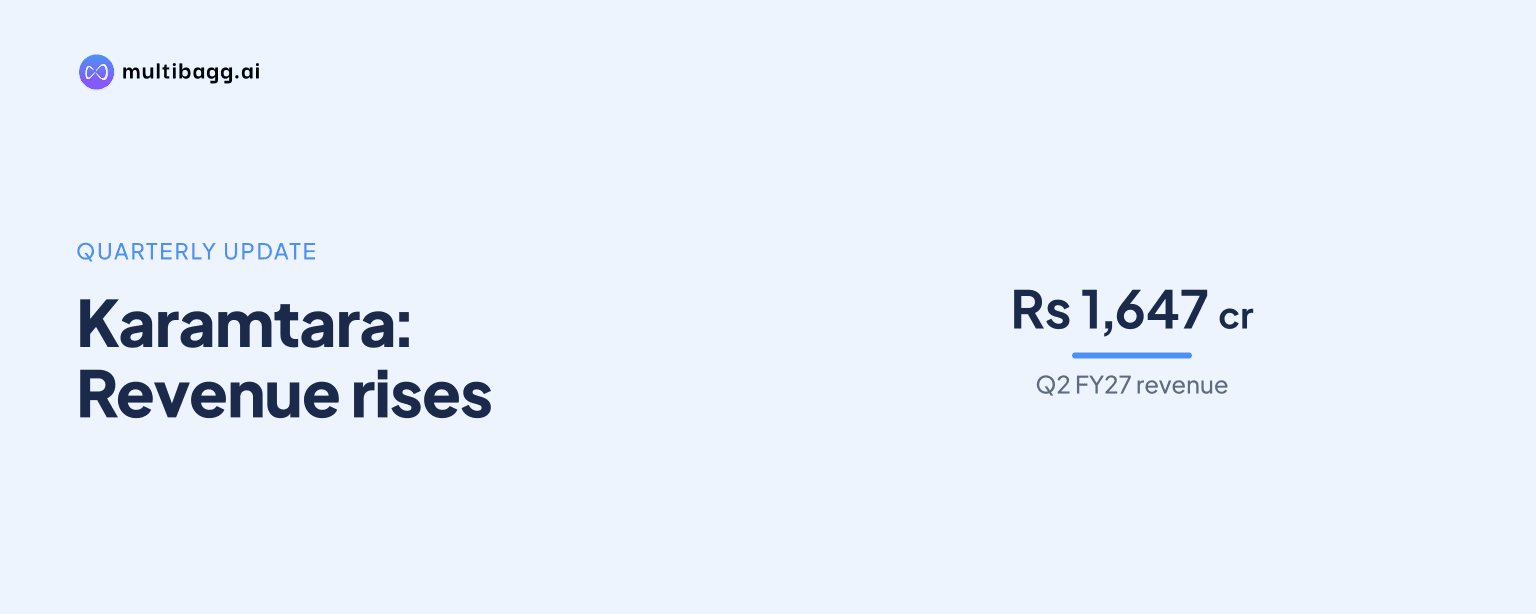
Karamtara Engineering Limited's Q2 FY27 revenue from operations rose 62% year on year to ₹1,646.7 crore. The company also reported profit after tax of ₹94.6 crore, up 37% year on year, and has made the audio recording of its November 6 investor and analyst call available online.
Know Karamtara Engineering inside out
Results, valuation, peers and who's buying, in one view.
What did Karamtara report for the September quarter?
Karamtara reported revenue from operations of ₹1,646.7 crore for Q2 FY27, compared with the year-ago quarter, while profit after tax rose 37% to ₹94.6 crore. The quarter covered the three months ended September 30, 2026, and the discussion with investors related to unaudited results for both the quarter and the first half of FY27.
The consolidated results data supplied with the filing-related reports put total income at ₹1,647.39 crore, EBITDA at ₹196.21 crore and net profit at ₹94.61 crore. EBITDA margin stood at 11.9%, while revenue was reported to be 4.2% higher than in Q1 FY27 and EBITDA 12.9% higher sequentially. The difference between revenue from operations and total income reflects the separate presentation of these measures in the reported figures.
Why did Karamtara release an earnings-call recording?
Karamtara released the recording to provide investors and analysts access to management's discussion of the September-quarter and half-year unaudited financial results. The company disclosed on November 6, 2026 that the audio recording of the earnings conference call was available through its website, www.karamtara.com, and through the link cited in its announcement.
The call was held on November 6 after Karamtara had announced the event on October 28. The scheduled time was 10:30 IST. The release of a call recording is an investor-information update rather than a fresh financial result, but it allows shareholders who did not attend the call to review management commentary and questions from analysts.
The company had issued an investor presentation on November 5 alongside the process for approving and disclosing the unaudited results. Its regulatory update on November 6 was specifically classified as an outcome of an analyst or institutional investor meeting under Regulation 30 of the Listing Obligations and Disclosure Requirements framework.
Got a follow-up? Ask IRIS
What do the reported order book and FY27 outlook indicate?
The supplied call-summary material said Karamtara's order book stood at ₹6,500 crore at September 30, compared with about ₹6,000 crore at June 30. It also stated that Q2 order intake was about ₹2,100 crore to ₹2,200 crore, with around ₹4,000 crore of the order book expected to be executed in FY27.
That material said management maintained a target for 60% to 65% revenue growth in FY27 over FY26. However, the transcript carrying these operational comments is explicitly marked as AI-generated and potentially inaccurate. Investors should therefore treat the order-book execution estimate, capacity commentary and forward-looking targets as call-summary information that should be checked against Karamtara's official presentation, recording or subsequent exchange filings.
The summary also identified freight disruption as a pressure point and said receivable days had increased with the international business mix. It described transmission as expected to account for around 20% of FY27 business, with a higher share anticipated later as Indian and Saudi capacity contributes. These details provide context for the reported growth, but they are not independently verified in the company announcement that made the audio recording available.
How does the update affect investors and business operations?
The update gives investors two measurable reference points: 62% year-on-year growth in Q2 revenue from operations and 37% growth in profit after tax. The 11.9% EBITDA margin and sequential increase in EBITDA offer additional information on operating performance during the quarter, while the accessible recording gives investors a route to assess management's explanation of those figures.
No share-price movement, dividend decision or revised margin guidance was disclosed in the supplied announcement about the recording. As a result, the available information supports an assessment of reported earnings and investor communication, but does not establish a direct market reaction. The results also show that profit growth was lower than revenue growth on a year-on-year basis, a comparison investors may consider alongside margin and freight-related commentary.
For operations, the reported ₹6,500 crore order book in the supplied call summary points to work visibility, subject to the qualifications attached to that AI-generated transcript. The same summary said year-end utilisation was expected at 60% to 70%, below a longer-term optimum of 85% to 90%, and referred to planned H2 FY27 capital expenditure of ₹200 crore to ₹250 crore. Those figures require confirmation from official company materials before they are used as the basis for financial forecasts.
Conclusion
Karamtara's September-quarter disclosure combines strong reported growth with a more accessible investor-information process. Revenue from operations of ₹1,646.7 crore and profit after tax of ₹94.6 crore are the central reported outcomes, while the November 6 recording enables investors to review the discussion around the unaudited Q2 and half-year results.
Investors can next watch for Karamtara's official presentation, filings and future results for confirmation of its stated FY27 growth outlook, order-book execution and margin trends. The supplied AI-generated call summary referred to trial production by the end of December and galvanising trials by March, but these planned milestones should be verified through company disclosures.