










Karamtara Retains FY27 Growth Target Despite Freight Pressure
Key highlights
- Karamtara reported H1 FY27 revenue of Rs 3,228 crore, up 67% year on year.
- Karamtara retained FY27 revenue-growth guidance of 60% to 65% over FY26.
- Q2 FY27 EBITDA was Rs 196 crore at an 11.9% margin, while freight remained elevated.
- Karamtara expects FY27 year-end capacity utilisation of 60% to 70%.
powered by IRIS
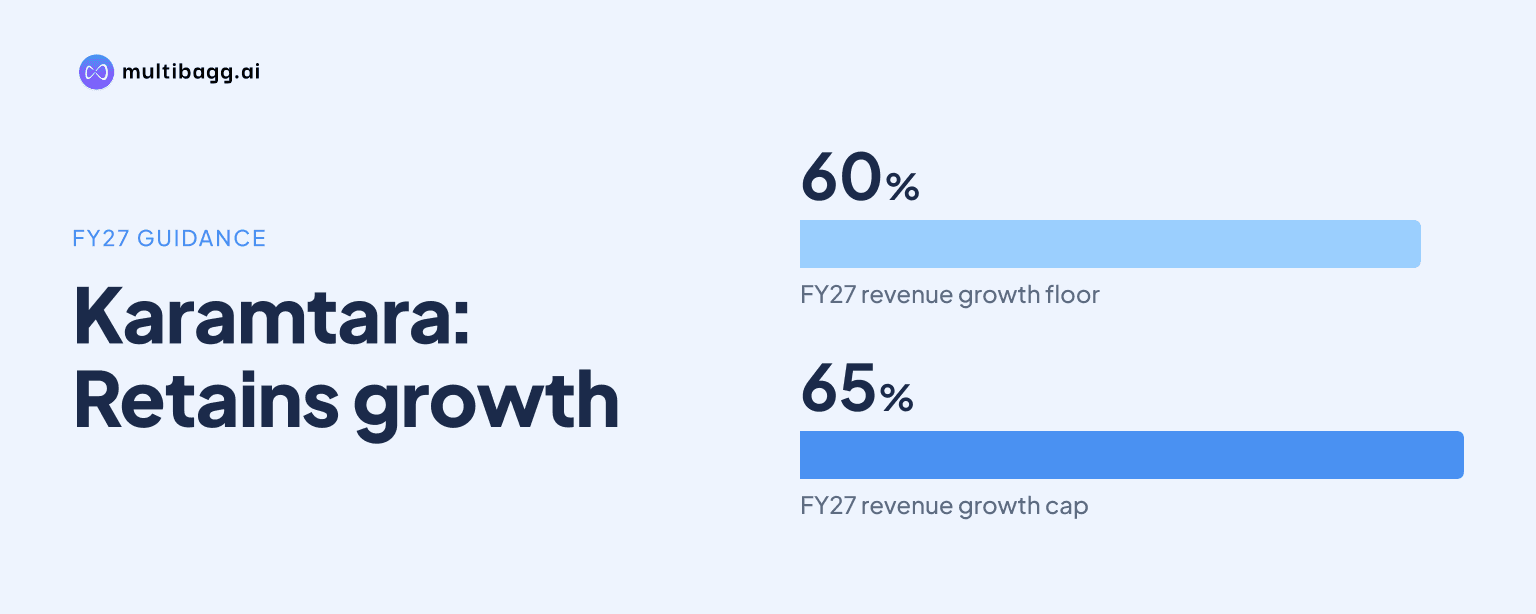
Karamtara Engineering Limited retained its FY27 revenue-growth target of 60% to 65% over FY26 on November 6, 2026, after H1 FY27 revenue rose 67% year on year to Rs 3,228 crore. Karamtara said historically stronger second-half deliveries and capacity additions support the target despite elevated freight costs and delayed Middle East and Africa dispatches.
Know Karamtara Engineering inside out
Results, valuation, peers and who's buying, in one view.
Why is Karamtara keeping its FY27 target unchanged?
Karamtara is keeping its FY27 revenue-growth target at 60% to 65% over FY26 because H1 FY27 revenue already grew 67% year on year to Rs 3,228 crore and management expects a larger share of annual deliveries in the second half. Management said approximately 45% of annual revenue historically comes in the first six months, meaning the remaining business is normally executed in H2.
The H1 result included a 70% international-revenue share and a 77% contribution from renewable products. In Q2 FY27, revenue from operations was Rs 1,647 crore, up 62% year on year, with international revenue at 73% and renewable products also at 73%. That mix supported reported growth, although it also increased exposure to shipping conditions.
Management said its confidence is not based on an expectation that disruption has disappeared. Rather, it said Karamtara remains hopeful of achieving its committed 60% to 65% growth range despite geopolitical issues, while acknowledging that continued freight pressure would still affect profitability. The guidance concerns revenue growth, not a stated margin target.
How did freight and shipping disruptions affect Karamtara?
Karamtara said freight, rather than raw-material prices, was the principal pressure on Q2 FY27 profitability because many global contracts are delivered to site. Q2 EBITDA was Rs 196 crore, up 46% year on year, but its 11.9% margin reflected elevated ocean and land freight, including higher gasoline-related transportation costs in the Middle East, the United States and Europe.
The disruption also affected execution: management said material for some Middle East and Africa supplies could not be dispatched, so some production was kept on hold. Karamtara nevertheless said it had passed on most of the increased freight cost to customers and expects the effect of that pass-through to be visible in Q3 and Q4, subject to shipping conditions.
Management noted that Q2 margin recovered by about 100 basis points from Q1. A basis point is one-hundredth of a percentage point. It said the remaining impact should ease if Middle East shipping normalises and held-back material begins to move, but it did not quantify the expected margin recovery.
Got a follow-up? Ask IRIS
Can higher utilisation support second-half delivery?
Karamtara expects capacity utilisation of 60% to 70% by the end of FY27, below its stated optimum range of 85% to 90%, as new facilities are still being ramped up. Management linked the lower near-term utilisation to about Rs 900 crore of capital expenditure in the prior year and Rs 370 crore of capital expenditure in H1 FY27.
Karamtara’s gross block stood at Rs 2,411 crore after the H1 FY27 capital expenditure. Its aggregated installed capacity reached 8,79,800 metric tonnes per annum at the end of the quarter, excluding rolling and galvanising facilities used for captive consumption. Management said capacity additions and debottlenecking over the last two years helped produce its historical high H1 revenue.
Bhachau is central to the planned ramp. Management said its large Bhachau transmission-tower facility had recently started production, while a new rolling mill for transmission towers and solar-tracker piles is being added there. A dedicated pre-engineered buildings, or PEB, facility aimed primarily at data-centre structures is expected to be ready around the beginning of the next financial year.
Which businesses are expected to contribute to growth?
Karamtara expects growth to be broad based across solar, wind and transmission, while transmission is set to become a larger contributor after FY27. Management said transmission represented about 20% of the business in the current year and should remain around that level in FY27, before improving from next year as Indian production expands and Saudi Arabia begins making transmission towers.
Saudi Arabia is the other material operational milestone. Management said the multi-product facility there was almost fully constructed, with trial production expected by the end of December and galvanising trials targeted by March. It expects a 12- to 18-month ramp-up, with an initial meaningful revenue contribution next year and a larger contribution in the following year.
The Saudi facility will make transmission towers and solar products, addressing local-content conditions that management said prevent those energy-infrastructure requirements from being served through exports from India or another country. Management also said the plant could serve neighbouring markets and North Africa over time, but did not disclose a revenue target for the operation.
Conclusion
Karamtara’s unchanged FY27 growth outlook rests on the 67% H1 revenue increase to Rs 3,228 crore, normal second-half delivery seasonality and newly added manufacturing capacity. The immediate trade-off is that international sales accounted for 70% of H1 revenue, leaving margins and dispatch timing exposed to the Middle East freight disruption even as Q2 EBITDA margin improved to 11.9%.
The next indicators are whether freight-cost pass-through appears in Q3 and Q4, whether utilisation reaches management’s 60% to 70% FY27 year-end range, and whether Saudi trial production starts by the end of December. Investors will also watch for galvanising trials by March and evidence that deferred Middle East and Africa shipments are moving again.