










Karamtara says US transmission demand drives Rs 550 crore order
Key highlights
- Karamtara disclosed a Rs 550 crore US transmission order received on November 5, 2026.
- The US accounted for more than 57% of Karamtara’s Rs 6,500 crore order book at September 30, 2026.
- Karamtara said international sales represented 73% of its sales mix, compared with 27% domestically.
- Management expects about Rs 4,000 crore, or roughly 60%, of its September order book to execute in the current financial year.
powered by IRIS
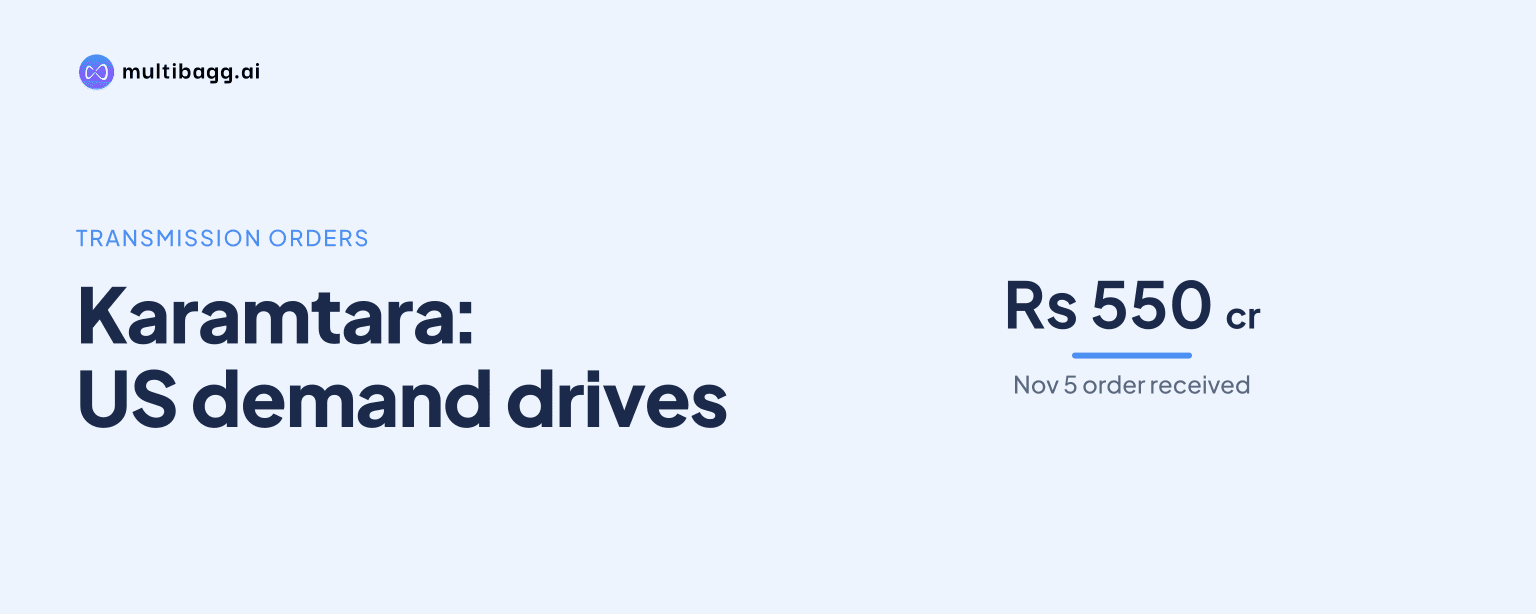
Karamtara Engineering Limited said on November 6, 2026 that US transmission demand had generated a new Rs 550 crore order, supported by power needs from data centres and chips and by ageing grids. Management said the US accounted for more than 57% of Karamtara’s Rs 6,500 crore order book as of September 30, 2026.
Know Karamtara Engineering inside out
Results, valuation, peers and who's buying, in one view.
Why does Karamtara expect US transmission demand to grow?
Karamtara expects US transmission demand to grow because management cited rising power requirements from chip facilities and data centres, alongside an ageing US transmission grid. It disclosed the Rs 550 crore US order, received on November 5, 2026, as it described the country as a potentially large transmission market for the company.
Management also linked demand to renewable-energy construction and grid reinforcement. It said transmission is needed to evacuate power from new generation capacity, while grids designed at 220 kilovolts, or kV, and 400 kV are being upgraded to 765 kV in several markets. These are management’s stated drivers rather than a quantified forecast of US power demand.
Karamtara said it has supplied transmission towers in more than 50 countries, including the US, Canada, Mexico, Europe, Africa and the Middle East. Management described local US transmission-tower production as negligible and named India and Turkey as key supply countries, while noting that only a limited number of producers are qualified for the market.
The company said its transmission capacity had earlier been directed more towards renewable-energy products after a 2021-22 pivot. With transmission facilities now operating and capacity expansion under way, management said it had secured large projects in Canada and the US. It did not disclose the Canadian order value or the expected revenue timing for the Rs 550 crore US order.
How much of Karamtara’s order book is tied to the US?
The US contributed more than 57% of Karamtara’s Rs 6,500 crore order book as of September 30, 2026, according to management. That exposure sits within an export-led sales mix: international sales contributed 73%, compared with 27% from domestic sales, during the period discussed in the Q2 FY27 call.
The order book rose by Rs 500 crore from about Rs 6,000 crore on June 30, 2026 to Rs 6,500 crore on September 30, 2026. Management said fresh orders secured during the quarter totalled about Rs 2,100 crore to Rs 2,200 crore, and it expected roughly 60% of the September order book, or about Rs 4,000 crore, to be executed in the current financial year.
Management also said it had announced Rs 1,200 crore of orders in the month before the November 6 call, separately from the Rs 550 crore US contract. It said orders were in hand for Q3 and Q4 and reiterated its expectation of meeting previously stated FY27 growth guidance of 60% to 65%, which remains a management outlook rather than a reported result.
How do US tariffs and freight affect Karamtara’s contracts?
Karamtara said tariffs and freight are passed through in its large North American contracts. Management said two large US projects are on free on board, or FOB, terms, with both tariff and freight charges applied at actual rates rather than treated as fixed costs borne by Karamtara.
Management said the customer approves the freight estimate before dispatch, after which shipping proceeds. It said tariff rates of 50%, 25% or zero would be factored into pricing under these arrangements. Management also said the selling price of its products retained a 30% difference relative to US manufacturers’ prices after tariffs were considered, although it did not provide contract-level pricing data.
The treatment differs from some Middle East contracts, where management said freight had been recovered fully in certain cases, partly recovered in others, and absorbed by Karamtara in some projects. It attributed pressure on profitability to freight rather than raw-material costs, as many global contracts require delivery to site and both ocean and land freight had increased.
Karamtara said it generally manages foreign-exchange exposure through pre-shipment credit in foreign currency, or PCFC, and a natural hedge. Management said imported raw materials for export orders create offsetting currency flows and that the company takes no currency risk on these projects. It did not disclose the value of currency exposure covered by these arrangements.
Got a follow-up? Ask IRIS
What capacity and execution plans support Karamtara’s US growth?
Karamtara said its US supply proposition rests on delivery history, repeat customer relationships and integrated manufacturing. Management said US customers face high replacement costs and extended lead times if supply is delayed, and cited Karamtara’s rolling-mill integration and galvanising plants as factors supporting delivery capability.
The company also said it has a US-based management team and is continuing to build that team. Management is assessing sales of other products into the US, including products connected with data-centre demand, but did not identify the products, potential customers or revenue contribution. The disclosed US order-book share of more than 57% therefore remains the clearest measure of the market’s current importance.
Karamtara expects sellable capacity to reach about 1.4 million tonnes after the Saudi Arabia and Kutch projects are operating. That figure excludes in-house profile-mill and galvanising capacity used for captive consumption. Management said the Bhachau facility would provide more transmission tonnage, while the Saudi plant is expected to begin commercial production in the next financial year.
Capacity utilisation was expected to reach 60% to 70% by FY27-end, below management’s stated optimum range of 85% to 90%, as newer facilities ramp up. Karamtara spent about Rs 900 crore on capital expenditure in the prior year and Rs 370 crore in the first half of FY27. It planned a further Rs 200 crore to Rs 250 crore in H2 FY27 for Saudi operations, a Bhachau profile unit, pre-engineered building capacity and a transmission-tower testing facility.
Will Karamtara keep prioritising the US market?
Karamtara said it intends to continue working in the US over the next four to five years because management views demand there as robust. However, it did not set a target US revenue mix and said it would also shift capacity towards markets offering better pricing, market penetration and commercial terms.
Management said transmission revenue is currently tilted towards exports but could become more evenly split between international and domestic markets over time. In addition to the US, it identified Europe as an opportunity because renewable-energy rollouts require new grid capacity, and said it was seeking qualification in more European countries.
Saudi Arabia is another part of the manufacturing plan. Management expected trial production there by December-end 2026 and galvanising trials by March 2027, followed by commercial production in the next financial year. It expects Saudi capacity utilisation to reach full levels in FY29-FY30, but has not provided an absolute revenue target for that facility.
Conclusion
Karamtara’s stated US opportunity combines a Rs 550 crore transmission order, a US share of more than 57% in its Rs 6,500 crore September order book, and contract structures under which management says tariffs and freight are passed through on major North American work. The order book was Rs 500 crore higher than at June 30, while international sales accounted for 73% of the reported sales mix.
The next disclosures to watch are execution of the approximately Rs 4,000 crore of order book expected in the current financial year, progress against management’s 60% to 65% FY27 growth guidance, and the effect of freight costs on margins. Management’s scheduled milestones include Saudi trial production by December-end 2026, galvanising trials by March 2027 and Rs 200 crore to Rs 250 crore of H2 FY27 capital expenditure.