










KNR enters Hyderabad projects despite higher funding needs
Key highlights
- KNR management cited more than Rs 3,000 crore of Hyderabad city contracts and more than Rs 5,000 crore of structural work overall.
- Management said Rs 600 crore of its cited Hyderabad portfolio has delayed GHMC payments, while Rs 2,400 crore has timely payments.
- KNR targets Rs 4,000 crore to Rs 5,000 crore of year-end orders, with management expecting most awards from highways.
- Management reported Rs 1,300 crore of unbilled revenue, including Rs 830 crore from irrigation.
powered by IRIS
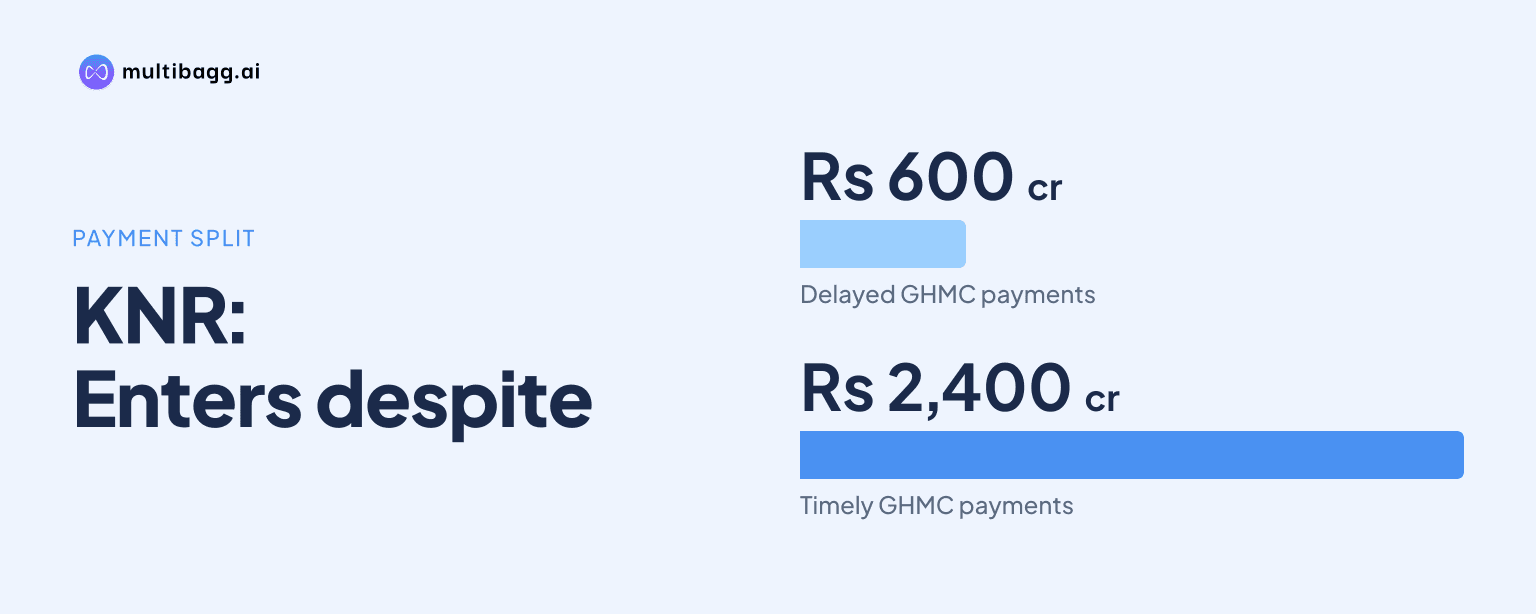
KNR Constructions Limited is entering Hyderabad urban infrastructure because management said lower competition has produced better pricing, despite no mobilisation advances and delayed payments on Rs 600 crore of its cited city portfolio. Management said Rs 2,400 crore of Hyderabad contracts have timely payments and that the broader structural-work portfolio exceeds Rs 5,000 crore.
Know KNR Constructions inside out
Results, valuation, peers and who's buying, in one view.
Why is KNR entering Hyderabad urban projects?
KNR is entering Hyderabad city structures because management said fewer contractors are bidding for this work, allowing it to secure better prices. Management attributed the lower competition to concerns about delayed payments and the lack of mobilisation advances, which are customer payments made before construction begins. KNR said it won Hyderabad work at prices above its internal estimate, but did not disclose project-level margins or completion dates.
The city contracts also give KNR a larger base in structural construction while metro and railway bidding remains tight, according to management. KNR said it has more than Rs 5,000 crore of structural contracts, including a Chennai flyover worth more than Rs 2,000 crore and Hyderabad city contracts worth more than Rs 3,000 crore. Management said its structural teams are fully occupied and have been expanded, limiting the immediate need to pursue metro work simply to establish a presence.
How do KNR's urban projects compare with metro and highway work?
KNR views urban structures as a selective addition to its work mix, while highways remain its main expected source of new orders. Management said it had submitted a railway bid at minus 9%, while the opened bid was minus 30%, illustrating the pricing pressure it sees in railway and metro projects. By comparison, management said Hyderabad work can support the lack of a mobilisation advance because the margin is somewhat higher.
Highways remain central to KNR's year-end award plans. Management set a target of Rs 4,000 crore to Rs 5,000 crore of orders by year-end and said it expected most of those awards to come from highways. It referred to Regional Ring Road work around Hyderabad and an Amaravati outer-ring-road opportunity, and said it had recently studied about 20 to 28 projects. Management said the prospective contracts generally have ticket sizes above Rs 3,000 crore and are mostly under the hybrid annuity model, or HAM.
What payment and working-capital risks does KNR face in Hyderabad?
KNR accepts higher working-capital needs in Hyderabad because management said most city contracts have timely payments, while acknowledging delays in the Greater Hyderabad Municipal Corporation, or GHMC, portion. Management first referred to about Rs 3,000 crore of Hyderabad orders, then described Rs 600 crore of a Rs 3,600 crore city portfolio as having delayed payments from GHMC. It said Rs 2,400 crore of contracts had timely payments, without reconciling the difference between the Rs 3,000 crore and Rs 3,600 crore figures cited during the call.
The immediate issue is the collection cycle from GHMC. Management said GHMC payments had been overdue for three months and that a fourth month was also due, blocking capital in city work. It said it was hearing that payment might arrive by the coming weekend or the following week, which was an expectation rather than a confirmed collection. Management described the Hyderabad Metropolitan Development Authority and Musi Riverfront Development Corporation as having ready funds, whereas it said GHMC funding was less planned.
Got a follow-up? Ask IRIS
How will KNR fund city work, mines and HAM assets?
KNR's management said its cash allocation is constrained by simultaneous spending needs in mining, city work and HAM assets. It cited capital expenditure at the Kusmunda mine and said the Jharkhand mine could require more than Rs 500 crore. Hyderabad flyover projects require higher working capital because KNR must fund mobilisation itself, which management said has delayed decisions on capital-return proposals.
For HAM assets, management said KNR may need to invest about Rs 100 crore from an approximate Rs 500 crore requirement, using equity from existing asset projects and surplus cash first. When asked about the following year, management said the remaining Rs 150 crore could be considered then. The comments indicate that the timing and level of HAM equity investment depend on appointed dates and internally available cash rather than a fixed annual commitment.
KNR also reported Rs 1,300 crore of unbilled revenue, which affects cash conversion across its operating portfolio. Management said irrigation accounted for Rs 830 crore of that amount, with roads and other sectors making up the balance of Rs 470 crore. It put the irrigation order book at Rs 1,600 crore and said about Rs 800 crore would remain as net order book after removing the relevant portion. This compares with the Rs 16,000 crore total order book management cited while discussing its wider funding requirements.
What does KNR's order pipeline say about its strategy?
KNR's strategy is to combine selectively priced city structures with highway and mining opportunities while managing receivable timing. Management said its order book had risen to Rs 16,000 crore and expressed confidence in securing Rs 5,000 crore to Rs 6,000 crore of additional awards, while describing Rs 4,000 crore to Rs 5,000 crore as the minimum range. Those ranges show management's confidence in further wins, but do not amount to a single formal order-inflow target.
The Chennai and Hyderabad structures broaden KNR's execution mix at a time when management said railway and metro pricing is tight. More than Rs 5,000 crore of structures includes projects with no mobilisation advance, increasing the need for internal funding. Management's rationale is that stronger project pricing and payment support from entities other than GHMC can offset that burden, provided land and foundation possession are made available on time.
Conclusion
KNR's disclosed project mix indicates an expansion into urban structures rather than a retreat from highways. The company has more than Rs 5,000 crore of structural work, including Chennai and Hyderabad flyovers, while management still expects highways to provide most of its Rs 4,000 crore to Rs 5,000 crore year-end order target. The central trade-off is better bid pricing against the cost of self-funded mobilisation and delayed receivables.
The next issues to watch are whether GHMC clears dues after the stated three to four months of delay, the award pace for highway projects above Rs 3,000 crore, and cash needs at Kusmunda, Jharkhand and HAM assets. Management also expects to pursue further orders by year-end, but its stated range of Rs 4,000 crore to Rs 6,000 crore leaves the eventual scale of new awards unresolved.