










KNR order book reaches Rs 16,355 crore as mining takes 42%
Key highlights
- KNR’s order book stood at Rs 16,355 crore at September 30, 2026, including recent awards.
- Mining represented 42% of KNR’s backlog, compared with 43% for roads.
- KNR targets Rs 4,000 crore to Rs 5,000 crore of order inflow in H2 FY27.
- KNR’s consolidated debt fell to Rs 1,180 crore at September 30, 2026, from Rs 2,438 crore at March 31, 2026.
powered by IRIS
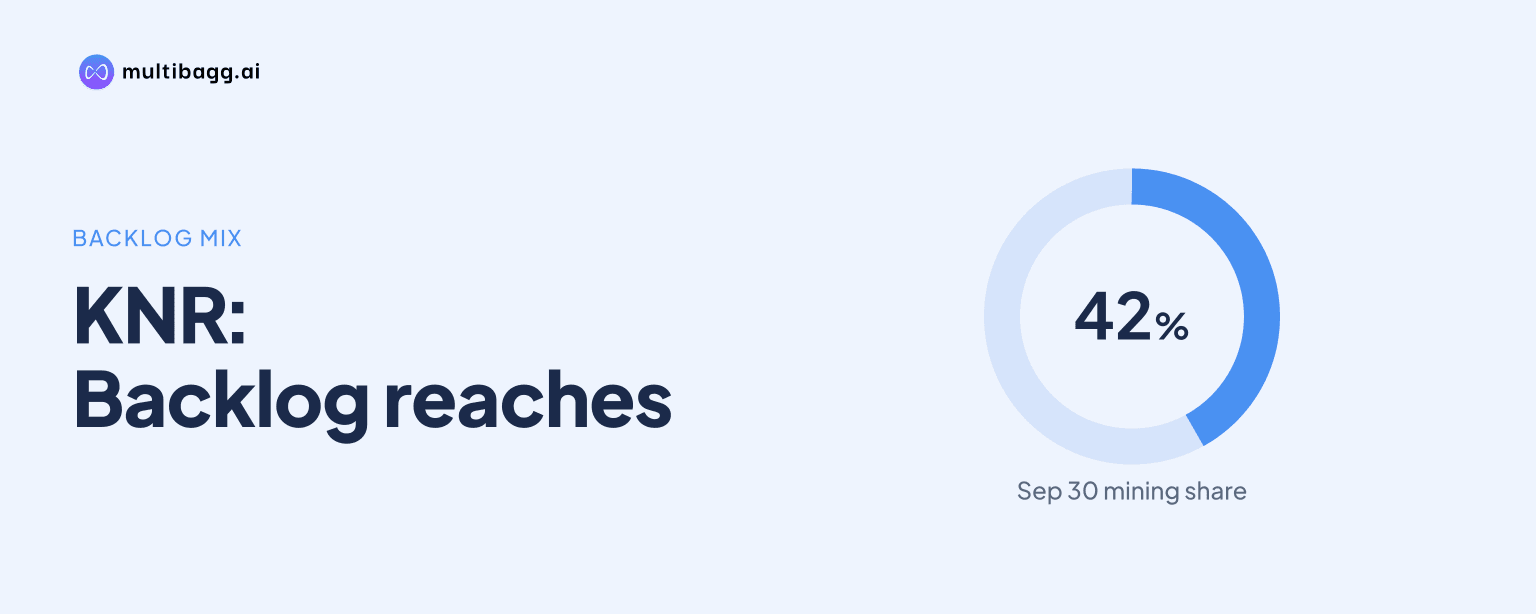
KNR Constructions Limited’s order book stood at Rs 16,355 crore as of September 30, 2026, including recent awards, with mining contributing 42% of the backlog against roads’ 43%. The total was Rs 4,646 crore higher than the reported Rs 11,709 crore balance after adding two hybrid annuity model projects and a Hyderabad elevated-corridor contract.
Know KNR Constructions inside out
Results, valuation, peers and who's buying, in one view.
What makes up KNR’s Rs 16,355 crore order book?
KNR’s Rs 16,355 crore order book includes two recently won hybrid annuity model, or HAM, projects and a Hyderabad Metropolitan Development Authority, or HMDA, corridor project that were not included in the Rs 11,709 crore reported order book at September 30, 2026. The Rs 4,646 crore difference therefore reflects identified project additions rather than a comparison between two reported reporting dates.
Mining accounts for 42% of the expanded backlog, only one percentage point below the 43% road share. Irrigation represents 10% and pipeline work 5%, meaning these three non-road segments together account for 57% of the Rs 16,355 crore total. Management said roads would remain KNR’s core business, while describing mining, urban infrastructure, irrigation and railways as part of a more diversified growth mix.
KNR said third-party clients account for 74% of the Rs 16,355 crore order book, while captive HAM projects account for 26%. Within the total backlog, central government contracts represent 43%, state government contracts 30%, and private-sector clients 1%. The client split leaves the company exposed primarily to public-sector project execution and payment processes.
How long will KNR take to execute the backlog?
KNR expects to execute its current order book over three to three-and-a-half years, excluding the mining project. The exclusion is material because mining is 42% of the backlog, and management did not provide a comparable execution period or annual revenue profile for that segment during the call.
The four HAM projects showed different stages of physical progress at September 30, 2026. Magadi to Somwarpet was about 92% complete and Marripudi to Somavarappadu was about 94% complete, while Mysore to Kushalnagar Package IV and Package V were at 29% and 25%, respectively. The figures show that two projects were nearing completion while the two Mysore packages remained at earlier stages.
KNR is targeting Rs 4,000 crore to Rs 5,000 crore of order inflow in H2 FY27. Management said only about Rs 400 crore of projects were at lowest-bidder, or L1, status at the time of the call, so most of the target requires additional awards rather than conversion of projects already identified as L1.
Which recent projects expanded KNR’s pipeline?
The identified urban-infrastructure award is an HMDA contract to build an elevated corridor from ICCC Banjara Hills to Shilpa Layout Flyover Road in Hyderabad. The Rs 1,396 crore Telangana project has a 24-month construction period, and KNR said it had received a letter of acceptance for the work.
KNR achieved financial closure on October 1, 2026, for KNR Manyamkonda Infra Private Limited, its wholly owned subsidiary for a Telangana HAM project. Across four HAM projects, KNR had invested Rs 193 crore by September 2026 against a revised equity requirement of Rs 396 crore. Management said it planned to infuse a further Rs 117 crore in H2 FY27 and Rs 85 crore in FY28.
Management also said KNR may need about Rs 510 crore of additional equity for Chennai and Telangana National Highways Authority of India HAM projects. This potential requirement is separate from the Rs 202 crore still to be invested in the four HAM projects, although the call did not set a timetable for the additional Rs 510 crore.
Got a follow-up? Ask IRIS
When could mining contribute more revenue to KNR?
Management said the Banhardih mine was likely to start in four to five months from the call and indicated that a more meaningful contribution would come in the following year. This was management’s expectation, not a confirmed start date, and it depends on the project moving into operations as anticipated.
For mining work already under way, management said KNR had recorded about Rs 17 crore of turnover in October and was targeting about Rs 20 crore in the current month. It separately said a roughly Rs 700 crore Gudebellur HAM project had not started because of a royalty implementation issue, despite land being ready. Management expected that issue to be resolved by month-end.
Management cited higher coal activity as support for its mining focus. Coal India offtake rose about 9% year on year to 454.6 million tonnes during April to October FY27, while October production increased 19% year on year. These industry figures support management’s view of opportunity in mining but do not establish KNR’s mining revenue, margins or project commencement schedule.
What could affect KNR’s order-book conversion?
Road conditions remain important because roads account for 43% of KNR’s order book. National highway construction declined around 19% year on year to 2,369 kilometres during April to September 2026, although fresh project awards rose nearly 63% to 2,236 kilometres. Management attributed slower construction to approval timelines, land acquisition challenges and delayed statutory clearances.
KNR reported consolidated revenue of Rs 1,188 crore and earnings before interest, tax, depreciation and amortisation, or EBITDA, of Rs 244 crore in H1 FY27, producing an EBITDA margin of 20.5%. Management retained its FY27 revenue guidance of Rs 2,200 crore to Rs 2,300 crore and said H2 margins could follow a similar pattern, while declining to guarantee a 13% margin for FY28 because of input costs and overheads.
Consolidated debt declined to Rs 1,180 crore at September 30, 2026, from Rs 2,438 crore at March 31, 2026. Working-capital debt stood at 104 days, compared with 78 days in March 2026. Management also said it hoped to receive some irrigation-project payment by the second week of December and that the state was considering payment of about Rs 600 crore, neither of which had been received at the time of the call.
Conclusion
KNR’s Rs 16,355 crore order book changes the prospective mix of its work, with mining at 42% nearly equal to the 43% share held by roads. The Rs 4,646 crore addition to the reported September balance includes HAM and Hyderabad urban-infrastructure awards, while irrigation and pipeline work account for a further 15% of the expanded backlog.
The next points to watch are whether KNR delivers Rs 4,000 crore to Rs 5,000 crore of H2 FY27 order inflow, whether Banhardih starts within management’s indicated four-to-five-month period, and whether irrigation payments materialise. Progress on the Rs 1,396 crore HMDA corridor, the Gudebellur royalty issue and planned HAM equity infusions will also shape the pace of execution.