










KNR Constructions Q2 Profit Includes ₹292 Crore HAM Sale Gain
Key highlights
- KNR Constructions reported ₹600 crore in consolidated Q2 FY27 revenue and ₹147 crore in EBITDA.
- Standalone Q2 FY27 profit of ₹281 crore included a ₹292 crore exceptional HAM asset-sale gain.
- KNR Constructions completed monetization of all four HAM assets to Indus Infra Trust.
- The company targets FY27 order inflows of ₹4,000 crore to ₹5,000 crore against a reported ₹16,355 crore order book.
powered by IRIS
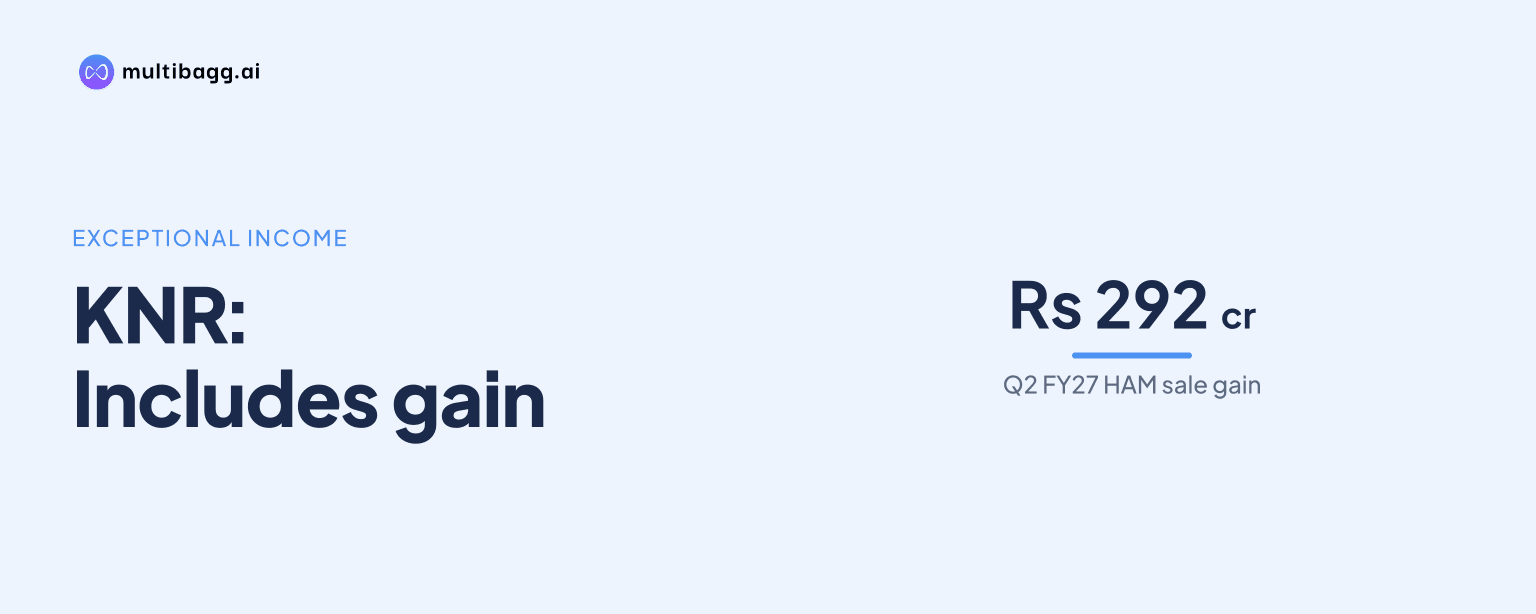
KNR Constructions Limited reported ₹600 crore in consolidated Q2 FY27 revenue, while its standalone reported net profit of ₹281 crore included a ₹292 crore exceptional gain from the sale of a HAM asset to Indus Infra Trust. The result separates underlying construction execution from the accounting effect of asset monetization.
Know KNR Constructions inside out
Results, valuation, peers and who's buying, in one view.
What did KNR Constructions report for Q2 FY27?
KNR Constructions reported standalone Q2 FY27 revenue of ₹477 crore, EBITDA of ₹44 crore and an EBITDA margin of 9.2%. Standalone net profit was ₹281 crore for the quarter. For the first half of FY27, standalone revenue stood at ₹914 crore, EBITDA was ₹109 crore and net profit was ₹563 crore.
On a consolidated basis, KNR Constructions reported Q2 revenue of ₹600 crore, EBITDA of ₹147 crore and an EBITDA margin of 24.6%. Consolidated net profit was ₹102 crore. Consolidated H1 FY27 revenue was ₹1,188 crore, EBITDA was ₹244 crore and net profit was ₹183 crore.
The difference between standalone and consolidated profit figures is important when reviewing the quarter. The company disclosed that the standalone result included an exceptional item linked to a HAM asset transaction, while the supplied call material separately reported the consolidated operating and profit figures.
How did HAM monetization affect the reported profit?
HAM monetization affected KNR Constructions' standalone Q2 profit through a ₹292 crore exceptional gain on the sale of KNR Guruvayur Infra to Indus Infra Trust. Management said the transfer completed the monetization of all four HAM assets to Indus Infra Trust.
The transaction was therefore a significant contributor to the standalone quarterly profit of ₹281 crore. The call summary also described adjusted standalone profit after tax at ₹30 crore, although the supplied excerpts do not provide a detailed reconciliation between each reported metric and the exceptional-gain calculation.
HAM, or hybrid annuity model, projects combine government support during construction with annuity-based payments over the operating period. Monetizing such assets through an infrastructure trust can allow an engineering, procurement and construction company to transfer completed project interests and realise proceeds from the sale.
For investors, the disclosed exceptional gain means the reported standalone profit should be read alongside revenue, EBITDA and margin data. Those operational measures provide a separate view of construction activity during the quarter, while the asset-sale gain relates to monetization of project assets.
What is KNR Constructions targeting for FY27?
KNR Constructions is targeting FY27 order inflows of ₹4,000 crore to ₹5,000 crore. Management said it is pursuing opportunities across roads, irrigation, mining and urban infrastructure, with Southern India remaining its key market.
The company maintained FY27 revenue guidance of ₹2,200 crore to ₹2,300 crore. Management also affirmed a revenue target of more than ₹3,000 crore for the following year during the call, according to the supplied earnings-call summary.
The reported order book was ₹16,355 crore including recently won projects. This figure gives context to management's order-inflow target, though the provided material does not specify a project-wise break-up, execution schedule or the proportion attributable to each business segment.
Management described the pipeline in Southern India as healthy across roads and urban infrastructure. It also referred to diversification into irrigation and mining, indicating that new opportunities are not limited to the company's traditional road-construction activity.
Got a follow-up? Ask IRIS
What operating factors were discussed on the earnings call?
KNR Constructions said Q2 FY27 execution remained subdued and highlighted margin and execution pressures. Its standalone EBITDA margin was 9.2%, based on EBITDA of ₹44 crore on revenue of ₹477 crore, which places the focus on execution performance in addition to the one-time HAM monetization gain.
The company also discussed its mining business context. Coal India offtake during April to October FY27 increased about 9% year-on-year to 454.6 million tonnes, while October production increased 19% year-on-year. KNR Constructions indicated that the Banhardih mine was likely to start in another four to five months.
These Coal India figures are sector data cited during the call rather than KNR Constructions' own financial performance. They provide context for mining activity and for the company's stated interest in a broader mix of infrastructure and mining opportunities.
What does the quarter mean for KNR Constructions investors?
KNR Constructions' quarter combines two separate developments: construction operations generated standalone revenue of ₹477 crore and EBITDA of ₹44 crore, while HAM monetization produced a disclosed exceptional gain of ₹292 crore. This distinction matters because exceptional proceeds do not measure recurring project execution in the same way as revenue and EBITDA.
The completed sale of all four HAM assets to Indus Infra Trust marks the end of the disclosed monetization programme for these assets. At the same time, management has retained its revenue guidance and set an FY27 order-inflow target of ₹4,000 crore to ₹5,000 crore, making order awards and execution the disclosed business markers for the rest of the year.
The company is also seeking opportunities across roads, irrigation, mining and urban infrastructure. The available call material does not provide a forecast for profitability, project margins or future share-price performance, so the disclosed figures should not be treated as a projection of those outcomes.
Conclusion
KNR Constructions' Q2 FY27 results show that reported standalone profit was materially shaped by a ₹292 crore gain from the sale of KNR Guruvayur Infra to Indus Infra Trust. Consolidated revenue was ₹600 crore and consolidated EBITDA margin was 24.6%, while standalone revenue and EBITDA margin were ₹477 crore and 9.2%, respectively.
The next disclosed items to watch are progress toward the ₹4,000 crore to ₹5,000 crore FY27 order-inflow target, delivery against ₹2,200 crore to ₹2,300 crore revenue guidance, and the indicated four-to-five-month timeline for the Banhardih mine to start.