










KNR expects Rs 600 crore Telangana irrigation dues by March
Key highlights
- KNR reported Rs 660 crore of irrigation receivables, mainly linked to Kaleshwaram Package IV.
- Management said Telangana was considering an irrigation payment of about Rs 600 crore by March.
- KNR's working-capital debt measure was 104 days on September 30, 2026, versus 78 days in March 2026.
- KNR plans around Rs 400 crore of FY27 capital expenditure, including Rs 300 crore to Rs 320 crore for mining.
powered by IRIS
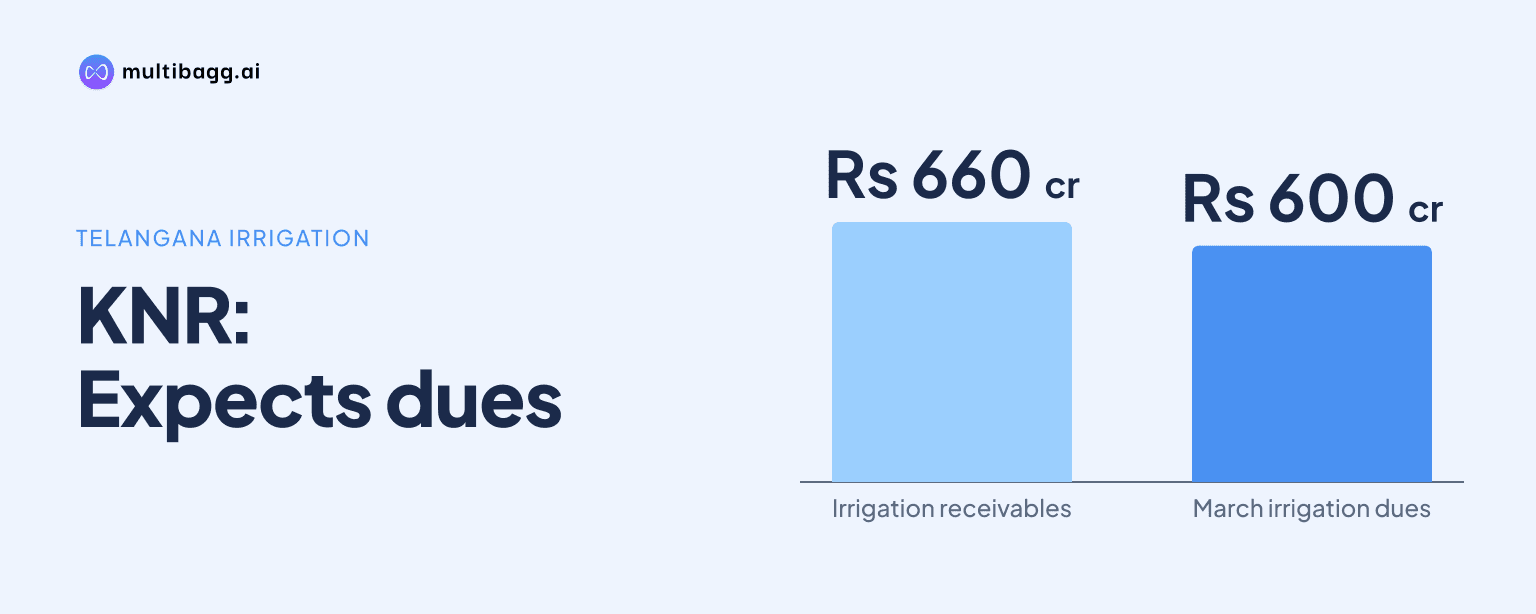
KNR expects Telangana to release about Rs 600 crore of irrigation dues by March, against Rs 660 crore of outstanding irrigation receivables reported in Q2 FY27. Management said the proposed payment mainly concerns certified bills for Kaleshwaram Package IV and could address part of a working-capital debt measure that rose to 104 days on September 30, 2026.
Know KNR Constructions inside out
Results, valuation, peers and who's buying, in one view.
How much Telangana irrigation money does KNR expect by March?
KNR expects Telangana to consider paying around Rs 600 crore by March, but management did not describe the amount as approved, received or contractually committed. In response to an analyst's question, management said it was considering this payment and separately said it hoped to receive some amount in the second week of December.
Management said the Finance Minister had committed to pay because of water shortages in Hyderabad, while also asking investors to wait three to four weeks for clarity on collections. The call does not confirm that any irrigation payment had been received by the time of the Q2 FY27 discussion. Therefore, the Rs 600 crore is management's collection expectation rather than a reported cash inflow.
The expected amount is close to the Rs 660 crore irrigation receivable KNR reported, though it is Rs 60 crore lower. Management said the balance related to retention money, called RE in the discussion, would require a further three to four months after release and then about two additional months to become ready. A March collection would therefore not necessarily settle all irrigation-related amounts.
What receivables does KNR have outstanding?
KNR reported Rs 660 crore of irrigation receivables, Rs 330 crore from hybrid annuity model, or HAM, projects, and Rs 1,400 crore including unbilled amounts. Management identified Kaleshwaram Package IV as the principal component of the irrigation amount and said it was pursuing the Telangana government for release of certified billings.
KNR distinguished the HAM balance from the irrigation dues. Management said the parent company can seek bank disbursements from HAM special-purpose vehicles, or SPVs, based on its funding position, and said there were no challenges in obtaining money from those assets. The irrigation balance, in contrast, depends on payments being released by the state government.
The Rs 1,400 crore figure includes unbilled amounts and should not be treated as equivalent to immediately collectible trade receivables. The call did not provide separate ageing, certification status or collection dates for the Rs 330 crore HAM amount. It did, however, specifically link the Rs 660 crore irrigation balance to completed and near-completed work in Telangana.
How do irrigation dues affect KNR's working capital?
KNR's working-capital debt measure rose to 104 days on September 30, 2026, from 78 days in March 2026. That was an increase of 26 days while the company reported Rs 660 crore in irrigation receivables, although management did not quantify how much of the increase resulted from the pending Telangana bills.
A release of certified irrigation bills would convert part of the reported receivable into cash, but KNR gave no revised working-capital-days target or debt-reduction estimate tied to the potential Rs 600 crore collection. Management instead highlighted that retention money would follow a longer process, separating the expected certified-bill release from a full resolution of the account.
KNR reported consolidated debt of Rs 1,180 crore on September 30, 2026, compared with Rs 2,438 crore on March 31, 2026. Management also reported consolidated net debt to equity of 0.22 times on June 30, 2026, versus 0.49 times on March 31, 2026. Debt declined across those periods, while the working-capital measure increased from the March level.
Got a follow-up? Ask IRIS
Why is irrigation revenue low despite KNR's large receivables?
Irrigation generated about 2% of KNR's quarterly revenue mix despite the Rs 660 crore receivable because most of the irrigation portfolio is already complete. Management said irrigation turnover was Rs 10 crore in Q2 FY27 and around Rs 20 crore in the first half of FY27.
Road engineering, procurement and construction, or EPC, accounted for 28% of quarterly revenue, HAM projects for 48%, and back-to-back subcontract work for 21%. This mix shows that current construction activity is concentrated outside irrigation, even as irrigation represents a significant reported receivable balance.
Management said remaining irrigation work was around Rs 100 crore, with major work principally in Package III. Package III had an order book of Rs 329 crore, but KNR expected to execute only Rs 50 crore to Rs 60 crore in the remaining six months of FY27 because land had only recently been provided. The receivables issue is thus largely related to work already completed rather than a large future irrigation execution pipeline.
What funding needs will compete with KNR's collections?
KNR expects total capital expenditure of around Rs 400 crore in FY27, including Rs 300 crore to Rs 320 crore for mining assets. It spent around Rs 220 crore in the first six months, of which about Rs 180 crore was for mining and Rs 40 crore related to roads and other assets.
Management said the Kusmunda mine could require about Rs 500 crore of investment in total. It said Rs 370 crore to Rs 380 crore had already been spent, with another Rs 60 crore to Rs 70 crore and about Rs 120 crore for electric vehicles discussed as further requirements. Banhardih could require another Rs 500 crore if it starts, taking the two-mine requirement to about Rs 1,000 crore.
HAM equity also requires funding. KNR said four assets had an equity requirement of Rs 395 crore, of which Rs 192 crore had already been included, leaving Rs 202 crore. Management expected about Rs 110 crore of this balance in FY27 and Rs 85 crore in FY28. Two additional HAM projects in ECR Chennai and Telangana have a separate Rs 510 crore equity requirement, depending on appointed dates.
Management said asset-monetisation proceeds would be used for mining capital expenditure and HAM equity investment. It did not allocate the possible Rs 600 crore Telangana collection to a specific use. As a result, the call does not establish how much of any collection would be applied to working capital, mine equipment or HAM equity.
What is KNR's broader FY27 execution outlook?
KNR maintained its earlier revenue guidance of Rs 2,200 crore to Rs 2,300 crore for FY27 and more than Rs 3,000 crore for the following year. Management said it did not want to change the outlook because expected order inflows remained in line with the assumptions underlying its guidance.
Management said margins had declined because of higher overheads, lower turnover, underutilised equipment, input-price changes and inflation. It did not guarantee an analyst's suggestion of a 13% earnings before interest, tax, depreciation and amortisation, or EBITDA, margin for FY28. Standalone Q2 FY27 EBITDA was Rs 44 crore on revenue of Rs 477 crore, equivalent to a 9.2% margin.
Mining is expected to add to future activity, but its timing remains conditional. Management said Banhardih had not started and could take another four to five months, while it targeted about Rs 100 crore of mining turnover in the remaining six months of FY27. The planned start of mining and the receipt of irrigation dues are therefore separate moving parts in KNR's execution and funding plans.
Conclusion
KNR's expected Rs 600 crore Telangana payment is material because it nearly matches the Rs 660 crore irrigation receivable balance, which management mainly linked to Kaleshwaram Package IV. The potential collection comes as irrigation construction contributes only 2% of quarterly revenue, while the company funds mining assets and planned HAM equity commitments.
The next disclosures to watch are whether KNR receives the amount it expected in December, whether a major portion of certified irrigation bills is collected by March, and whether Banhardih begins within management's four-to-five-month estimate. The appointed dates for the ECR Chennai and Telangana HAM projects also matter because they determine when the separate Rs 510 crore equity requirement may begin.