










KP Green Engineering debt rises to Rs 447 crore in H1 FY27
Key highlights
- KP Green Engineering’s total debt rose to Rs 447 crore at September 2026 from Rs 196 crore a year earlier.
- Fixed assets more than doubled to Rs 695 crore at September 2026 from Rs 330 crore.
- H1 FY27 total income rose 27% to Rs 682 crore, while EBITDA increased 17% to Rs 119 crore.
- KP Green Engineering ended September 2026 with an order book of Rs 1,892 crore.
powered by IRIS
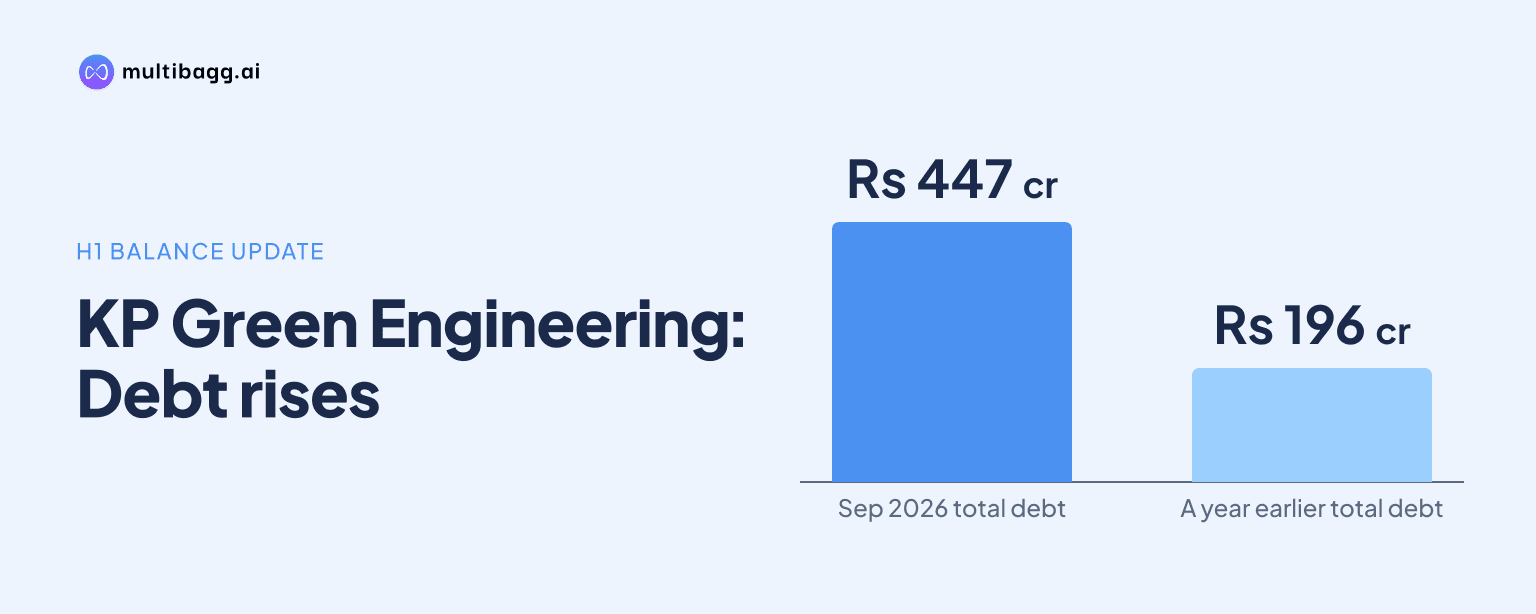
KP Green Engineering Limited reported total debt of Rs 447 crore at September 30, 2026, versus Rs 196 crore a year earlier, as fixed assets more than doubled to Rs 695 crore from Rs 330 crore during its manufacturing-capacity build-out; debt-to-equity increased to 0.91 times from 0.50 times.
Know KP Green Engineering inside out
Results, valuation, peers and who's buying, in one view.
Why did KP Green Engineering’s debt rise in H1 FY27?
KP Green Engineering’s debt rose as the company added manufacturing capacity and incurred higher capital expenditure, according to management. Total debt was Rs 447 crore at the end of September 2026, Rs 251 crore above the Rs 196 crore reported a year earlier, while management described H1 FY27 as a period of building for the future.
The increase in borrowings accompanied a substantially larger fixed-asset base. Fixed assets stood at Rs 695 crore at September 2026, up Rs 365 crore from Rs 330 crore a year earlier, while net worth increased Rs 109 crore to Rs 491 crore from Rs 382 crore. Fixed assets therefore grew faster in absolute terms than net worth during the period.
Management did not provide a breakdown of the Rs 447 crore debt by maturity, interest rate or instrument. It said the enlarged manufacturing platform had capacity of about 4 lakh tonnes and served 23 products across renewables, power and transmission, telecom, railways, roads and highways, and buildings.
How did KP Green Engineering’s leverage change after the asset build-out?
KP Green Engineering’s debt-to-equity ratio increased to 0.91 times at September 2026 from 0.50 times a year earlier. The ratio rose because total debt reached Rs 447 crore while net worth was Rs 491 crore, despite the latter increasing from Rs 382 crore over the same period.
The expanded asset base includes the Matar facility, which management said covers about 55 acres and has galvanising capacity of 90,000 tonnes a year. The facility has a 15-tonne single-dip galvanising kettle, and management said the company’s aggregate manufacturing capacity was about 4 lakh tonnes.
Management linked the investment cycle to higher depreciation and interest costs, which it said reduced profit after tax, or PAT, in H1 FY27. It said these costs should reduce as installed capacity is utilised more fully and PAT normalises, but it did not specify a date or quantify the expected decline in either cost.
What happened to KP Green Engineering’s profit and cash generation?
KP Green Engineering reported PAT of about Rs 32 crore in H1 FY27, compared with Rs 58 crore in FY26 as stated by management, despite total income increasing 27% to Rs 682 crore from Rs 536 crore in H1 FY26. Management attributed the lower PAT to higher depreciation and interest costs following capacity additions.
Earnings before interest, tax, depreciation and amortisation, or EBITDA, rose 17% to Rs 119 crore from Rs 102 crore, slower than total-income growth of 27%. EBITDA margin was about 17.4%, profit before tax was Rs 50 crore, earnings per share were Rs 6.9 for the half year, and cash profit increased 11% to Rs 75 crore.
Management also said the working-capital cycle had stretched amid higher capital expenditure, sales and turnover. It cited lower trade payables and retention that can delay customer receipts, and said it would seek to shorten the cycle, with an expectation of positive operating cash flow from the next H1.
Got a follow-up? Ask IRIS
Can KP Green Engineering improve utilisation of its new capacity?
KP Green Engineering said overall capacity utilisation was about 40% to 50% during the November 2026 call and management expected it to reach about 70% next year. Management said rapid expansion over the past three years meant that obtaining, executing and efficiently completing sufficient orders would take time.
The galvanising plant had moved to utilisation above 50%, from 35% to 40% previously, according to management. It expected the plant to reach 70% utilisation by the end of the financial year, although it said higher gas and zinc prices during the preceding six months had increased costs.
Order execution is central to the utilisation plan. KP Green Engineering ended September with an order book of Rs 1,892 crore and announced about Rs 770 crore of orders during the period, comprising about Rs 240 crore in July, Rs 258 crore in August and Rs 270 crore in October. Management said current orders generally take 12 to 15 months to execute.
What are KP Green Engineering’s plans after H1 FY27?
KP Green Engineering plans to execute its Rs 1,892 crore order book on time, improve asset utilisation and translate its capacity additions into profitability, management said. It also said it could add further capacity because of demand and its capabilities, without disclosing capital cost, funding mix or timing.
Management identified potential adjacent metal-product expansions, including a hot rolling mill, onshore-offshore tubular towers, container manufacturing, cables and conductors, and aluminium extrusion. It also said its Rs 819 crore Bharat Sanchar Nigam Limited order covers supply and erection at about 1,280 sites under the Bharat Sanchar Nigam Limited 4G saturation project.
For FY27, management said it expected turnover of about Rs 1,700 crore to Rs 1,800 crore and higher growth in H2 after a slower H1. It also referred to the KP 3.0 target of a 25% compound annual growth rate for the next five years across group companies, including KP Green Engineering; these are management expectations rather than reported results.
Conclusion
KP Green Engineering’s H1 FY27 results show that the balance sheet has expanded sharply alongside manufacturing capacity. Fixed assets increased by Rs 365 crore to Rs 695 crore and total debt by Rs 251 crore to Rs 447 crore, while income and EBITDA rose but PAT was affected by the higher depreciation and interest costs identified by management.
The next disclosures to watch are management’s target of about 70% overall capacity utilisation next year, 70% galvanising-plant utilisation by the financial year-end, and execution of orders over the stated 12-to-15-month cycle. Management also expects positive operating cash flow from the next H1 and FY27 turnover of about Rs 1,700 crore to Rs 1,800 crore.