










KP Green Engineering plans Rs 300 crore expansion capex
Key highlights
- KP Green Engineering plans about Rs 300 crore of capex over the next 18 months.
- A promoter has committed about Rs 100 crore, including Rs 25 crore expected within 30 to 60 days after process completion.
- KP Green Engineering expects tubular-tower capex to begin in the next financial year after purchasing land.
- Management expects galvanising utilisation to reach 70% by year-end, from above 50% currently.
powered by IRIS
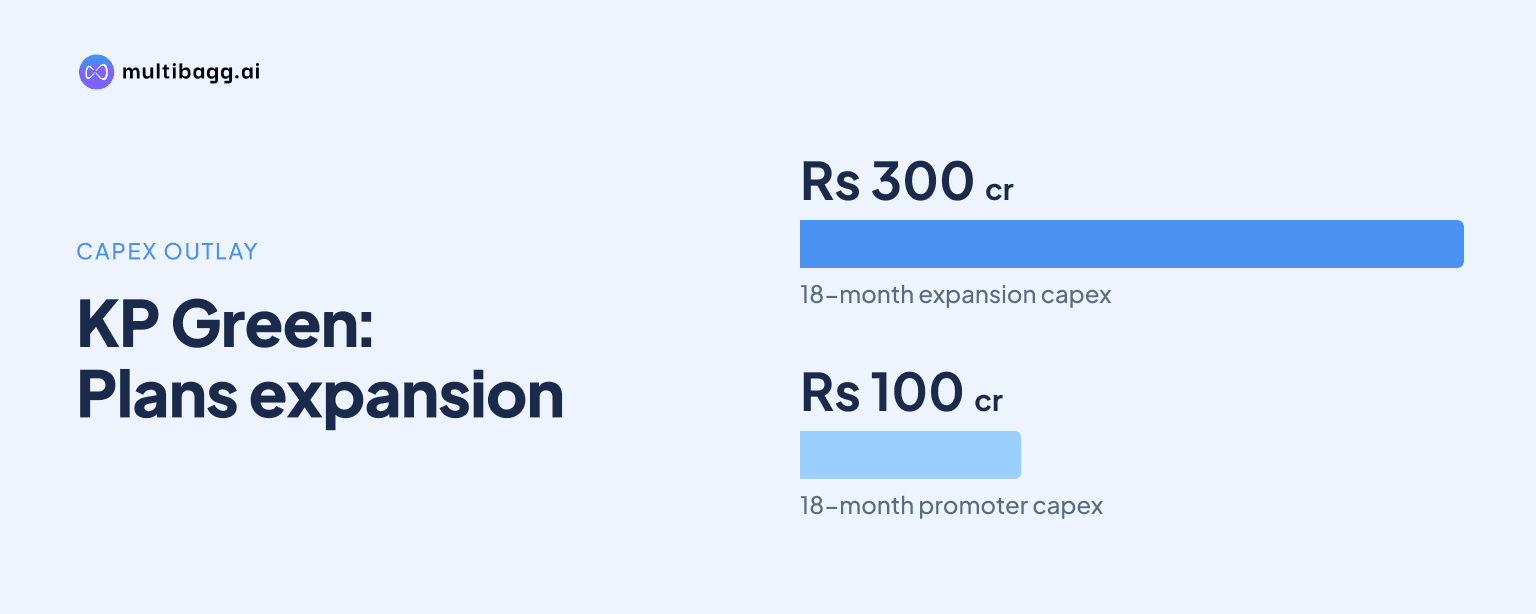
KP Green Engineering plans about Rs 300 crore of capital expenditure over the next 18 months to develop a hot-rolling mill and tubular-tower products, with management saying debt and equity will fund the expansion. A promoter has committed about Rs 100 crore, including Rs 25 crore expected after completion of the process within 30 to 60 days.
Know KP Green Engineering inside out
Results, valuation, peers and who's buying, in one view.
What does KP Green Engineering's Rs 300 crore capex cover?
KP Green Engineering expects about Rs 300 crore of capex during the next 18 months for its manufacturing expansion, although management did not give a project-wise allocation or a fixed spending schedule. In response to a question on H2 expenditure, management said it could not specify how much capex would fall in that half year or how the programme would be sized.
The two disclosed product areas are a hot-rolling mill and onshore and offshore tubular towers. Management said it had already purchased land for the tubular-tower project and expected that capex to begin in the next financial year. The programme therefore includes an identified overall outlay, but not a disclosed commissioning date, capacity figure or revenue contribution for either new facility.
Management linked the Rs 300 crore programme to adding product categories over the next two to three years, rather than describing it as maintenance expenditure. It did not disclose vendor selection, construction milestones, installed capacity or customer commitments for the hot-rolling mill and tubular-tower facilities.
How would KP Green Engineering's hot-rolling mill affect raw-material sourcing?
KP Green Engineering says the hot-rolling mill would allow it to produce in-house material that it currently purchases from the market. Muinulhaque Kadva said the company would use working capital now deployed for external raw-material purchases in its own rolling-mill operation instead.
Management's stated objective is greater control over raw materials, operations and pricing. Kadva said an owned mill could help the company optimise operations and protect its price and margin position when markets are stable. This is management's intended mechanism, not a forecast of savings, because the call did not quantify mill throughput, input-cost reductions or a future margin target.
The case for greater input control follows cost pressure at the galvanising business during the preceding six months and the last quarter. Management said geopolitical developments had increased zinc and gas prices. It said the Indian Electrical and Electronics Manufacturers' Association, or IEEMA, price-variation formula allowed substantial recovery of those increases, but also said overall costs had risen.
Why is KP Green Engineering adding tubular towers?
KP Green Engineering is entering tubular towers to address larger wind-turbine models, including 5.4-megawatt models cited by management. Kadva said newer wind models are coming in tubular-tower formats, while the company already manufactures lattice structures, described on the call as hybrid towers.
The company said it could start tubular towers “very soon” and identified both onshore and offshore applications as future product areas. However, management did not say whether the initial project would serve both markets from the outset. It also did not disclose a tubular-tower order book, certification plan, annual capacity or first-delivery timing.
The expansion is being planned while existing facilities are still ramping up. Management said overall capacity utilisation was about 40% to 50% currently and expected it to reach about 70% next year. Separately, galvanising utilisation rose from 35% to 40% earlier to above 50%, and management expects it to reach 70% by the end of the year.
Got a follow-up? Ask IRIS
How will KP Green Engineering fund the expansion?
KP Green Engineering says debt as well as equity will be required for its expansion path, and the disclosed promoter commitment is about Rs 100 crore. Management said Rs 25 crore would come after the process is completed within 30 to 60 days, while the promoter has about 18 months to provide the remaining Rs 75 crore and may contribute it earlier.
Management did not disclose a debt-equity ratio, borrowing cost, repayment schedule or separate debt amount for the projects. In discussing the 18-month programme, Kapil Kriplani referred to “Rs 300 crore of debt,” but the call did not clearly establish whether this was a separate borrowing target or financing connected with the stated Rs 300 crore capex plan. The precise debt requirement is therefore unresolved.
The financing discussion also occurred against elevated depreciation and financing costs. An investor referred to depreciation of about Rs 28 crore in H1 and interest plus depreciation of almost Rs 65 crore in H1. Management did not independently confirm those figures, but said depreciation would mostly remain on similar lines in H2 and that unchanged interest and depreciation could support better profit after tax, or PAT.
What operating outlook accompanies KP Green Engineering's capex plan?
KP Green Engineering's management expects full-year turnover of about Rs 1,700 crore to Rs 1,800 crore and guided to a PAT margin of 5% to 7% for the next two quarters. It attributed the cautious profitability outlook to uncertainty around zinc, gas and other raw-material prices rather than predicting that input costs would decline in H2.
Management nevertheless expects H2 sales to be better than H1. It confirmed an investor's calculation that H2 revenue would be about Rs 1,000 crore to Rs 1,200 crore if turnover reaches Rs 1,800 crore for the full year. Current orders generally execute over 12 to 15 months, and management said it aims to retain roughly 12 to 15 months of orders for at least 12 months of visibility.
Management also said it is striving for a compound annual growth rate, or CAGR, of 25% for the next five years and expects to provide more granular guidance in Q4. That target is management's stated aspiration and is not a project-specific forecast. The call did not quantify contributions from hot rolling, tubular towers, galvanising utilisation or overseas orders to the 25% CAGR objective.
Conclusion
KP Green Engineering's Rs 300 crore, 18-month capex plan would move part of its materials process in house through hot rolling and add tubular towers to its wind-product range. The company has explained the strategic rationale of raw-material control and access to larger turbine formats, but has not disclosed project allocation, capacity, commissioning dates or detailed debt terms.
The next disclosed milestones are the initial Rs 25 crore promoter contribution within 30 to 60 days after process completion, the remaining Rs 75 crore within about 18 months, and the expected start of tubular-tower capex in the next financial year. Management's planned Q4 guidance, the targeted 70% galvanising utilisation by year-end and any clarification of debt funding will provide further measures of execution.