










KP Green Engineering Revenue Rises 28% to ₹679 Crore
Key highlights
- KP Green Engineering reported H1 FY27 revenue from operations of ₹678.8 crore, up 27.6% year-on-year.
- Total income rose 27% to ₹682 crore and EBITDA increased 17% to ₹119 crore in H1 FY27.
- Reported H1 FY27 net profit declined 41% to ₹34.4 crore from ₹58.3 crore a year earlier.
- KP Green Engineering’s order book stood at ₹1,892 crore on September 30, 2026.
powered by IRIS
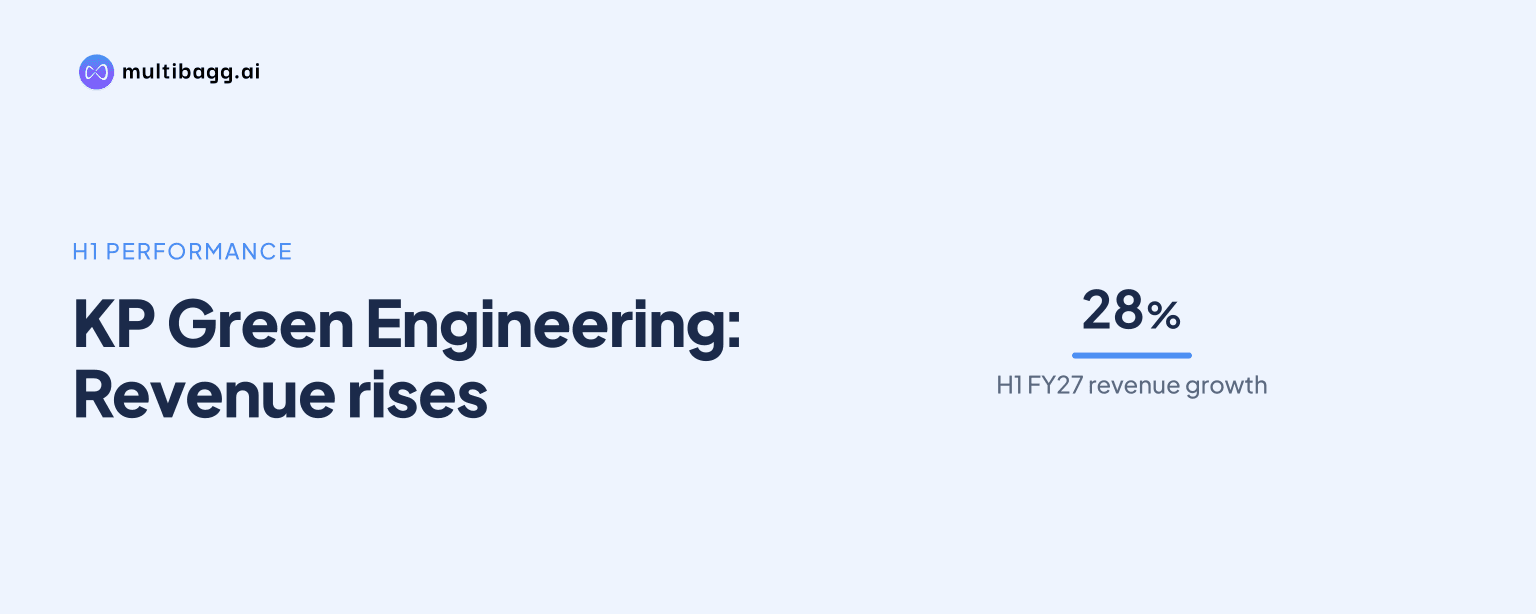
KP Green Engineering Limited reported consolidated revenue from operations of ₹679 crore for H1 FY27, up 28% year-on-year, supported by manufacturing expansion and demand across renewable energy, transmission, telecom and infrastructure projects. Total income rose 27% to ₹682 crore and the order book stood at ₹1,892 crore on September 30, 2026.
Know KP Green Engineering inside out
Results, valuation, peers and who's buying, in one view.
What did KP Green Engineering report for H1 FY27?
KP Green Engineering reported broad-based growth in revenue and operating earnings for the half year ended September 30, 2026. Revenue from operations was ₹678.8 crore, compared with ₹532.1 crore in H1 FY26, representing a 27.6% increase. The company rounded this figure to ₹679 crore in its communication.
Total income increased to ₹682 crore from ₹536 crore a year earlier, a rise of 27%. EBITDA rose 17% to ₹119 crore from ₹102 crore. The company said cash profit increased 11% to ₹75 crore, compared with ₹67 crore in the corresponding half of the preceding financial year.
The financial update was issued in November 2026 following the close of the September quarter. KP Green Engineering is the design, engineering, fabrication and galvanising arm of KP Group, serving projects in renewable energy, transmission, telecom and infrastructure.
How did the company’s profit and margins change?
KP Green Engineering’s profit after tax declined despite higher revenue and EBITDA. The consolidated results cited net profit of ₹34.4 crore for H1 FY27, against ₹58.3 crore in H1 FY26, a year-on-year decline of 41%.
The earnings-call transcript described profit after tax as about ₹32 crore, compared with ₹58 crore in H1 FY26. The company’s consolidated-results summary provides the more precise reported net profit figure of ₹34.4 crore. Profit before tax was ₹49.7 crore, compared with ₹78.4 crore a year earlier.
The results summary showed an operating margin of 7.3% for H1 FY27, versus 14.6% in H1 FY26. Separately, the company reported EBITDA of ₹119.35 crore and an EBITDA margin of 17.6%. These measures are presented differently in the supplied results material and should not be treated as directly interchangeable.
What supported KP Green Engineering’s revenue growth?
KP Green Engineering attributed its H1 FY27 progress to expanding manufacturing capacity, a growing third-party customer base and work across several end markets. Its offerings include design, engineering, fabrication and galvanising, with project exposure to renewable energy, transmission, telecom and infrastructure.
During the earnings call, the company referred to supplies including bridges, coverage towers and crash barriers. These activities widen its presence beyond a single end-market and link revenue to infrastructure-related project execution as well as energy-sector demand.
The 28% increase in revenue was stronger than the 17% rise in EBITDA. The difference indicates that operating earnings did not grow at the same pace as revenue during the period. The reported decline in net profit also means investors need to assess revenue growth alongside profitability trends rather than revenue alone.
Got a follow-up? Ask IRIS
What does the ₹1,892 crore order book indicate?
KP Green Engineering closed H1 FY27 with an order book of ₹1,892 crore as of September 30, 2026. This order book represents work secured by the company across its operating segments and provides visibility into the projects it is positioned to execute.
The order book was nearly 2.8 times H1 FY27 revenue from operations of ₹678.8 crore. This comparison is based on a half-year revenue figure and does not establish when individual orders will be executed or recognised as revenue.
Management also referred to a longer-term 25% growth objective during the earnings call. However, the supplied material does not provide a granular revenue, margin or execution timetable linked to that objective. The order book will therefore remain relevant for tracking how the company translates secured work into sales and earnings.
What should investors note from the H1 FY27 results?
KP Green Engineering’s H1 FY27 results show a company delivering higher sales and EBITDA while reporting lower net profit. The gap between operating growth and bottom-line performance is important because net profit fell from ₹58.3 crore to ₹34.4 crore even as total income rose by ₹146 crore.
The investor-presentation summary also cited debt of ₹447 crore and stated that debt had more than doubled. The supplied information does not provide the comparable debt figure or the reasons for the change. As a result, the stated debt level can be noted, but a detailed assessment of leverage movement is not possible from the available disclosures.
For customers and industry participants, the higher order book and capacity expansion point to continuing project activity in the company’s served sectors. For shareholders, the key reported measures are the pace of order execution, operating profitability, net-profit performance and debt disclosed in subsequent financial updates.
Conclusion
KP Green Engineering delivered 28% year-on-year revenue growth to ₹679 crore in H1 FY27 and increased EBITDA by 17% to ₹119 crore. Its ₹1,892 crore order book supports visibility across renewable energy, transmission, telecom and infrastructure work, but the 41% decline in reported net profit makes profitability a central part of the result.
The next points to watch are the conversion of the September 30, 2026 order book into revenue, progress on manufacturing capacity expansion and management’s stated long-term 25% growth objective. Future disclosures on margins, net profit and the cited ₹447 crore debt level will provide additional context on financial performance.