










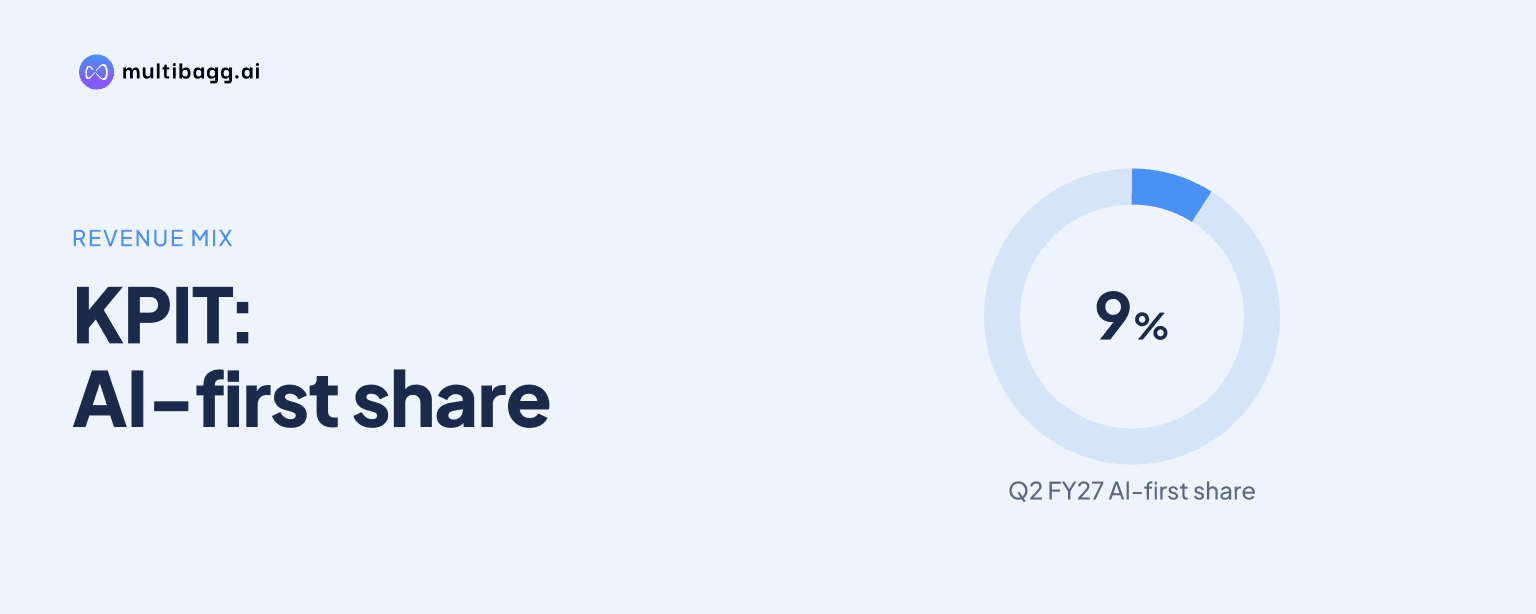
KPIT says AI-first projects made up 9% of Q2 FY27 total revenue
Key highlights
- KPIT said AI-first projects contributed roughly 9% of Q2 FY27 total revenue.
- KPIT reported more than 9,000 AI-platform users and more than 5 million quarterly transactions.
- Fixed-price projects reached about 70% of KPIT’s work in Q2 FY27.
- KPIT’s EBITDA margin rose 60 basis points from 17.2% to 17.8%.
powered by IRIS
KPIT Technologies Limited said projects centred on artificial intelligence, or AI, which management calls AI-first, made up roughly 9% of total revenue in Q2 FY27 ended September 30, 2026, while fixed-price work reached about 70% and its AI platform recorded more than 5 million quarterly transactions.
Know KPIT Technologies inside out
Results, valuation, peers and who's buying, in one view.
How large is KPIT’s AI-first revenue contribution?
AI-first projects accounted for roughly 9% of KPIT’s total revenue in Q2 FY27, according to management. KPIT distinguished this share from the wider use of AI across its operations: management said AI was used in almost every project and product, but classified as AI-first only solutions based on AI that make a significant differentiation for the client. The company also uses that distinction in its go-to-market activity.
The 9% figure therefore measures a narrower category than general AI-assisted delivery. Management said this revenue contribution should rise significantly, but did not disclose a numerical target or timetable. The metric ties AI to client solutions and reported revenue rather than solely to employee tools, training or internal experiments.
KPIT’s product business provides a related measure of its changing mix. Product revenue grew 5% quarter-on-quarter and 25% year-on-year in Q2 FY27, while services revenue was flattish, management said. KPIT did not quantify the product-revenue base or state that AI caused the full increase, but said greater product contribution affected profitability.
How widely is KPIT using its AI platform?
KPIT reported more than 9,000 users of its overall AI platform, more than 5 million transactions during Q2 FY27 and 12,000 engineering agents built. These are measures of operating adoption rather than separate revenue disclosures, since the call did not specify what proportion of transactions was client-facing or provide prior-quarter figures for users, transactions or agents.
Management said it had begun using the platform in many services and solutions delivery engagements. It said clients had appreciated the change and identified AI-native deliveries and AI products as areas of focus. KPIT’s stated delivery mechanism is the use of AI in projects, where management expects productivity gains and more differentiated client solutions.
Beacon is central to this product approach, according to management. KPIT said Beacon had been well received and formed the basis for almost all of its products, while it also planned to take Beacon to market in due course. The call did not disclose Beacon revenue, customer numbers or a launch date, so its financial contribution cannot be separated from the roughly 9% AI-first revenue share.
Got a follow-up? Ask IRIS
Why does fixed-price work matter to KPIT’s AI plan?
Fixed-price projects had moved to about 70% of KPIT’s work in Q2 FY27, management said. KPIT described that proportion as important because it sees fixed-price engagements as those where it can capture both productivity and differentiation as AI use expands. Management did not provide a comparable fixed-price percentage for an earlier quarter.
The pricing mix sits alongside a reported profitability change. KPIT said its earnings before interest, tax, depreciation and amortisation, or EBITDA, margin rose from 17.2% to 17.8%, an increase of 60 basis points, largely because products contributed more than services and solutions. Management did not attribute the full margin movement to AI or fixed-price contracts, so the call supports a business-mix link rather than a direct AI-margin calculation.
KPIT continued to invest in technology during the quarter while maintaining Rs 620 crore of net cash. Management said net cash declined partly after a Rs 140 crore dividend payment and an initial Cymotive acquisition payment of about Rs 100 crore. These movements show that the company is pursuing its AI and product plans alongside shareholder distributions and acquisitions, rather than presenting AI solely as a cost-saving programme.
What business conditions frame KPIT’s AI rollout?
KPIT’s overall revenue grew 6.5% year-on-year and 1% quarter-on-quarter in rupee terms in Q2 FY27. In constant currency, which excludes exchange-rate movements, growth was 0.2% year-on-year and 0.5% quarter-on-quarter. Management had expected a flatter constant-currency quarter, placing the AI metrics within a period of comparatively muted company-wide growth.
The operating outcome varied by vehicle segment. Off-highway and commercial-vehicle revenue grew 27% year-on-year and 17.6% quarter-on-quarter, while passenger-car revenue declined about 8% year-on-year and 4% sequentially. Management said two top accounts affected by programme cancellations or spending cuts represented 13% of total revenue, while growth in off-highway, commercial vehicles and products made up for that decline.
KPIT said 89% of its wins came from target accounts and described its pipeline as active, although realization was taking time. It identified autonomy, connected technologies and IDART among the areas of its wins. Management also said it was creating offerings for Energytech and deep tech, expecting early successes in two to three quarters but cautioning that meaningful revenue contribution would take longer.
Conclusion
KPIT’s Q2 FY27 disclosures indicate that AI has moved beyond broad internal adoption into a defined revenue category, with AI-first projects contributing roughly 9% of revenue and fixed-price work comprising about 70% of the portfolio. More than 9,000 platform users, over 5 million quarterly transactions and 12,000 engineering agents provide scale indicators, while the 60-basis-point EBITDA-margin increase was attributed largely to a higher product mix.
The next checkpoint is Q4, when management said it would provide clearer parameters for tracking the strategy in the following year. Investors can also watch whether the two accounts representing 13% of total revenue bottom out over the next couple of quarters, whether product reporting becomes more detailed, and whether Energytech and deep-tech offerings generate the early successes management expects in two to three quarters.