










KPIT Expects Europe Consolidation to Expand Its Wallet Share
Key highlights
- KPIT expects European supplier consolidation to be meaningfully concluded by the end of Q1 next year.
- Management expects the impact from two affected European OEM accounts to bottom out over the next couple of quarters.
- KPIT reiterated that H2 will be better than H1 despite a long-drawn European passenger-car recovery.
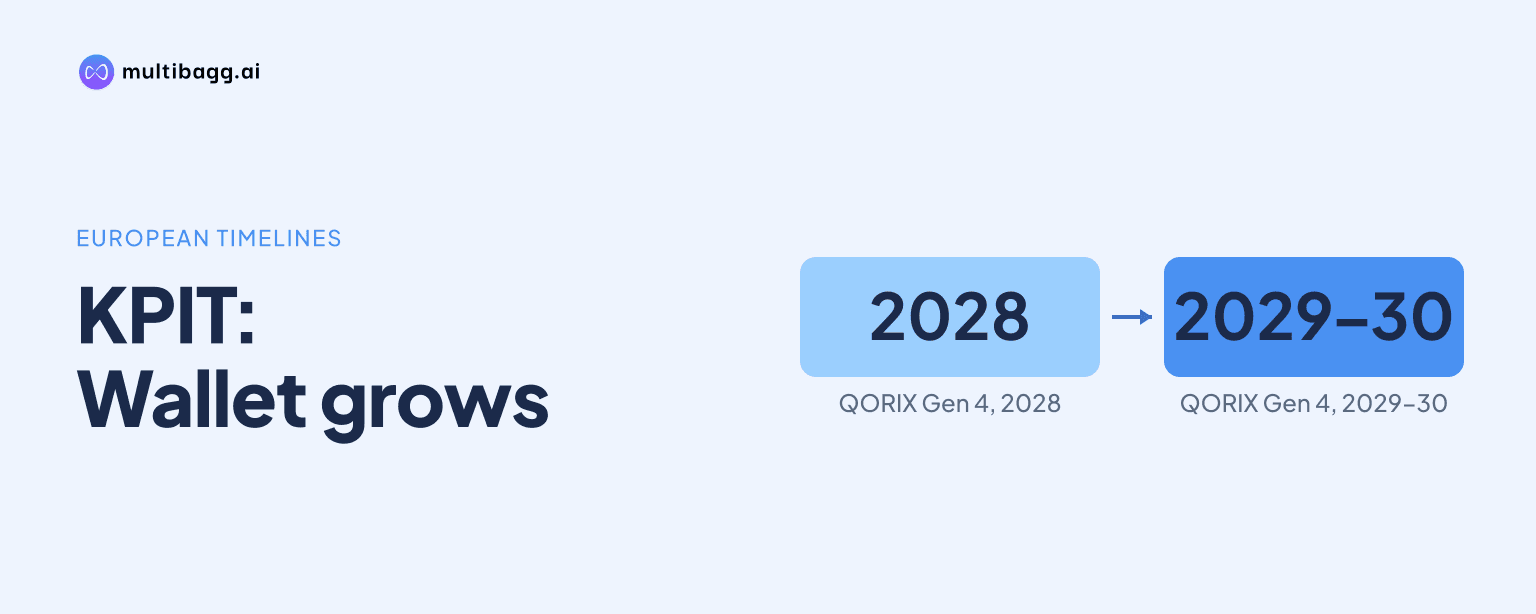
- Most QORIX Gen 4 programmes previously expected in 2028 are now scheduled for 2029-'30.
powered by IRIS
KPIT Technologies Limited (KPIT) expects European original equipment manufacturer (OEM) supplier consolidation to expand its wallet share in the first half of next year, even as European passenger-car recovery remains prolonged. Management expects the impact from two affected European OEM accounts to bottom out over the next couple of quarters, while consolidation is expected to be meaningfully concluded by the end of the first quarter next year.
Know KPIT Technologies inside out
Results, valuation, peers and who's buying, in one view.
Why does KPIT expect Europe consolidation to expand wallet share?
KPIT expects consolidation to create openings because European passenger-car OEMs are reducing costs but cannot indefinitely defer technology spending. Kishor Patil said OEMs are increasingly considering a shift from their European ecosystems towards India, while KPIT aims to combine lower-cost delivery, its technology solutions and an artificial intelligence, or AI, native approach.
Management’s view is that a lower overall technology budget can still produce a larger KPIT footprint at a customer. Patil said KPIT could help OEMs reduce costs while delivering differentiated solutions, but did not disclose a revenue target, contract value or expected wallet-share gain. This is management’s assessment rather than a quantified forecast.
When could European vendor consolidation affect KPIT?
KPIT expects European supplier consolidation to be meaningfully concluded by the end of the first quarter next year, with the business impact potentially visible in the first half of next year. Patil said consolidation had already begun to some extent, although the timing would differ among suppliers and OEMs.
The company separates this timetable from the underlying passenger-car market recovery. Sachin Tikekar described the recovery for European passenger-car OEMs as long-drawn, with continued pressure likely for some time. KPIT therefore expects its own opportunity to come from changes in sourcing, delivery and supplier structures rather than from a broad revival in European vehicle demand.
Which European technology budgets does KPIT expect to remain active?
KPIT expects selected European technology budgets to remain active in digital cockpit, diagnostics, software updates, after-sales transformation and cybersecurity. Tikekar said European spending would continue to decline overall as OEMs address their cost base, but the remaining budgets would be prioritised in these areas.
Autonomous driving is another allocation area cited by management. Tikekar said the category had moved to the back burner for two or three years after COVID before rebounding substantially, while navigation on autonomy, or NOA, had become a standard in China and could become somewhat standard in Europe and the United States. KPIT also cited investment in robotaxis by newer companies.
KPIT said its validation products may help customers address quality and development-time requirements. Patil added that European customers are seeking more remote work than under their historical onsite model, and management has started adjusting client-engagement capacity from higher-cost to lower-cost centres. He said KPIT would not optimise technology investments or the associated teams.
Got a follow-up? Ask IRIS
How does KPIT's European outlook differ by vehicle segment?
KPIT sees a more favourable near-term European outlook for trucks and off-highway equipment than for passenger cars. Tikekar said trucks were returning slowly and off-highway was continuing to perform reasonably well, compared with the prolonged passenger-car recovery expected at European OEMs.
Management said truck and off-highway customers are beginning their first software-defined machine and software-defined vehicle programmes. Anup Sable said their core technology requirements resemble passenger vehicles, including Android-based head units, body electronics and central-zonal architecture. KPIT identified opportunities in architecture, feature development and integration, diagnostics and aftermarket work.
KPIT expects growth from trucks and off-highway for years, but declined to specify a rate for the remainder of the year. Management reiterated that the second half, or H2, would be better than the first half, or H1. This segment outlook differs from European passenger cars because it is based on new software-defined programmes rather than supplier consolidation alone.
What could delay KPIT's European recovery?
KPIT's immediate constraint is the continuing impact from two European OEMs, which management expects to persist for the next couple of quarters. Tikekar said both remain strategic clients and that KPIT is seeing initial green shoots in other areas, but the company expects broad-based growth elsewhere to more than offset the pressure while those accounts bottom out.
QORIX presents a separate timing issue. Management said programmes for its Gen 4 middleware performance product, previously expected in 2028 for most OEMs, are now mostly scheduled for 2029-'30. KPIT plans to continue product investment for medium-term strategic reasons while exploring smaller products, adjacent uses such as robotics and additional partners to create revenue before the main market develops.
KPIT's ability to capture AI and fixed-price-project leverage will also depend on customers. Patil said AI, products and solutions could increase revenue, but added that the outcome would vary according to client technology adoption and their ability to manage such engagements. Management has not provided a quantified savings or margin target from the delivery-model changes.
Conclusion
KPIT's stated European strategy is to gain a larger role during an OEM downturn rather than wait for passenger-car demand to recover. Management believes cost pressure, India-based delivery, AI-led transformation, products and supplier consolidation can increase its footprint, while trucks and off-highway offer a comparatively more direct growth route.
The next disclosed milestones are the expected bottoming out of the two affected European OEM accounts over the next couple of quarters, meaningful conclusion of consolidation by the end of the first quarter next year, and possible visible benefits in H1 next year. Management is also still exploring QORIX adjacencies and partners after Gen 4 programme schedules shifted from 2028 to 2029-'30.