










KPIT expects two OEM declines to bottom within two quarters
Key highlights
- KPIT said two major OEM accounts reduced revenue by more than 13% and should bottom within the next couple of quarters.
- Off-highway and commercial-vehicle revenue grew 27% year on year in Q2 FY27, while passenger-car revenue declined about 8%.
- Products revenue rose 25% year on year and EBITDA margin increased 60 basis points to 17.8% in Q2 FY27.
- KPIT reported net cash of Rs 620 crore after a Rs 140 crore dividend and about Rs 100 crore initial Cymotive payment.
powered by IRIS
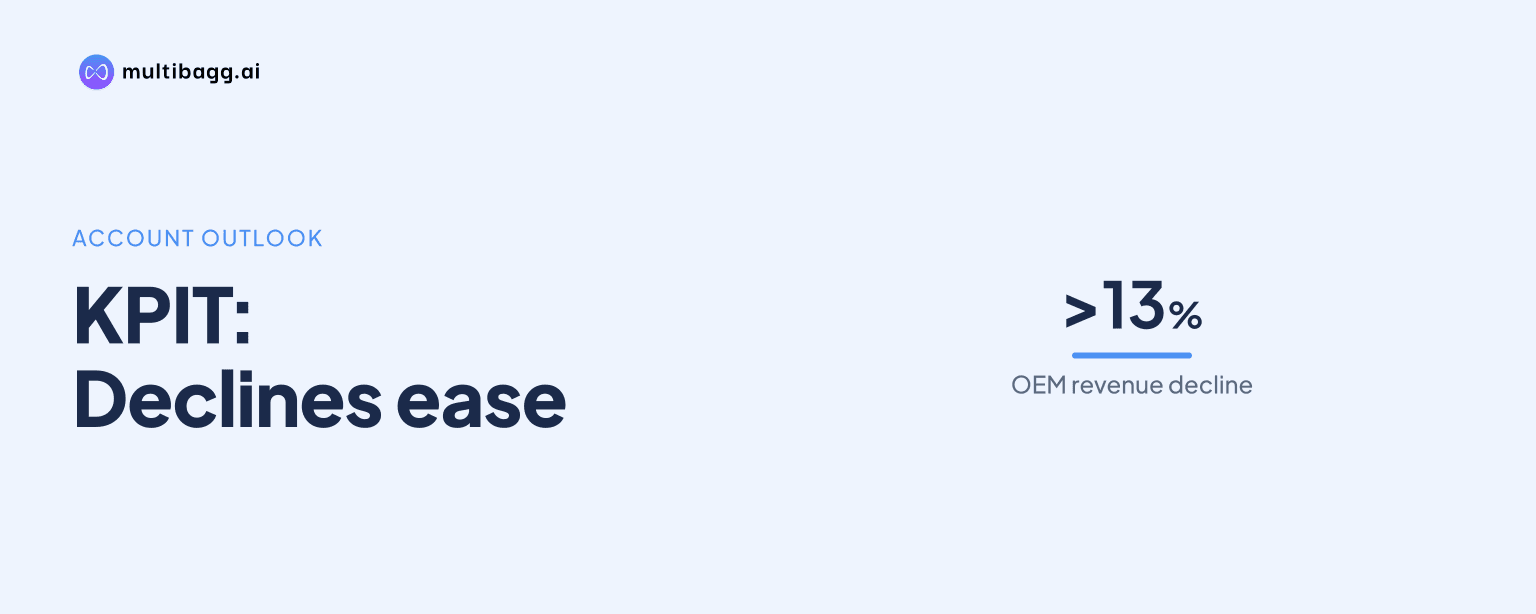
KPIT Technologies Limited expects revenue declines at two major original equipment manufacturer, or OEM, clients to bottom within the next couple of quarters after cancelled programmes and spending cuts reduced revenue by more than 13%. KPIT said growth in off-highway, commercial vehicles and products should more than offset the customer drag before a gradual recovery begins.
Know KPIT Technologies inside out
Results, valuation, peers and who's buying, in one view.
Why are KPIT's two major OEM accounts declining?
KPIT's two affected OEM accounts are declining because large programmes were cancelled or expenses were cut. One customer is in Japan, Korea and China, or JKC, and the other is in Europe; management said their combined revenue decline exceeded 13% of KPIT's total revenue in Q2 FY27.
The customer disruption was reflected in passenger-car revenue, which declined about 8% year on year and 4% quarter on quarter in Q2 FY27. Management did not identify the clients or quantify the remaining decline, but said the accounts would continue to fall over the next couple of quarters before bottoming.
Management also said it was seeing initial growth opportunities at the two strategic accounts despite the programme cancellations. It expects some growth to return in the early part of the next year, although it described the recovery as gradual after the substantial reduction in existing programmes.
How did KPIT's businesses perform in Q2 FY27?
KPIT's Q2 FY27 growth came from off-highway, commercial vehicles and products, while passenger cars declined. Revenue rose 6.5% year on year and 1% quarter on quarter in rupee terms, compared with constant-currency growth of 0.2% year on year and 0.5% sequentially.
Products revenue grew 25% year on year and 5% quarter on quarter, while services revenue was flat, management said. This shift in business mix helped earnings before interest, tax, depreciation and amortisation, or EBITDA, margin rise 60 basis points to 17.8% from 17.2%.
KPIT also said fixed-price projects had increased to about 70% in Q2 FY27. Management linked that mix to its use of artificial intelligence, or AI, in delivery, because fixed-price work provides a structure for productivity improvements and differentiated solutions.
How will KPIT offset the revenue loss from two clients?
KPIT plans to offset the two-client revenue decline through broader growth in existing and new passenger-car customers, off-highway customers, trucks and products. Management said 89% of recent wins came from target accounts and reiterated that the second half of FY27 should be better than the first half.
Off-highway is a central part of that plan because KPIT has three clients in the vertical and is adding two more. It said two consulting engagements have moved into software-defined machine, or SDM, programmes, following one SDM-related win announced in the previous quarter.
KPIT also expects truck activity to improve after several sluggish quarters, particularly in the US market. Management said the North American truck market is showing signs of growth and expects trucks in both Europe and the US to contribute in the immediate quarters ahead.
The company contrasted that outlook with European passenger-car OEMs, where it said spending remains under pressure as manufacturers cut costs. KPIT's management argued that its technology, products and AI-led delivery could help it gain work even when a customer's total engineering spend is declining.
Got a follow-up? Ask IRIS
Where does KPIT see growth outside the affected accounts?
KPIT sees broad-based growth in the US across passenger cars, off-highway, trucks and products, while India has driven much of the growth in Southeast Asia, India and the Middle East, or SIMA. Management said India growth in Q2 FY27 came from passenger cars, trucks and off-highway work for Indian and global OEMs.
In Europe, KPIT expects opportunities from supplier consolidation, remote delivery and AI-led transformation rather than a recovery in OEM spending. Management said European passenger-car OEMs are seeking material cost reductions and may move more work from European suppliers to delivery locations in India.
Management expects the effect of supplier consolidation to become visible in the first half of the next year. It said the consolidation process, which had already started for some suppliers, could be meaningfully concluded by the end of the first quarter of that year.
KPIT is also building its Vietnam presence around an existing OEM relationship and a centre with a large Chinese Tier 1 supplier. The centre is intended to support a Chinese OEM's global programme outside China, while management said Vietnam could become a hub for Southeast Asia because of talent availability and its business environment.
What operating measures and risks should investors monitor?
KPIT reported net cash of Rs 620 crore in Q2 FY27, after paying a Rs 140 crore dividend and making an initial Cymotive acquisition payment of about Rs 100 crore. Days sales outstanding, or DSO, rose to 53 days from 51 days, which management said increased the working-capital cycle and affected operating cash flow.
AI adoption is another measure management highlighted for Q2 FY27. More than 9,000 users accessed KPIT's AI platform, more than 5 million transactions were completed, and 12,000 engineering agents were built during the quarter; about 9% of revenue came from AI-first projects.
A separate timing issue concerns QORIX, where major Generation 4 OEM programmes expected in 2028 have shifted to 2029-30. Management said KPIT is examining adjacencies and smaller products for revenue before those programmes start, while continuing investment in QORIX because it sees medium-term strategic relevance.
Conclusion
KPIT's Q2 FY27 performance showed two contrasting trends: more than 13% of revenue was affected by declines at two major OEM clients, while off-highway and commercial-vehicle revenue rose 27% year on year and products revenue grew 25%. Management's stated plan is to use wider customer coverage, trucks, off-highway programmes and products to offset the near-term client drag.
The next evidence point is whether the second half of FY27 is better than the first half, as management reiterated, and whether the two affected OEM accounts bottom within the next couple of quarters. Investors can also watch for the product-reporting parameters management said it plans to provide when discussing the next year, as well as progress in European supplier consolidation and the delayed QORIX programme timeline.