










KPIT Adds Two Off-Highway Clients to Three-Client Base
Key highlights
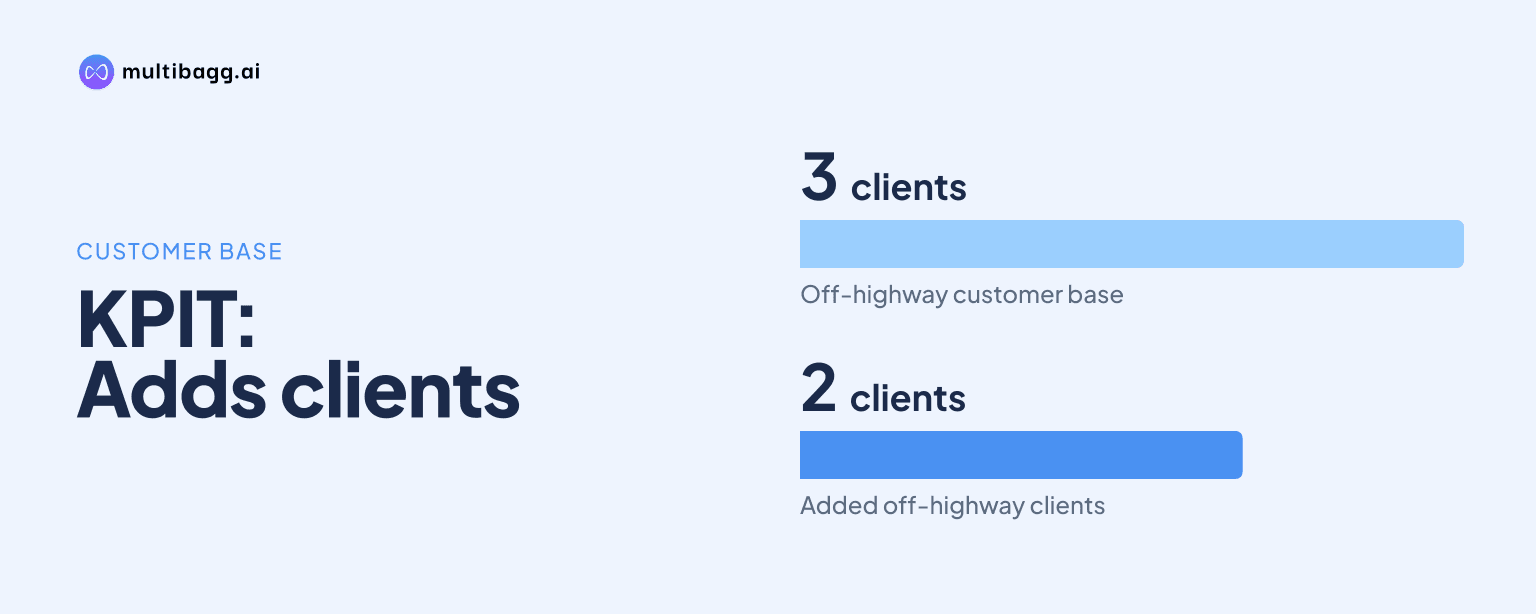
- KPIT has three off-highway customers and is adding two more clients.
- KPIT said the US truck market is showing growth signs after several sluggish quarters.
- Management expects trucks and off-highway to contribute increasingly to revenue and profit.
- KPIT maintained that H2 will be better than H1 as two large OEM accounts bottom out over the next couple of quarters.
powered by IRIS
KPIT Technologies Limited is adding two off-highway clients to its existing base of three, as management expects software-defined-machine work and a recovering truck market to contribute increasingly to revenue and profit. KPIT said its commercial-vehicle opportunities span construction and mining equipment, trucks, architecture, integration, diagnostics and aftermarket software.
Know KPIT Technologies inside out
Results, valuation, peers and who's buying, in one view.
Why is KPIT expanding into off-highway and truck software?
KPIT is expanding because management believes off-highway equipment and trucks are entering a software transition comparable with the software-defined-vehicle, or SDV, change in passenger cars about four years ago. KPIT divides its commercial-vehicle activity into off-highway, mainly construction and mining equipment, and trucks. Management said both verticals should generate increasingly meaningful contributions to revenue and profit over time.
The off-highway market uses the term software-defined machines, or SDM, but Anup Sable said its foundational technology is broadly similar to passenger-vehicle SDV programmes. KPIT said it can apply its SDV experience, advanced solutions and artificial intelligence, or AI, work to accelerate SDM programmes. The company identified architecture, feature development, integration, diagnostics and aftermarket as addressable areas across the two commercial-vehicle verticals.
KPIT said the engineering overlap is substantial despite differences between a passenger car and a construction or mining machine. Management cited Android-based head units, body electronics and central-zonal architectures as common technology elements. It said the cockpit experience may differ in off-highway equipment, but the underlying software and electronics work remains relevant to KPIT’s existing capabilities.
This strategy is part of the company’s stated effort to track growth by passenger cars, trucks and off-highway rather than through a single automotive market lens. Management also said product revenue, solution revenue and AI transformation would be key strategic measures. Kishor Patil said KPIT expects to provide clearer internal performance parameters when it discusses the next financial year, after two to three quarters of tracking.
How many off-highway customers does KPIT have?
KPIT has three off-highway customers and is adding two more, which would take its disclosed client base in the vertical to five. Sachin Tikekar described off-highway as relatively new for KPIT and said the business is naturally concentrated at this stage because it began with three clients. Management did not disclose the identity, revenue contribution or contract value of any account.
Management nevertheless expects off-highway revenue to increase over the medium term. Tikekar said the opportunity was not a one-off lasting one or two years and that the vertical should contribute increasingly to the top line and bottom line. That is a management expectation rather than a segment forecast, as KPIT did not provide off-highway revenue, growth rates or operating margins.
India is one source of demand cited by management. Tikekar said year-on-year and quarter-on-quarter growth in India had come from passenger cars, trucks and off-highway, including work for Indian original equipment manufacturers, or OEMs, and global OEMs expanding their Indian footprint. KPIT characterised India as a broad-based growth market but did not separate the off-highway share from passenger-car or truck revenue.
KPIT also outlined potential off-highway opportunities in Korea and Japan. In Korea, it has a consulting engagement with one off-highway OEM on an SDM programme that management said is committed for launch next year. In Japan, KPIT said it is seeking ways to enter one to two off-highway players, alongside conversations with a truck OEM and expansion with passenger-car OEMs and Tier 1 suppliers.
How will KPIT transfer passenger-car software experience to machines?
KPIT plans to transfer passenger-car SDV skills into SDM programmes through common work in software architecture, feature development, integration and validation. Management said its experience in SDV is relevant because off-highway and truck customers are beginning their first SDM or SDV programmes. KPIT also said AI-led transformation could support faster and more efficient delivery for those customers.
The company’s intended commercial model includes products, solutions and fixed-price delivery. An analyst noted that fixed-price contracts had reached 71%, and management said it would be in a position to share product revenue, potentially through more detailed reporting next year. Patil said AI leverage, products and solutions could help increase revenue, while cautioning that adoption depends on customers’ readiness to use the technology and manage these engagements.
Management linked the expansion to changes in how clients want engineering work delivered. KPIT said European customers are seeking more remote work than previously, which could change the mix of delivery capacity from higher-cost to lower-cost centres. Patil said the company has started to optimise the client-engagement mix but would not reduce its technology investments or technology teams.
The off-highway approach is therefore based on technology reuse rather than a claim that all machine applications are identical to passenger cars. KPIT said cockpit requirements may be different in an off-highway machine, while body electronics and central-zonal architecture remain applicable. The company has not disclosed the share of its SDV intellectual property or product portfolio that has already been deployed with its three off-highway customers.
Got a follow-up? Ask IRIS
What is KPIT’s outlook for truck software growth?
KPIT expects truck business to pick up in the immediate quarters ahead, particularly in North America, after a sluggish market lasting several quarters. Management said the US truck market is finally showing signs of growth and added that it expects truck growth in both Europe and America. It did not provide a numerical truck-growth target, order value or regional revenue split.
The truck outlook differs from KPIT’s assessment of European passenger-car OEMs. Management said European passenger-car companies remain under pressure to cut costs and face a long-drawn recovery, while trucks are returning slowly and off-highway has continued to perform reasonably well. This contrast is important to KPIT’s vertical strategy because commercial-vehicle demand could offset some exposure to weaker European passenger-car spending.
KPIT said its US business is already growing across all three of its verticals. Management cited growth in US passenger cars and off-highway, expected growth in trucks, and product sales as another contributor. It described this as broad-based growth but did not disclose whether commercial vehicles now account for a larger share of US revenue than in a prior period.
The company maintained that the second half, or H2, would be better than the first half, or H1, despite declines at two large OEM clients. Management said those accounts should bottom out over the next couple of quarters, while broad-based growth is expected to make up for the reduction. It also said any recovery at those two OEMs in the early part of next year would be gradual.
What could affect KPIT’s commercial-vehicle expansion?
The immediate issue is whether newer customer relationships become larger programmes. KPIT is adding two clients to its three-client off-highway base, while the Korean SDM programme is planned for launch next year and Japanese opportunities remain at the discussion stage. These developments are disclosed opportunities and plans, not contracted revenue guidance.
A second factor is the pace at which OEMs fund software priorities. Management said overall European spending is likely to decline, but cited digital cockpits, diagnostics, updates, after-sales transformation, cybersecurity and autonomous-driving work as areas that may receive priority. KPIT has said it has a footprint in these areas, but it has not quantified the revenue that could move from passenger-car programmes into truck or off-highway programmes.
Management also expects margin progression to depend partly on growth and delivery mix. When asked about a return to a 20% to 21% earnings before interest, tax, depreciation and amortisation, or EBITDA, range, Patil said margins should improve to some extent each quarter but suggested that reaching that range would be early next year. This was management commentary, not formal margin guidance.
Conclusion
KPIT’s commercial-vehicle strategy rests on a disclosed expansion from three off-highway clients to five, alongside management’s expectation that truck demand improves after several sluggish quarters. The company is seeking to apply passenger-car SDV experience to SDM work in construction, mining and truck applications, with India, North America, Korea and Japan among the markets management discussed.
Next, investors can watch whether the two new off-highway clients develop into meaningful engagements, whether the Korean SDM programme launches next year, and whether truck demand improves in the immediate quarters as management expects. KPIT also plans more detailed product-revenue reporting next year and expects the decline at two large OEM customers to bottom out over the next couple of quarters.