










KRBL domestic revenue rises 33% as pack volumes accelerate in Q2 FY27
Key highlights
- KRBL domestic revenue excluding power rose 33% year on year to Rs 1,390 crore in Q2 FY27.
- Branded rice sales increased 23% to Rs 1,134 crore, while consumer-pack volumes grew 18%.
- Modern trade and e-commerce consumer-pack volumes rose 31% in Q2 FY27.
- KRBL raised portfolio prices in Q3 after key paddy prices rose by at least Rs 1,000 per quintal year on year.
powered by IRIS
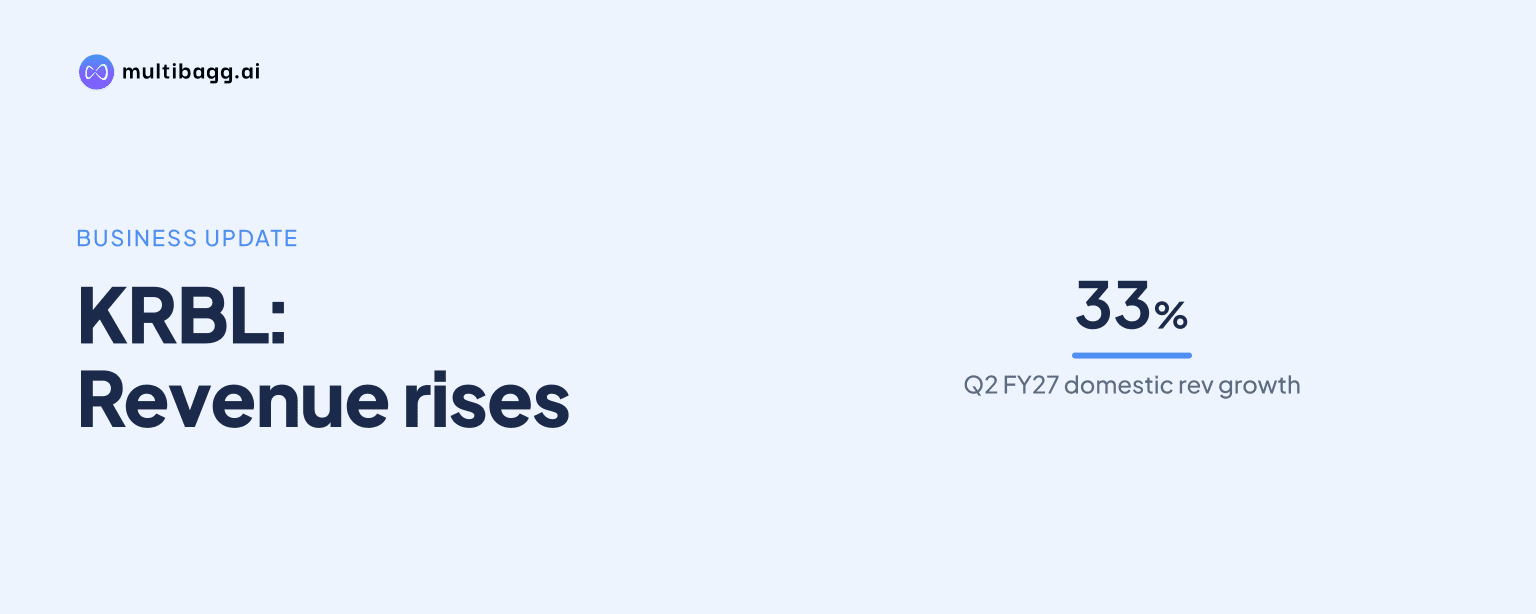
KRBL Limited’s domestic revenue excluding power rose 33% year on year to Rs 1,390 crore in Q2 FY27, as branded rice sales increased 23% and consumer-pack volume growth accelerated to 18%. KRBL has since raised prices across its portfolio in Q3 after basmati paddy costs climbed by at least Rs 1,000 per quintal from a year earlier.
Know KRBL inside out
Results, valuation, peers and who's buying, in one view.
How fast did KRBL’s domestic business grow in Q2 FY27?
KRBL’s domestic business grew 33% year on year in Q2 FY27, reaching Rs 1,390 crore excluding power, while first-half domestic revenue rose 24% to Rs 2,612 crore. The quarterly result was the company’s highest domestic revenue to date, according to management, and helped offset weaker bulk exports to the Middle East.
Branded rice sales increased to Rs 1,134 crore from Rs 921 crore a year earlier, a rise of 23%. Unbranded rice sales rose to Rs 166 crore from Rs 53 crore, including a selective additional rice sale of Rs 102 crore. That sale contributed to the domestic revenue increase, meaning branded-rice sales provide a more direct measure of the India Gate portfolio’s performance.
KRBL reported total income of Rs 1,768 crore for Q2 FY27, up 15% year on year, while revenue from operations was Rs 1,727 crore, up 15% sequentially from Q1 FY27. Domestic revenue rose 14% quarter on quarter, whereas export revenue increased 22% from Q1, though first-half export revenue was still down 41% at Rs 541 crore because of lower Middle East bulk shipments.
Why did India Gate consumer-pack volumes accelerate?
KRBL said consumer-pack volume growth accelerated because general trade returned to growth while modern trade and e-commerce expanded faster. Consumer-pack volumes rose 18% year on year in Q2 FY27, compared with 7% in Q1 FY27, marking an 11-percentage-point acceleration between the two quarters.
Modern trade and e-commerce together increased consumer-pack volumes by 31% in Q2. General trade, which had declined about 5% in Q1, grew 10% in Q2. Management said the recovery in general trade accounted for most of the improvement in consumer-pack growth from the first quarter to the second quarter.
Branded bulk-pack volumes grew 11% year on year in Q2 after some trade buyers had delayed purchases while awaiting price clarity. First-half bulk-pack volumes remained below the prior year, but management described October as another strong month. Regional rice volumes also rose 42% in Q2, lifting their first-half growth to 32%.
India Gate held an estimated 36% volume share in general trade in the 12 months ended September, nearly twice the next player’s share, according to management. Its modern-trade share was 39.6%, more than 6 percentage points ahead of the next player, while its estimated September exit share in e-commerce was 41.1%, compared with about 33% for the next player.
What price increases has KRBL made after higher paddy costs?
KRBL raised prices across its portfolio in Q3 FY27 after holding domestic rice prices unchanged through Q2 FY27. Average domestic rice realisation was about Rs 80 per kilogram in both Q1 and Q2, although it was around 12% higher than in Q2 FY26.
Management cited late-October prices of about Rs 4,500 per quintal for 1509 paddy and Rs 5,200 per quintal for 1121 paddy in key Punjab and Haryana markets. Both were at least Rs 1,000 per quintal above the previous year. KRBL said it would now manage prices by variant and channel, balancing its market-share objective against the need to protect gross margins.
The company also pointed to higher regional-rice prices, which management believes support domestic basmati pricing. Wholesale Sona Masoori prices in parts of Karnataka were reported at Rs 75 to Rs 80 per kilogram in early October, versus about Rs 50 previously. In Telangana, fine-rice retail prices moved from Rs 70 to Rs 80 per kilogram to Rs 82 per kilogram, while basmati rose from Rs 113 to Rs 122 per kilogram.
KRBL said it had seen no noticeable consumer migration from branded basmati to loose rice so far. Management noted that households could move to lower-priced variants or smaller packs, but said at least three months of purchasing data after the price increases would be needed before reaching a conclusion on consumer behaviour.
Got a follow-up? Ask IRIS
Can KRBL sustain domestic volume growth after the price increase?
KRBL management said approximately 10% overall domestic rice volume growth remains achievable in FY27, supported by consumer-pack momentum, October bulk-pack demand and regional-rice growth. This is a management target rather than reported full-year growth, and its delivery will be tested as Q3 price increases work through retail channels.
India Gate was present in around 3.3 lakh outlets and reached about 1.2 crore urban households at the time of the call. KRBL is seeking to improve availability in towns where distribution remains limited, while its order-to-cash programme links order placement, stock allocation, collections and claims for distributors.
The company is also extending the brand into adjacent food categories. India Gate poha had reached about 44% of KRBL’s existing rice outlet base in launch towns by mid-September, and about 30% of retailers that stocked it had placed a repeat order. Masala sales rose to about Rs 4.5 crore in the first half from Rs 3.1 crore a year earlier.
Management’s stated ambition is to exit FY27 with an annualised masala revenue run rate of about Rs 25 crore. The second-half plan is to place biryani masalas in more outlets and build repeat purchases in ready-to-cook regional blends, while the domestic rice business focuses on volume growth and gross-margin protection.
How does domestic growth compare with KRBL’s export performance?
KRBL’s domestic growth has become more important because first-half export revenue fell 41% to Rs 541 crore, largely due to lower bulk shipments to the Middle East. By contrast, branded exports grew 18% in the first half, and exports to markets outside the Middle East rose 14%, indicating that the decline was concentrated in a specific region and export format.
Q2 export revenue was Rs 297 crore, up 22% from Q1 but down 31% from Q2 FY26. Management attributed the Middle East pressure to more difficult payment channels, restricted movement through the Strait of Hormuz and its decision to limit opportunities where risk and return did not justify larger volumes.
Higher realisation, product mix and other income lifted Q2 gross margin to 34.5%, compared with 29.2% in Q2 FY26. Earnings before interest, tax, depreciation and amortisation margin was 21.1%, up from 16.6%, while profit after tax was Rs 159 crore, compared with Rs 172 crore a year earlier; the reported profit-after-tax margin rose to 14.6% from 11.2%.
Conclusion
KRBL’s domestic channels supplied a larger counterweight to export disruption in Q2 FY27, with general trade returning to 10% consumer-pack volume growth and modern trade plus e-commerce growing 31%. The operating result came alongside a 41% first-half decline in export revenue to Rs 541 crore, while Q2 gross margin improved by 5.3 percentage points to 34.5%.
The next test is demand after Q3 portfolio price increases and higher paddy costs. Management plans to assess at least three months of post-increase purchasing data, targets approximately 10% domestic rice-volume growth in FY27, and intends to manage prices by variant and channel while protecting gross margins.