










KRBL domestic revenue hits record ₹1,390 crore in Q2 FY27
Key highlights
- KRBL reported record domestic revenue of ₹1,390 crore in Q2 FY27, up 33% year on year.
- India Gate had a retail presence in 3.3 lakh outlets and reached 1.2 crore Indian households.
- KRBL reported market shares of 36.2% in general trade, 39.6% in modern trade and 41.1% in e-commerce.
- KRBL’s working-capital days fell to 95 in Q2 FY27 from 147 in Q2 FY26.
powered by IRIS
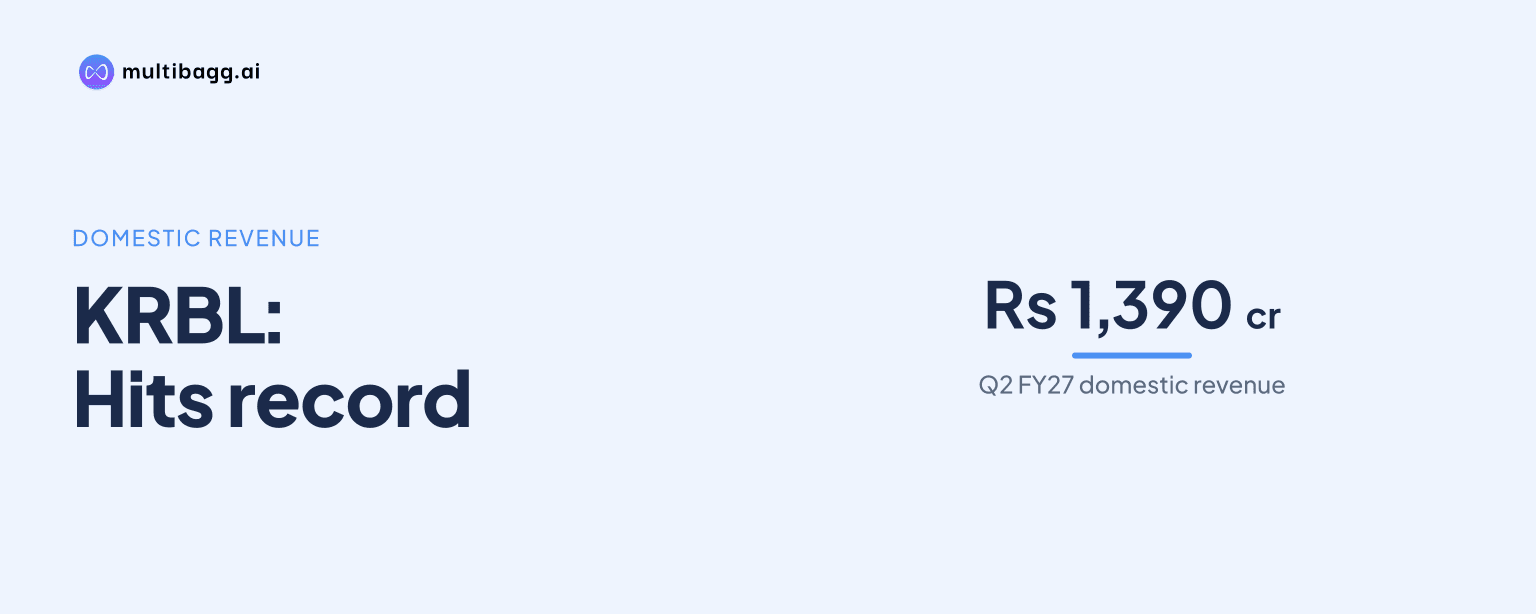
KRBL reported record domestic revenue of ₹1,390 crore in Q2 FY27, up 33% year on year, with both volume and realisation growth contributing to the increase. The result, which excludes power revenue, came as KRBL reported a 3.3 lakh-outlet retail footprint and digitised distributor order-to-cash operations.
Know KRBL inside out
Results, valuation, peers and who's buying, in one view.
How did KRBL’s domestic revenue perform in Q2 FY27?
KRBL’s domestic revenue reached ₹1,390 crore in Q2 FY27, its highest-ever quarterly domestic revenue, and increased 33% from Q2 FY26. KRBL said both volume growth and realisation growth drove the result, which is reported on a consolidated-financials basis and excludes power revenue.
The ₹1,390 crore outcome places the India Gate packaged-basmati business at the centre of KRBL’s domestic strategy in Q2 FY27. KRBL did not split the 33% growth between volume and realisation, so the presentation does not establish the individual contribution of either driver to the quarterly increase.
KRBL’s domestic programme covers distribution expansion, supply-chain remodelling, brand investment and new products and categories. For the Q2 FY27 revenue result, however, the stated immediate drivers were volume and realisation rather than a quantified benefit from any one strategic programme.
How large is KRBL’s India Gate retail reach?
KRBL reported that India Gate had a presence in 3.3 lakh retail outlets and reached 1.2 crore Indian households. The outlet figure covers all channels of packaged basmati according to RMS data for January 2026, while the household measure is presented as urban Indian household penetration on an all-India basis.
KRBL reported market shares of 36.2% in general trade, 39.6% in modern trade and 41.1% in e-commerce. The general-trade and modern-trade figures are based on RMS moving annual total data through September 2026, whereas the e-commerce measure is an internal September 2026 exit figure.
E-commerce had the highest reported share at 41.1%, which was 1.5 percentage points above modern trade at 39.6% and 4.9 percentage points above general trade at 36.2%. The figures are not fully like-for-like because the first two are moving annual total measures and e-commerce is a September 2026 exit measure.
The 3.3 lakh-outlet footprint provides the physical base for KRBL’s plan to democratise distribution. The presentation does not disclose the prior-period outlet count, so it does not quantify how much the retail footprint expanded by Q2 FY27.
How is KRBL extending domestic distribution and supply?
KRBL said it is establishing direct distribution in non-covered and underpenetrated towns within general trade. This initiative is intended to take distribution deeper, while the company’s broader India strategy identifies distribution democratisation as one of four strategic pillars.
For modern trade and e-commerce, KRBL said it is seeking wider and deeper supply while improving servicing and cost efficiency. Its supply-chain design includes two source-labelled network categories containing 13 locations and 16 locations respectively, or 29 locations in total.
KRBL also said it is building a more robust go-to-market practice, with stronger governance and measures intended to safeguard against infiltration. The presentation refers to a move towards a “FOR” model, but does not define the model, give a rollout timetable or provide a target for towns, outlets or service levels.
The supply-chain programme is therefore linked to the 3.3 lakh-outlet retail base through direct distribution and channel servicing rather than through a disclosed revenue target. KRBL did not state how many towns were newly covered by Q2 FY27 or quantify any cost reduction from the 29-location network.
Got a follow-up? Ask IRIS
What does KRBL’s order-to-cash system do for distributors?
KRBL has digitised the distributor journey through an end-to-end order-to-cash, or O2C, system developed in partnership with a leading global consulting firm. The system covers four stages: order, fulfilment, collection and settlement, with a workflow tool operating underneath the process.
At the order stage, distributors place orders online and the system checks credit. At fulfilment, warehouse stock is reserved against each confirmed order, creating a stated connection between confirmed demand and stock availability.
The collection module matches payments to invoices faster, according to KRBL, while the settlement module includes distributor management and claims management. KRBL said schemes are shared automatically and claims follow a clear settlement path under the digital workflow.
KRBL described the intended outcome of the O2C project as greater efficiency and agility across distributor operations. The presentation does not disclose a distributor adoption rate, implementation date, processing-time reduction, claims-cycle improvement or quantified savings from the system.
What changed in KRBL’s working capital during Q2 FY27?
KRBL’s working-capital days fell to 95 days in Q2 FY27 from 147 days in Q2 FY26, a reduction of 52 days. Inventory days declined by 22 days to 117, receivable days declined by eight days to 25, and payable days increased by 22 days to 47.
Total inventory stood at ₹2,203 crore on 30 September 2026, compared with ₹2,279 crore on 30 September 2025. Rice inventory value declined to ₹1,900 crore from ₹1,995 crore, while paddy inventory value increased to ₹146 crore from ₹123 crore.
Rice inventory volume fell to 278 thousand metric tonnes on 30 September 2026 from 304 thousand metric tonnes a year earlier. Paddy inventory volume also declined, to 31 thousand metric tonnes from 33 thousand metric tonnes, even as the reported paddy inventory value rose by ₹23 crore.
KRBL reported net bank borrowings of negative ₹2,895 crore in Q2 FY27, compared with negative ₹2,157 crore in Q2 FY26. KRBL attributed lower net bank debt mainly to lower net working capital and internal accruals; its current ratio was 3 times versus 5 times, while its interest coverage ratio was 531 days versus 208 days.
Conclusion
KRBL’s record ₹1,390 crore domestic revenue in Q2 FY27 combined 33% year-on-year growth with a 3.3 lakh-outlet India Gate footprint, reported shares across general trade, modern trade and e-commerce, and a digitised distributor workflow. At the same time, working-capital days fell by 52 days, while total inventory declined by ₹76 crore as of 30 September 2026.
The next development to watch is KRBL’s disclosed plan to expand direct distribution in non-covered and underpenetrated towns, improve modern-trade and e-commerce servicing, and operate the O2C system across the distributor journey. KRBL has not provided targets, completion dates or quantified operating benefits for these programmes, leaving their future contribution to revenue and efficiency unresolved.