










KRBL international revenue falls 31% on lower Middle East exports
Key highlights
- KRBL reported Rs 297 crore of international revenue in Q2 FY27, down 31% year on year.
- KRBL attributed the Q2 FY27 international revenue decline to lower exports to the Middle East.
- The Middle East accounted for 71% of India’s FY26 basmati rice export volume, versus 10% for Europe.
- KRBL says India held 85% of global basmati market exports and recorded 8% export-volume growth in FY26.
powered by IRIS
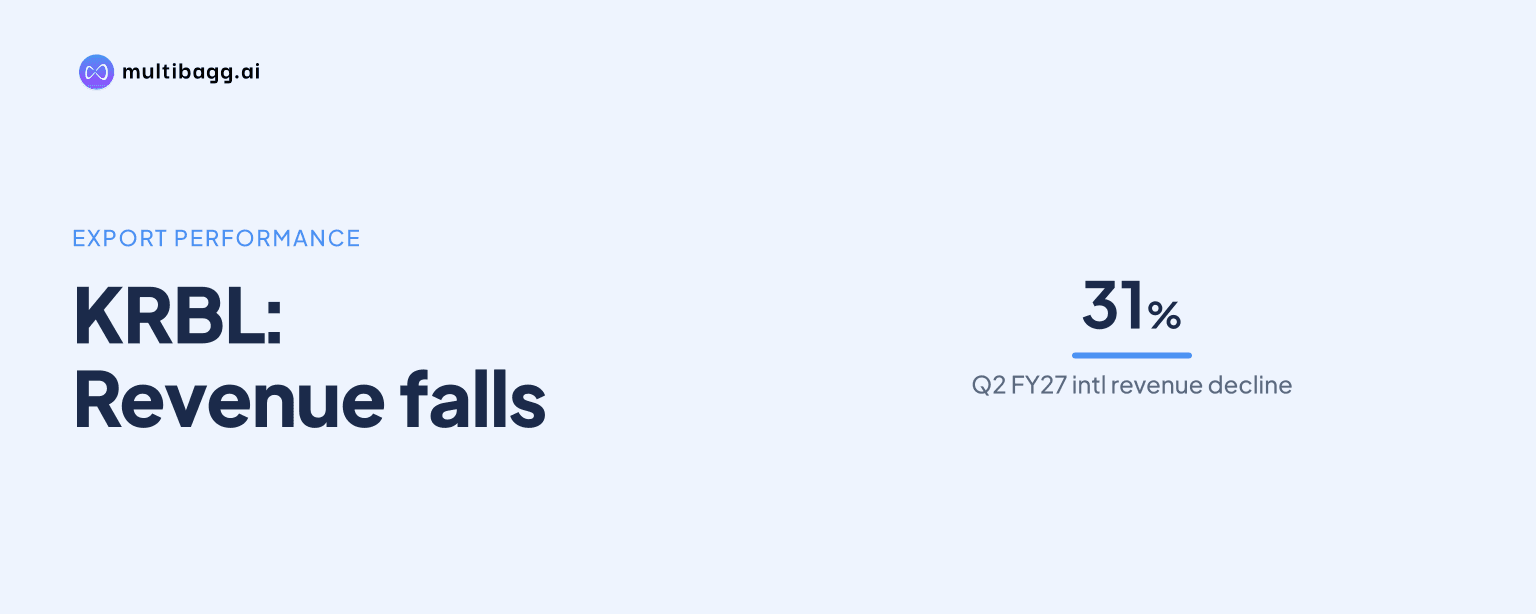
KRBL Limited reported Rs 297 crore of international revenue in Q2 FY27, down 31% year on year, because exports to the Middle East were lower. The decline came as the Middle East accounted for 71% of India’s basmati rice export volume in FY26, making the region central to the wider export market.
Know KRBL inside out
Results, valuation, peers and who's buying, in one view.
Why did KRBL international revenue fall in Q2 FY27?
KRBL’s international revenue fell because exports to the Middle East were lower. The company reported Rs 297 crore of revenue for Q2 FY27, representing a 31% year-on-year decline, and directly identified lower Middle East exports as the reason for the movement.
The comparison is with the corresponding prior-year quarter because KRBL labels the change as year on year, or YoY. The presentation does not provide a prior-year revenue amount, country-level sales split, shipment volumes or price realisations, so the disclosed evidence is the Rs 297 crore quarterly revenue figure and the 31% decline.
How concentrated are India’s basmati exports in the Middle East?
India’s basmati exports are concentrated in the Middle East, which accounted for 71% of export volume in FY26. Europe represented 10%, while North America and Africa each accounted for 6%; Asia contributed 5% and other regions 2%.
The Middle East’s 71% share exceeded the combined 29% share of every other listed region. This is India-level export data rather than KRBL-specific revenue or shipment data, but it gives context to KRBL’s stated Q2 FY27 shortfall from lower sales into the region.
KRBL says demand for Indian basmati rice among local consumers in the Middle East has increased because of Indian quality standards. The presentation nevertheless identifies lower exports to that region as the immediate factor behind the 31% year-on-year reduction in Q2 FY27 international revenue.
What export opportunities does KRBL identify beyond the Q2 setback?
KRBL identifies India’s leading position in basmati exports as an opportunity beyond the Q2 FY27 decline. The company says India holds 85% of global basmati market exports and recorded 8% export-volume growth in FY26, supported by high-yielding varieties, farming-technology adoption and a focus on basmati quality.
These are market-level factors disclosed by KRBL, not a forecast for its revenue or exports. The presentation also says India expects its 85% share of basmati market exports to rise, while not providing a date, target percentage or forecast for KRBL’s own international business.
KRBL also points to growing United States demand for PUSA basmati, which it says was commercialised by KRBL. It adds that the Indian diaspora supports rice consumption abroad both as a staple and as a premium restaurant item, offering demand drivers outside the Middle East’s 71% share of India’s FY26 export volume.
Got a follow-up? Ask IRIS
How does KRBL plan to respond to lower Middle East exports?
KRBL plans direct marketing to improve penetration among local consumers in export markets. Its stated actions include Arabic television commercials, or TVCs, on mainstream channels and social-media activity targeted by customer geographic location.
The company also plans to increase focus on the India Gate HORECA line-up for hotel, restaurant and café customers. These are strategic actions rather than reported results: the presentation gives no budget, implementation date, revenue target or evidence that the measures have offset the Rs 297 crore Q2 FY27 international revenue outcome.
For existing markets, KRBL lists channel deepening and diversification, acquisition of adjacent basmati consumers, and new products. This approach is aimed at expanding reach within established markets, while the company does not quantify the number of channels, customers or products involved.
Which channels and products does KRBL intend to use for export growth?
KRBL plans channel expansion and direct marketing in new or seeded markets. It also lists economy variants and small packs as tools to drive penetration, distinguishing this programme from its existing-market strategy of channel deepening, diversification, adjacent-consumer acquisition and new products.
The company’s wider product activity includes India Gate Uplife quinoa, positioned around complete protein, and black rice, positioned around everyday immunity. KRBL says the quinoa contains nine essential amino acids, while the black-rice proposition highlights iron and cell protection; the presentation does not connect either product to the Rs 297 crore Q2 FY27 international revenue figure.
India Gate Uplife is presented as a health platform covering weight management, gut health, active health, everyday immunity, complete protein and heart balance. Those product categories broaden KRBL’s stated offering, but no export sales, country launch plans or contribution to international revenue are disclosed for them.
Conclusion
KRBL’s quarterly international revenue decline shows the significance of Middle East trade to its export narrative. The company attributed the Q2 FY27 reduction to lower Middle East exports, while its FY26 market chart shows that the region accounted for 71% of India’s basmati export volume, compared with 10% for Europe and 6% each for North America and Africa.
The next development to watch is execution of KRBL’s disclosed export plan: Arabic TVCs, geo-targeted social media, a larger India Gate HORECA focus, channel expansion, and economy variants or small packs in new or seeded markets. KRBL has not disclosed numerical sales targets or timing for these initiatives, and its safe-harbor statement notes that market, currency, regulatory and competitive factors could affect outcomes.