










KRBL export revenue falls 41% as Gulf trade disruptions persist
Key highlights
- KRBL’s first-half FY27 export revenue fell 41% to Rs 541 crore, mainly due to lower Middle East bulk exports.
- Q2 FY27 export revenue rose 22% from Q1 to Rs 297 crore but remained 31% below the prior-year quarter.
- Indian basmati export realisations rose about 21% in rupee terms between April and August 2026.
- KRBL’s domestic revenue excluding power increased 33% year on year to Rs 1,390 crore in Q2 FY27.
powered by IRIS
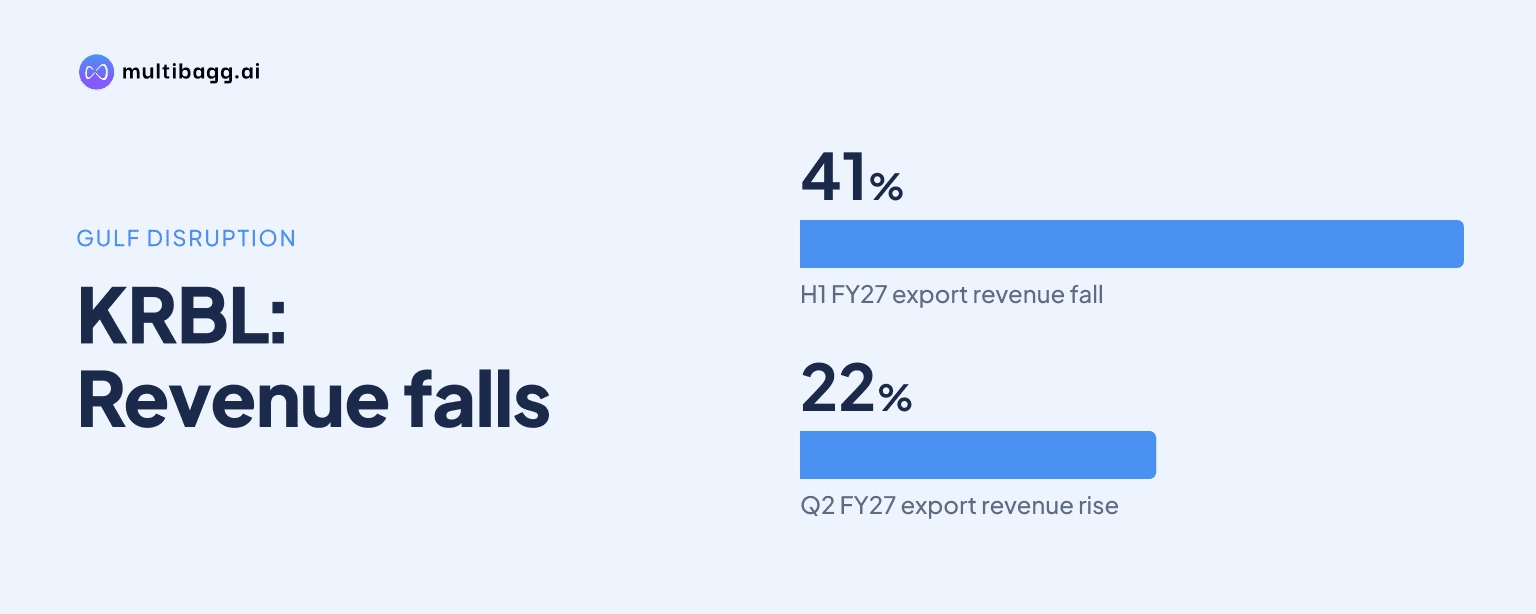
KRBL Limited said first-half FY27 export revenue fell 41% to Rs 541 crore because Gulf transit and payment disruption curtailed bulk rice trade, although Q2 FY27 export revenue rose 22% sequentially to Rs 297 crore and Indian basmati export realisations increased about 21% in rupee terms.
Know KRBL inside out
Results, valuation, peers and who's buying, in one view.
Why did KRBL’s export revenue fall 41% in the first half?
KRBL said its Rs 541 crore first-half FY27 export revenue decline was almost entirely due to lower bulk exports to the Middle East. Management cited more difficult payment channels in parts of the region, restricted movement through the Strait of Hormuz and its decision to take only opportunities where the risk-reward balance was acceptable.
The company’s Q2 FY27 export revenue of Rs 297 crore was 22% above Q1 FY27 but remained 31% below the prior-year quarter. That sequential increase indicates some recovery in shipments during Q2, while the year-on-year comparison shows that Gulf conditions continued to restrict business versus FY26.
India shipped about 2.5 million tonnes of basmati between April and August 2026, compared with 2.7 million tonnes in the same period a year earlier. Management said the entire decline was in the Middle East, while shipments to the rest of the world were unchanged, linking KRBL’s shortfall to the regional disruption rather than a broad export-market decline.
Is the Gulf disruption a demand problem for basmati rice?
Management said the Gulf issue is a logistics and transaction problem rather than a demand problem. Transit through the Strait of Hormuz has been intermittent, freight and war-risk premiums remain elevated, and marine cover is available on a shipment-by-shipment basis, adding uncertainty to export movement and costs.
Indian basmati export realisations were about 21% higher in rupee terms between April and August 2026, while the rupee value of India’s basmati exports rose around 12%. The increase in export value despite the fall to 2.5 million tonnes from 2.7 million tonnes supports management’s view that pricing and underlying demand have held up.
Trade has partly adapted through alternative routes. Basmati shipments to Jordan, largely for onward movement to Iraq, were up almost sixfold during the year and more than offset the decline in direct shipments to Iraq, according to management.
Iran remains an exception because payment and banking channels became considerably more difficult after US sanctions were tightened in August 2026. Management said low regional inventories could lead to restocking when routes become dependable, but it expects normalisation to be gradual rather than sudden.
How did domestic growth offset KRBL’s export weakness?
KRBL’s domestic revenue excluding power rose 33% year on year to Rs 1,390 crore in Q2 FY27, taking first-half domestic revenue to Rs 2,612 crore, up 24%. The company recorded its highest-ever quarterly revenue from operations of Rs 1,727 crore, up 14% year on year, as domestic expansion offset lower Middle East bulk exports.
Domestic branded rice sales rose 23% to Rs 1,134 crore from Rs 921 crore in Q2 FY27. Unbranded rice sales increased to Rs 166 crore from Rs 53 crore, although management said Rs 102 crore of that increase came from a selective additional rice sale.
Consumer-pack volume growth accelerated from 7% year on year in Q1 FY27 to 18% in Q2 FY27. Modern trade and e-commerce consumer-pack volumes grew 31%, general-trade consumer packs grew 10% after a decline of around 5% in Q1, and branded bulk-pack volumes rose 11% as buyers resumed purchases after waiting for prices to settle.
KRBL held domestic rice realisations at around Rs 80 per kg in both Q1 and Q2 FY27, about 12% above Q2 FY26. India Gate held around 36% volume share in general trade and 39.6% in modern trade for the 12 months ended September, while KRBL’s internal estimate put its September e-commerce exit share at 41.1%.
Got a follow-up? Ask IRIS
What do higher paddy prices mean for KRBL’s margins?
KRBL said major basmati paddy varieties traded at around Rs 4,500 to Rs 5,200 per quintal in late October 2026, at least Rs 1,000 per quintal above a year earlier. Management attributed the increase to almost no industry carryover stock, high export realisations and Middle East buyers rebuilding depleted inventories.
Management said KRBL would procure in stages rather than chase prices, focusing on low-moisture, high-recovery paddy. It also said the company had taken price increases across its portfolio in Q3 FY27 and would manage them by variant and channel while seeking market-share growth and protection of gross margins.
Gross margin in Q2 FY27 was 34.5%, compared with 29.2% in Q2 FY26, supported by higher realisations, product mix and higher other income. Earnings before interest, tax, depreciation and amortisation margin was 21.1%, versus 16.6%, while profit after tax was Rs 159 crore, compared with Rs 172 crore, and the reported margin rose to 14.6% from 11.2%.
Management also said Q2 FY27 gross profit and earnings before interest, tax, depreciation and amortisation were lower than in Q1 FY27 because other income declined. It attributed the lower other income to lower gains on the sale or revaluation of treasury investments and lower foreign-exchange gains.
What is KRBL expecting in the second half of FY27?
Management expects exports to recover progressively in the second half of FY27, subject to conditions in the Gulf. Saudi Arabia, KRBL’s largest export market, has steady demand and continues to be served through the wholesale route, while exports outside the Middle East grew 14% in the first half.
For domestic rice, management said about 10% volume growth remains achievable in FY27. That assessment is based on 18% Q2 consumer-pack volume growth, continued bulk-pack buying in October and 42% Q2 regional-rice volume growth, although management said it needs at least three months of data after price increases to assess consumer behaviour.
KRBL is also extending India Gate into adjacent categories through its retail base. By mid-September, poha had reached about 44% of existing rice outlets in launch towns and around 30% of retailers that stocked it had placed a repeat order; first-half masala sales rose to about Rs 4.5 crore from Rs 3.1 crore a year earlier.
Conclusion
The first-half export decline shows that KRBL’s exposure to Gulf bulk trade affected sales despite higher basmati realisations and continuing demand. Export revenue fell 41% to Rs 541 crore, but Q2 export revenue rose 22% from Q1, non-Middle East exports grew 14% in the first half, and domestic revenue excluding power rose 33% to Rs 1,390 crore in Q2.
The next issue to watch is whether Gulf transit, insurance and payment channels become dependable enough for the regional restocking management anticipates. In India, KRBL’s execution of Q3 FY27 price increases and management’s target of about 10% domestic rice volume growth will show how paddy prices of Rs 4,500 to Rs 5,200 per quintal move through the business.