










KRBL Q2 EBITDA margin reaches 21.1% despite lower profit
Key highlights
- KRBL reported a Q2 FY27 EBITDA margin of 21.1%, up from 16.6% in Q2 FY26.
- KRBL's Q2 FY27 PAT was Rs 159 crore, compared with Rs 172 crore in the corresponding quarter.
- KRBL held Rs 2,895 crore of cash, bank balances and treasury investments on September 30, 2026.
- KRBL's rice inventory declined to 278,000 tonnes on September 30, 2026, from 304,000 tonnes a year earlier.
powered by IRIS
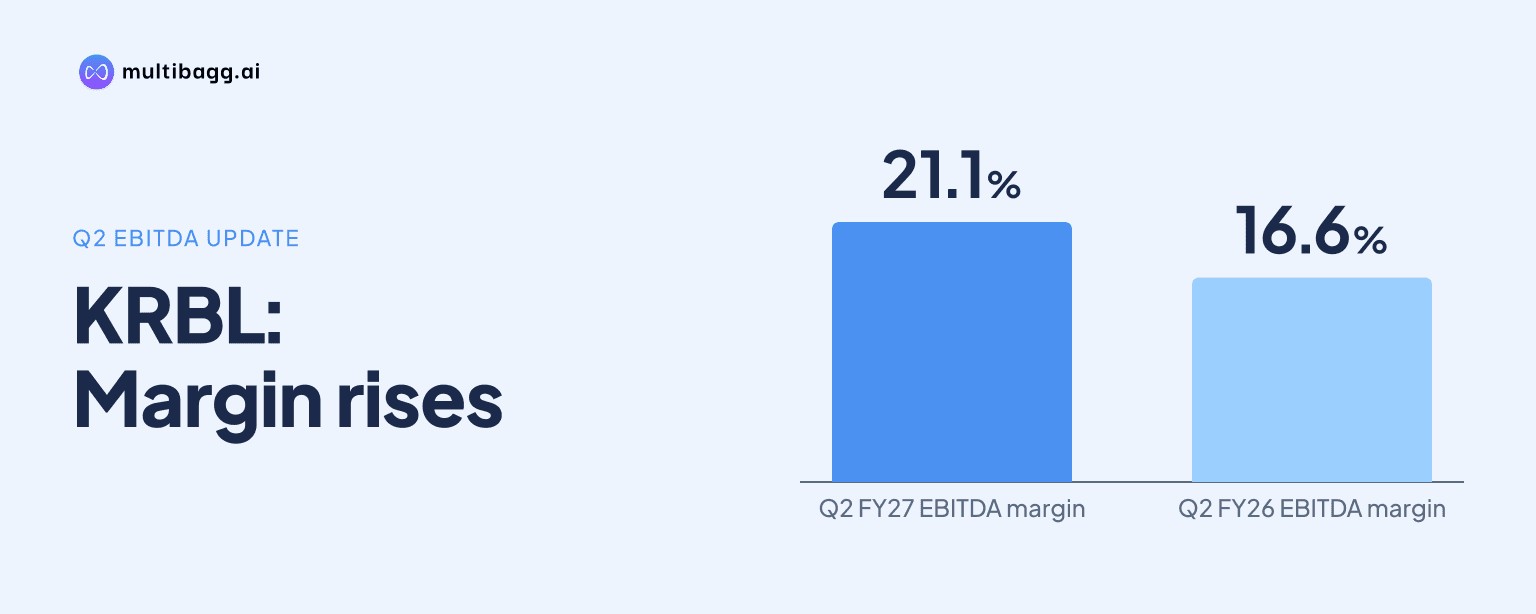
KRBL Limited reported a Q2 FY27 EBITDA margin of 21.1%, up from 16.6% a year earlier, as gross margin rose to 34.5% on higher realizations and product mix, while profit after tax fell Rs 13 crore to Rs 159 crore. KRBL held Rs 2,895 crore of cash, bank balances and treasury investments at September 30, 2026.
Know KRBL inside out
Results, valuation, peers and who's buying, in one view.
Why did KRBL's Q2 FY27 EBITDA margin rise to 21.1%?
KRBL's Q2 FY27 EBITDA margin rose because gross margin expanded to 34.5% from 29.2% in Q2 FY26. Management attributed the increase to higher realizations, better product mix and higher other income, although a higher proportional share of freight and advertising costs partly offset the benefit. Total income increased 15% year on year to Rs 1,768 crore for the quarter ended September 30, 2026.
The margin expansion did not result in higher absolute profit after tax, or PAT. KRBL reported Q2 PAT of Rs 159 crore, or 14.6% of income, compared with Rs 172 crore, or 11.2%, in the corresponding quarter. The transcript reports the lower PAT alongside the higher EBITDA margin but does not provide a specific reconciliation for the Rs 13 crore year-on-year decline.
KRBL's sequential comparison showed a different pattern. Revenue from operations rose 15% quarter on quarter to Rs 1,727 crore in Q2 FY27, with export revenue up 22% and domestic revenue up 14%. However, management said gross profit and EBITDA declined from Q1 because other income was lower, mainly owing to lower treasury-investment gains or revaluation gains and lower foreign-exchange gains.
How did KRBL's domestic business offset weaker Middle East exports?
KRBL's domestic business offset part of the export weakness through 33% year-on-year growth in Q2 domestic revenue, excluding power, to Rs 1,390 crore. First-half domestic revenue reached Rs 2,612 crore, up 24%, while H1 FY27 total income rose 6% to Rs 3,329 crore. Management attributed the domestic increase to branded volume and realization growth, alongside a selective bulk rice sale of Rs 102 crore.
Domestic branded rice sales increased 23% to Rs 1,134 crore from Rs 921 crore a year earlier. Unbranded rice sales rose to Rs 166 crore from Rs 53 crore, including the additional bulk sale. Consumer-pack volume growth accelerated to 18% in Q2 from 7% in Q1, while modern trade and e-commerce together recorded 31% consumer-pack volume growth and general trade grew 10% after a roughly 5% Q1 decline.
Exports remained affected by lower bulk shipments to the Middle East. H1 export revenue was Rs 541 crore, down 41%, while branded exports grew 18% and exports outside the Middle East rose 14%. Q2 export revenue of Rs 297 crore was 22% above Q1 but 31% below the prior-year quarter, as management cited tougher payment channels, restricted Strait of Hormuz movement and its decision to weigh risk against reward in bulk trade.
KRBL said India Gate held about 36% volume share in general trade for the 12 months ended September, nearly twice the next player’s share. Its share was 39.6% in modern trade, while internal estimates placed its September e-commerce exit share at 41.1%. India Gate was available in about 3.3 lakh outlets and reached around 1.2 crore urban households, according to management.
Got a follow-up? Ask IRIS
What do KRBL's inventory and cash balances show?
KRBL had lower rice inventory and higher liquidity at September 30, 2026, which management said provides flexibility for staggered new-crop procurement. Cash and bank balances, including treasury investments, stood at Rs 2,895 crore, compared with Rs 2,157 crore a year earlier. Management said it would not chase paddy prices when they run ahead of fundamentals.
Total inventory was Rs 2,203 crore, including Rs 146 crore of paddy and Rs 1,900 crore of rice. At September 30, 2025, paddy inventory was Rs 123 crore and rice inventory was Rs 1,995 crore. On a volume basis, paddy inventory declined to 31,000 tonnes from 33,000 tonnes, while rice inventory declined to 278,000 tonnes from 304,000 tonnes.
New-crop paddy prices were higher in late October. Management cited prices of about Rs 4,500 per quintal for 1509 paddy and Rs 5,200 per quintal for 1121 paddy in key Punjab and Haryana mandis, with both at least Rs 1,000 per quintal above the prior year. KRBL said its procurement would focus on quality, low moisture and high-recovery paddy, purchased in stages through the season.
What is KRBL's outlook for pricing, volumes and exports?
KRBL management continues to regard about 10% year-on-year domestic rice-volume growth as achievable in FY27. Domestic rice realizations averaged about Rs 80 per kilogram in both Q1 and Q2, around 12% above Q2 FY26. Management said it raised prices across the portfolio in Q3 and would manage pricing by variant and channel while seeking volume growth and protecting gross margins against higher paddy costs.
Management said it had not seen a noticeable movement from branded basmati to loose rice after category-wide price increases. It wants at least three months of purchasing data before drawing conclusions about whether consumers are trading down to lower-priced variants or smaller packs. Regional rice prices also matter, with wholesale Sona Masoori prices in parts of Karnataka reported at Rs 75 to Rs 80 per kilogram in early October, versus around Rs 50 previously.
For Q3 FY27, management indicated an EBITDA margin range of 16% to 20% because sales will include both old crop and higher-cost new crop. It said older-crop margins would be higher and added that the outcome should be nearer 20%, while noting that inventory includes products aged up to two years rather than stock meant for a single quarter.
KRBL said export recovery depends primarily on conditions in the Middle East, including vessel access through the Strait of Hormuz and payment conditions. Management said bulk sales in H1 were almost zero and that sales could more than double if the United States and Iran reached an agreement, potentially allowing bulk exports of 30,000 to 40,000 tonnes or more. That statement was conditional on the regional situation rather than a forecast of completed sales.
Conclusion
KRBL's Q2 FY27 results show that domestic sales, realizations and mix raised operating profitability even as lower Middle East bulk exports constrained the wider revenue mix. Gross margin improved by 5.3 percentage points to 34.5% and EBITDA margin rose by 4.5 percentage points to 21.1%, while PAT fell to Rs 159 crore. The Rs 2,895 crore liquidity balance and lower rice inventory give management capacity to time procurement as paddy costs rise.
The next indicators are the impact of Q3 portfolio price increases, progress toward management's approximately 10% FY27 domestic-volume objective and the margin effect of selling higher-cost new crop with older inventory. Investors will also watch Strait of Hormuz shipping access, Middle East payment channels and any United States-Iran agreement, because management linked a recovery in bulk exports to those unresolved conditions.