










Kuantum Papers Completes Four-Machine Upgrade Six Days Early
Key highlights
- PM 3 was commissioned on 28 August 2026 after 59 days, six days ahead of its 65-day shutdown plan.
- Kuantum Papers reduced wood-pulp steam consumption to 0.8 metric tonnes per tonne from 1.8 metric tonnes.
- Q2 FY27 operational income was Rs 279 crore, down 8% quarter on quarter because of the planned machine shutdown.
- August 2026 copier-paper production reached a monthly record of 4,482 metric tonnes.
powered by IRIS
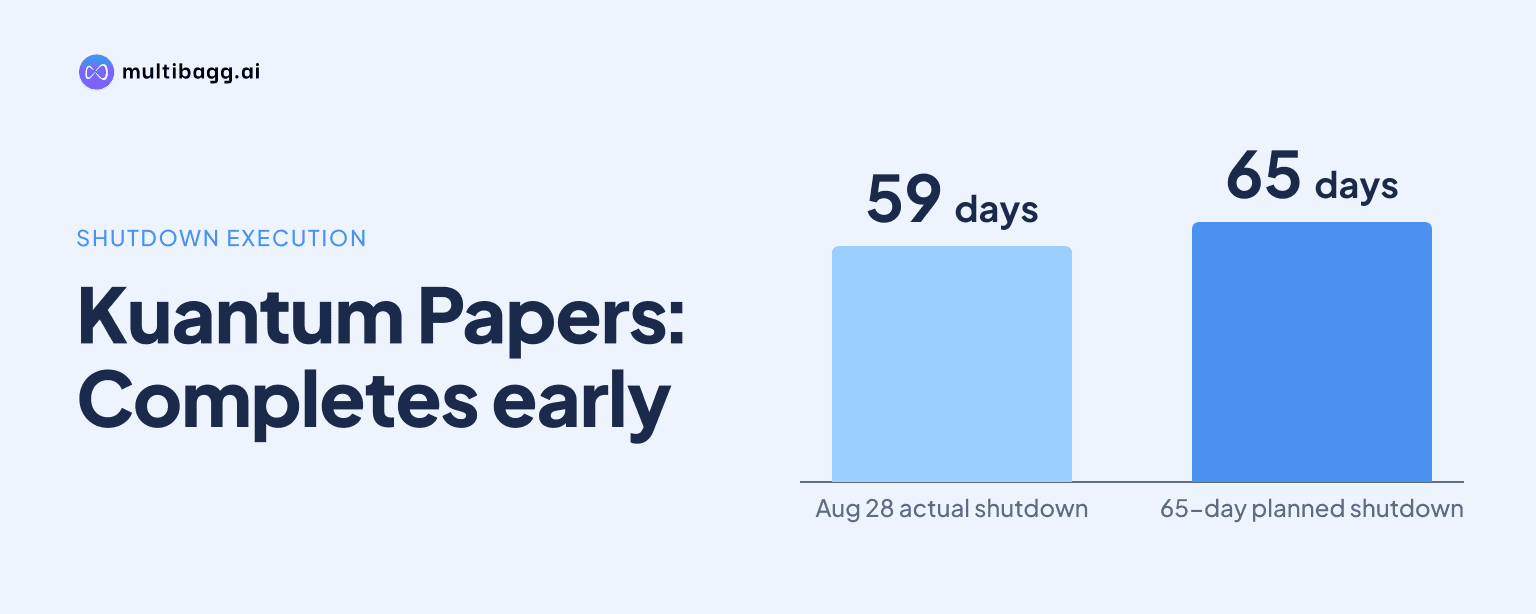
Kuantum Papers Limited completed the modernisation of all four paper machines when PM 3 was commissioned on 28 August 2026 after a 59-day rebuild, six days ahead of its 65-day shutdown plan. Kuantum Papers also reported that its Double Displacement Digester System reduced steam use to 0.8 metric tonnes per tonne of pulp from 1.8 metric tonnes.
Know Kuantum Papers inside out
Results, valuation, peers and who's buying, in one view.
What did Kuantum Papers complete with the PM 3 rebuild?
Kuantum Papers completed the upgrade and modernisation of all four paper machines through the commissioning of PM 3 on 28 August 2026. The PM 3 rebuild took 59 days against a scheduled shutdown period of 65 days, allowing the company to finish the work six days earlier than planned. Management described the commissioning as a milestone in its mill-upgradation programme.
PM 3 received a film press, I-table, table vision, web-break monitoring, a calendaring system and an automatic starch-cooking module. Management said these additions are intended to improve production efficiency, process control and paper quality. The completed four-machine programme gives Kuantum Papers an upgraded manufacturing base across its paper-machine operations.
How much has Kuantum Papers reduced pulp-making steam use?
Kuantum Papers reduced steam consumption in wood pulping by 1.0 metric tonne per tonne of pulp, to 0.8 metric tonnes from 1.8 metric tonnes, after fine-tuning its Double Displacement Digester System. The same system improved wood-pulp yield by 1%, according to management, combining a raw-material utilisation gain with lower energy use.
The digester result is relevant because management identified agricultural-material and fuel costs as pressures during Q2 FY27, even as domestic wood prices softened on better availability. In a separate cost comparison with Q1 FY27, management said the combined cost and consumption of agro and wood raw materials had declined by about 15% to 17%, but did not disclose an absolute rupee amount.
How did the PM 3 shutdown affect Kuantum Papers' Q2 FY27 results?
Kuantum Papers reported Rs 279 crore of Q2 FY27 operational income, down 8% quarter on quarter, because the planned shutdown of one paper-machine line for the upgrade reduced production and sales volume. Earnings before interest, tax, depreciation and amortisation, or EBITDA, were Rs 35 crore and the EBITDA margin was 12.4%, down 84 basis points from the preceding quarter.
The quarterly profit after tax was Rs 2 crore, with a 0.8% margin, as management cited lean-season selling realisations alongside higher raw-material and fuel costs. In contrast, first-half FY27 operational income rose 16% year on year to Rs 533 crore, while EBITDA of Rs 75 crore was broadly in line with the prior year; higher depreciation and finance costs left first-half profit after tax at Rs 9 crore and the margin at 1.5%.
Got a follow-up? Ask IRIS
What other operating changes has Kuantum Papers made?
Kuantum Papers overhauled its 20-megawatt turbine generator and one 30-tonne-per-hour boiler during Q2 FY27 to improve equipment efficiency, reduce energy consumption and support reliable operations. The company also introduced a single-vendor chemical solution across its Agro Pulp Mill and Hardwood Pulp Mill under its Total Cost Management initiative, which management said delivered cost savings.
The company recorded its highest monthly copier-paper production of 4,482 metric tonnes in August 2026, a month that included the PM 3 commissioning. Its research and development team also completed the protocol for PFAS-free 40 GSM, or grams per square metre, oil-and-grease-resistant paper for food wrapping. Management said this specialty paper was commercially launched in Q3 FY27, adding a value-added product to the portfolio.
What is Kuantum Papers expecting after the upgrade?
Kuantum Papers management said Q3 FY27 was looking more upbeat than the seasonally lean Q2 FY27 and expected paper prices to increase by 7% to 11%. It said no price increase affected Q2 results because action came only toward the end of the quarter. Management also said it operated at 100% capacity utilisation in Q2 FY27 and sold all it produced by collecting orders in advance.
Management expects domestic paper-price increases to be sustained for at least the next two quarters, while cautioning that pricing and input costs move independently in a competitive market. It estimated that the West Asia conflict added about 2% of sales to chemical costs on a quarterly basis, while fuel-cost impact was around 3% to 3.5%. Wood availability was expected by management to increase, with prices stable or lower rather than rising.
Conclusion
The finished four-machine programme moves Kuantum Papers from a period of shutdown-led volume disruption to one in which it can seek benefits from upgraded equipment. The 59-day PM 3 rebuild, 1% wood-pulp-yield improvement and reduction in pulp steam use from 1.8 to 0.8 metric tonnes per tonne are the disclosed operational measures that management links to lower resource and energy consumption.
Investors will next watch whether Q3 FY27 price realisations rise within management's stated 7% to 11% range and whether the upgraded assets support profitability after Q2 FY27 EBITDA margin of 12.4%. Kuantum Papers also plans to target annual production of about 1 crore clonal saplings within the next two to three years, following Q2 FY27 production of 17.93 lakh saplings and plantation coverage above 22,000 acres.