










Kuantum Papers targets 75,000 farm-forestry acres by 2030
Key highlights
- Kuantum aims to cover 75,000 acres through farm forestry by 2030, compared with more than 22,000 acres planted so far.
- Kuantum plans to expand its Clonal Propagation Centre to produce 1 crore clones annually.
- Kuantum’s FY26 raw-material mix was 50% agro residues, 48% locally procured wood and 2% imported wood.
- Kuantum has 365 MT per day of pulp capacity and irrigates more than 2,050 acres with treated effluent.
powered by IRIS
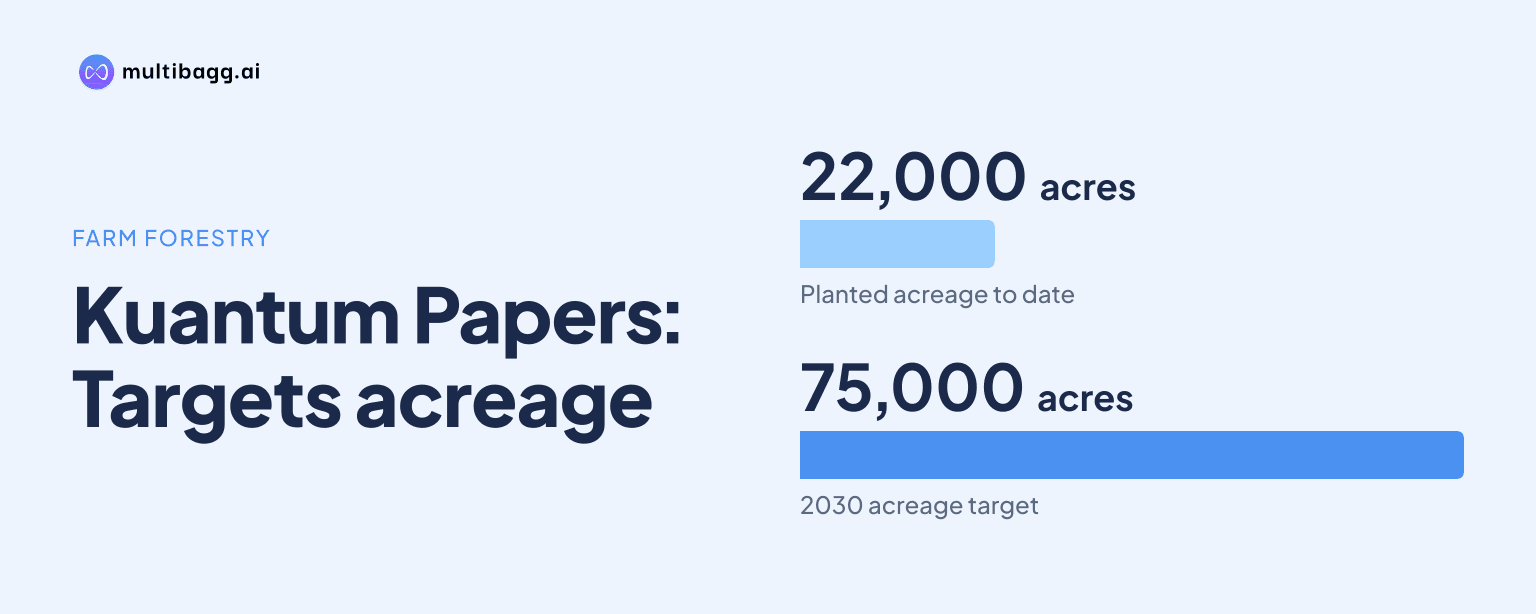
Kuantum Papers aims to cover 75,000 acres through social farm forestry by 2030, after establishing successful plantations across more than 22,000 acres. The plan is paired with a proposed annual capacity of 1 crore clonal saplings and comes as imported wood represented 2% of Kuantum’s FY26 raw-material mix.
Know Kuantum Papers inside out
Results, valuation, peers and who's buying, in one view.
What is Kuantum’s 2030 farm-forestry target?
Kuantum targets coverage of 75,000 acres by 2030 through its social farm forestry programme, compared with more than 22,000 acres of successful plantations achieved so far. The company also aims to expand its in-house Clonal Propagation Centre to produce 1 crore clones annually, providing the planting material for the stated acreage objective.
The programme began more than a decade ago at Kuantum’s Clonal Propagation Centre. It cultivates clonal saplings of Eucalyptus, Poplar, Casuarina, Melia and Subabul, and the presentation describes the initiative as supporting small and marginal farmers with barren or non-fertile land while creating a sustainable wood source.
Kuantum says the programme is intended to secure raw material within a specified radius of its operations. According to the company, local availability can reduce overall manufacturing costs and provide multi-year wood availability; however, the presentation does not quantify expected wood volumes, cost savings or the proportion of the 75,000 acres that would supply the mill.
The 2030 plan expands a supply channel rather than replacing the sources currently disclosed. As of FY26, agro residues accounted for 50% of Kuantum’s raw-material mix, locally procured wood accounted for 48%, and imported wood represented 2%. The target therefore relates to a raw-material base that continues to include wheat straw and purchased local wood.
How does Kuantum currently source pulp raw materials?
Kuantum operates separate agro-pulping and wood-pulping streets with combined capacity of 365 metric tonnes, or MT, of pulp a day. The agro-pulping street has capacity of 165 MT per day, while the wood-pulping street has 200 MT per day, making the latter 35 MT per day larger.
Wheat straw accounts for about 100% of pulp from the 165-MT-per-day agro street. This feedstock aligns with agro residues making up 50% of Kuantum’s overall FY26 raw-material mix, two percentage points more than the 48% contribution from locally procured wood.
In the 200-MT-per-day wood street, wood chips and wood logs account for 93% of wood pulp, while bamboo accounts for 7%. Kuantum says wood materials are predominantly sourced as wood chips and veneer waste, which are by-products from furniture and plywood industries, alongside wood from certified sustainable forestry operations.
The FY26 input mix and the two pulp lines measure different parts of the operating model. Agro residues had the larger raw-material share at 50%, but the wood-pulping street had the greater installed capacity at 200 MT a day versus 165 MT for agro pulp. Kuantum does not provide throughput or utilisation data for either line.
Got a follow-up? Ask IRIS
How does Kuantum recover and make mill inputs?
Kuantum says its Chemical Recovery Plant recovers and reuses more than 95% of caustic soda through black-liquor treatment. The facility has capacity of 700 tonnes per day of black-liquor solids, comprising Recovery Boiler 1 at 200 solids tonnes per day and Recovery Boiler 2 at 500 solids tonnes per day.
The 500-tonnes-per-day boiler is a HERB recovery boiler supplied by Andritz and based on SRS technology, according to Kuantum. The Chemical Recovery Plant includes a recovery boiler, evaporator and recausticizing plant, and the company says the system has increased its steam-to-solid ratio without disclosing the ratio before or after the installation.
Kuantum also has an on-site precipitated calcium carbonate, or PCC, plant established with Specialty Minerals Inc. PCC is a paper-production filler, and the company says it recently expanded plant capacity from 25,000 tonnes per annum to 50,000 tonnes per annum, a doubling of capacity.
A separate collaboration with Tanovis AG covers a full-scale lignin precipitation system that separates non-biodegradable lignin from black liquor. Kuantum describes the system as first-of-its-kind in the world, but does not disclose its throughput, lignin output, sales volume or financial contribution.
How does treated effluent connect with Kuantum’s local sourcing plan?
Kuantum uses treated effluent to irrigate more than 2,050 acres of fields in surrounding villages through a pipeline network installed at its expense. This infrastructure connects the company’s effluent treatment system with nearby agricultural land, although the presentation does not state whether those fields overlap with the more than 22,000 acres under farm forestry.
The upgraded Effluent Treatment Plant has two streams based on chemical oxygen demand, or COD. Low-COD Stream 1 uses aerobic treatment and high-COD Stream 2 uses anaerobic treatment; Kuantum says the upgrade is intended to meet treated-effluent parameters and prepare for environmental norms, without giving water-volume or COD-reduction data.
The two programmes have distinct disclosed purposes and scales. Farm forestry has a 2030 coverage target of 75,000 acres to establish a sustainable wood source, while treated effluent currently irrigates more than 2,050 acres of nearby fields. The presentation supports local agricultural links but does not establish that irrigation is a direct contributor to the forestry target.
Kuantum’s operating infrastructure also includes a captive co-generation plant with turbines totalling 38 megawatts and boilers rated at 190 tonnes per hour. The company says the system supports its own power and steam needs and reduces dependence on the state power grid, but it does not quantify a connection between co-generation capacity and forestry or raw-material output.
Conclusion
Kuantum’s disclosed raw-material approach combines a 75,000-acre farm-forestry objective with a FY26 mix of 50% agro residues, 48% locally procured wood and 2% imported wood. Its 365-MT-per-day pulp capacity uses wheat straw in the agro line and primarily wood chips and logs in the wood line, while chemical recovery and PCC production support mill-input processing.
The next disclosed milestone is the 2030 goal of covering 75,000 acres and expanding the Clonal Propagation Centre to annual output of 1 crore clones. Updates on plantation acreage, clone-production capacity, future raw-material mix and any quantified effect on manufacturing costs or wood availability will show how the plan progresses.