










Kuantum Papers pairs 540 TPD capacity with 38 MW power
Key highlights
- Kuantum has 540 TPD of approved paper capacity across four machines, including PM4 at 285 TPD.
- Kuantum’s pulping facilities total 365 TPD, split between 165 TPD of agro pulp and 200 TPD of wood pulp.
- Kuantum’s chemical recovery plant processes 700 TPD of black-liquor solids and recovers more than 95% of caustic soda.
- Kuantum’s co-generation equipment includes 38 MW of turbines and 190 TPH of boilers.
powered by IRIS
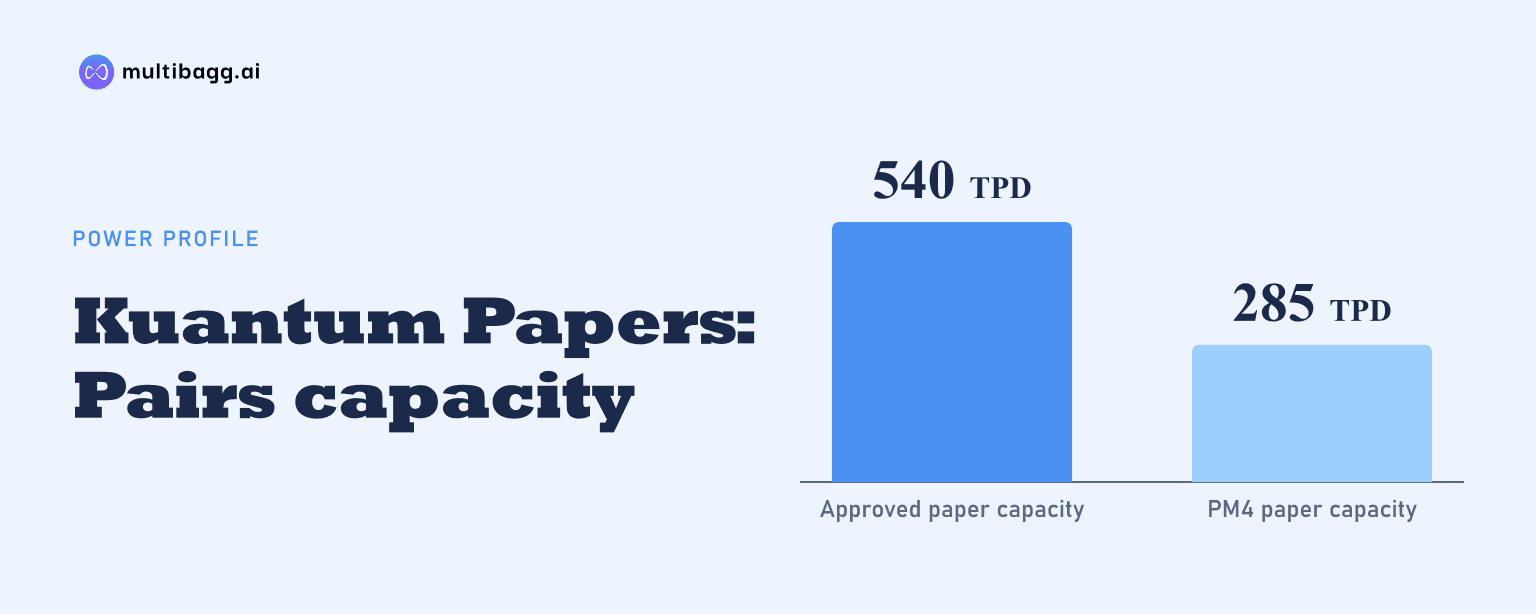
In its current-facilities disclosure, Kuantum Papers reports 540 tonnes per day (TPD) of approved paper capacity supported by 365 TPD of pulping, 38 megawatts (MW) of installed turbine capacity and recovery of more than 95% of caustic soda from black liquor. The stated configuration links paper making with fibre processing, chemical recovery and captive steam and power.
Know Kuantum Papers inside out
Results, valuation, peers and who's buying, in one view.
How is Kuantum’s 540 TPD paper capacity divided?
Kuantum’s 540 TPD approved paper capacity is divided among four paper machines, with PM4 contributing 285 TPD, more than half of the total. PM3 contributes 115 TPD, while PM2 and PM1 contribute 75 TPD and 65 TPD respectively. PM4 has 170 TPD more capacity than PM3, the second-largest machine.
Kuantum says the different configurations of its four machines enable it to make surface-sized, non-surface-sized and value-added specialty products. It says upgrades and modifications to PM1, PM2 and PM4 increased production capacity, improved quality and expanded its value-added range. The presentation does not provide pre-upgrade capacities or production volumes for the three upgraded machines.
The company’s manufacturing process places the paper machines after raw-material aggregation, pulping, cooking and washing, screening and bleaching. It then identifies roll forming, sheeting and cutting, warehousing and distribution as subsequent stages. This sequence shows that the 540 TPD figure is part of a mill process with upstream pulp preparation rather than a stand-alone paper-machine operation.
What pulp facilities support Kuantum’s paper machines?
Kuantum has 365 TPD of pulping capacity, comprising 165 TPD of agro-based pulp and 200 TPD of wood pulp. The wood-pulp stream is 35 TPD larger than the agro-pulp stream, while paper capacity exceeds disclosed in-house pulping capacity by 175 TPD. Kuantum says it combines its own agro and wood pulp with imported pulp to produce fibre for paper.
The agro-pulping street uses agro residues, primarily wheat straw, and its disclosed 165 TPD capacity is entirely separate from the 200 TPD wood-pulping street. In the wood-pulp mix, wood chips and wood logs account for 93% and bamboo accounts for 7%. The company describes wood chips and veneer waste as byproducts of furniture and plywood industries, while also citing certified sustainable forestry operations as a wood source.
Kuantum says its Displacement Digester System, or DDS, has improved pulp yield in the wood-pulping operation. It also says it has eliminated dependency on imported hardwood pulp by becoming self-reliant in wood raw material, and is seeking to replace imported softwood pulp with in-house wood pulping. Those statements concern hardwood and softwood pulp specifically, whereas the facility overview still states that imported pulp is combined with in-house fibre.
As of FY26, Kuantum reported a raw-material mix of 50% agro residues, 48% locally procured wood and 2% imported wood. Agro residues and locally procured wood therefore represented 98% of that mix. The company also cites its Punjab location as providing access to wheat straw, samandha and bagasse, although the FY26 agro-pulp composition is shown as approximately 100% wheat straw.
How does Kuantum recover caustic soda from black liquor?
Kuantum’s chemical recovery plant has capacity for 700 TPD of black-liquor solids, split between a 200 solids TPD Recovery Boiler 1 and a 500 solids TPD Recovery Boiler 2. The recovery system includes a recovery boiler, evaporator and recausticizing plant. It receives black liquor from the pulping process and is designed to return recovered chemicals to later pulp-production runs.
Kuantum says treatment of black liquor recovers and reuses more than 95% of caustic soda. The company says this mechanism enables cost reductions, margin improvements and reuse in subsequent pulp production, but it does not disclose a financial value for savings or margin change. The recovery rate is stated as more than 95%, rather than as an annual volume of caustic soda recovered.
The company says its 500 TPD HERB recovery boiler, supplied by Andritz, uses SRS technology to process caustic from black liquor. It also says the chemical recovery plant has increased the steam-to-solid ratio, improving overall operating efficiency. The 500 solids TPD boiler represents more than twice the 200 solids TPD capacity of the other recovery boiler.
Got a follow-up? Ask IRIS
How does Kuantum’s captive power plant serve the mill?
Kuantum has 38 MW of installed turbine capacity and 190 tonnes per hour (TPH) of operational boiler capacity at its co-generation plant. The plant has two turbines and two boilers rated at 60 TPH and 130 TPH. The 130 TPH boiler is 70 TPH larger than the 60 TPH boiler and accounts for more than two-thirds of total disclosed boiler capacity.
Kuantum says the co-generation plant is intended to make it self-sufficient in power and steam requirements and to reduce dependency on the State Power Grid. The facility overview says the plant supplies uninterrupted steam and power to process units. That mechanism connects captive energy to pulp manufacture, chemical recovery and paper making within the integrated site.
The company states that the 130 TPH high-pressure CFBC boiler, or circulating fluidized bed combustion boiler, operates with an extraction-cum-condensing turbine and an extraction-cum-back-pressure turbine. Management says this configuration generates power at rates below grid rates. The presentation does not disclose actual electricity generation, turbine utilisation, grid tariffs or a quantified power-cost saving, so the 38 MW figure is installed capacity rather than reported output.
What environmental and fibre infrastructure is part of Kuantum’s mill?
Kuantum’s integrated infrastructure includes an effluent treatment plant alongside four paper machines, agro and wood pulp mills, a chemical recovery plant and a co-generation plant. The effluent plant has two treatment streams: a low chemical oxygen demand, or COD, stream using aerobic treatment and a high-COD stream using anaerobic treatment. The company says it upgraded the facility to meet treated-effluent parameters and prepare for environmental norms.
Kuantum says treated effluent is used to irrigate more than 2,050 acres of fields in surrounding villages through a pipeline network laid at its expense. The presentation does not disclose the upgrade’s cost, completion date or treated-effluent quality results. It therefore identifies the treatment mechanism and land coverage, but not a measured environmental outcome.
The company also states that it aims to increase its Clonal Propagation Center’s capacity to produce 1 crore clones annually and cover more than 75,000 acres by 2030. Kuantum describes this target as supporting a sustainable source of wood material. The presentation does not give the center’s current clone-production capacity, capital expenditure or interim milestones.
Conclusion
Kuantum’s disclosed setup combines four paper machines, two separate pulp streams, two chemical-recovery boilers and two turbines within one mill. PM4 is the largest paper machine at 285 TPD, the wood-pulp stream is 200 TPD against 165 TPD for agro pulp, and the 700 solids TPD recovery system is intended to reuse caustic soda from black liquor.
The next disclosed milestone is Kuantum’s aim to reach annual production of 1 crore clones and cover more than 75,000 acres by 2030 through its Clonal Propagation Center. Progress toward that target would indicate how the company is developing its stated sustainable wood-material source alongside its existing 48% locally procured wood share in the FY26 raw-material mix.