










Kuantum Papers Limited sees 7%-11% H2 FY27 price rise on demand
Key highlights
- Kuantum Papers expects paper prices to increase by 7% to 11% in H2 FY27.
- Q2 FY27 operational income was Rs 279 crore, down 8% quarter on quarter.
- Q2 FY27 EBITDA margin was 12.4%, down 84 basis points quarter on quarter.
- Management estimated chemical inflation at about 2% of quarterly sales and fuel-cost pressure at about 3% to 3.5%.
powered by IRIS
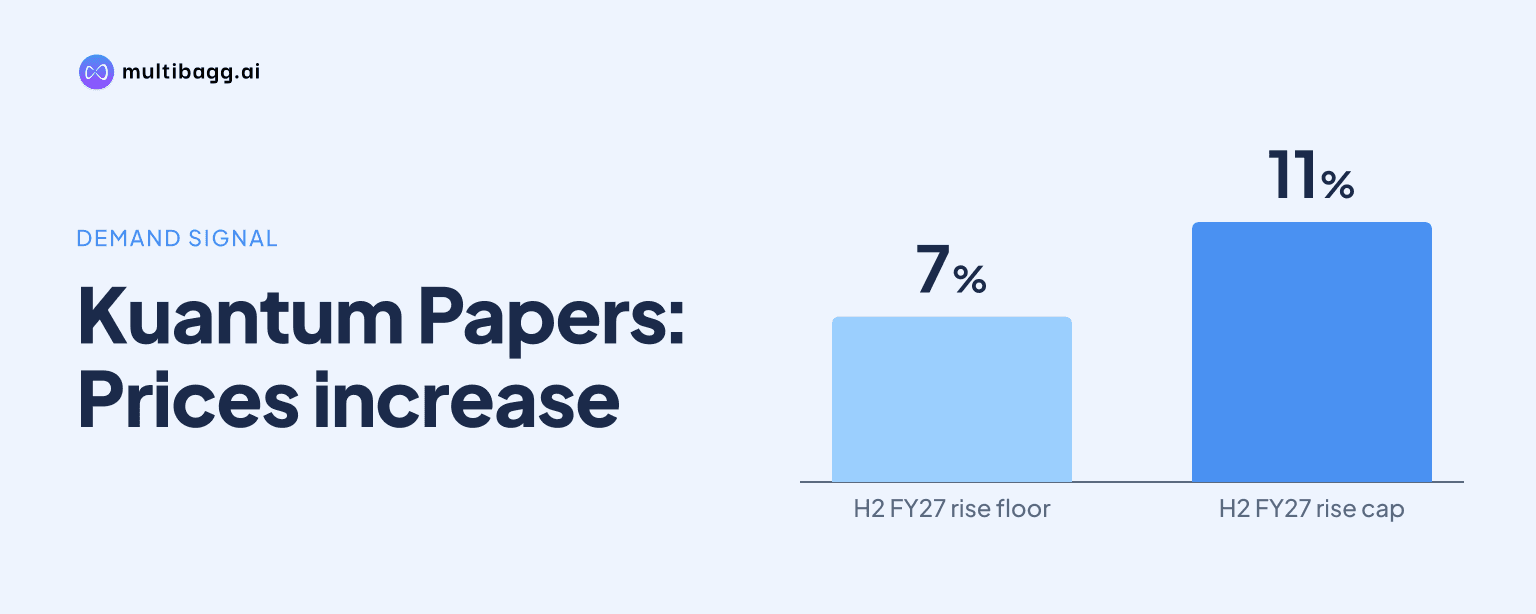
Kuantum Papers Limited expects a 7% to 11% paper-price increase in H2 FY27, after Q2 FY27 EBITDA margin fell 84 basis points to 12.4%, as management expects seasonal demand and stable imports to improve realisations despite fuel and chemical cost inflation.
Know Kuantum Papers inside out
Results, valuation, peers and who's buying, in one view.
What price increase does Kuantum Papers expect in H2 FY27?
Kuantum Papers expects paper prices to increase by 7% to 11% in H2 FY27. Management said Q3 FY27 was looking upbeat, with market tailwinds indicating better price realisations after the seasonally lean Q2 FY27 period.
The company said a price action occurred only toward the end of Q2 FY27 and therefore did not materially affect that quarter's financial results. The 7% to 11% range is management's expectation for the second half, rather than a reported Q2 FY27 increase in realised prices.
Management also said the upward price trend could be sustained for at least the next two quarters. It linked that outlook to the normal seasonal improvement in H2 demand from paper-consuming sectors, while noting that paper pricing is determined by market forces rather than being automatically passed through from cost increases.
Why does Kuantum Papers expect demand to support prices?
Kuantum Papers said it operated at 100% capacity utilisation in Q2 FY27 and sold all the paper it produced despite the lean season. Management attributed this to advance order collection for production lines and the company's market presence, which it said supported absorption of available output.
Management described paper imports as stable, rather than increasing as they had over the prior two years. It said higher ocean freight linked to the West Asia conflict had reduced import volumes and limited their effect on the domestic paper market.
The import trend does not eliminate additional domestic supply. Management said Indian exports had also declined because of elevated ocean freight, leaving material that had previously been exported available in the domestic market. It characterised the resulting demand-and-supply position as stable and said it was seeking antidumping duties across paper grades, although no government decision or timing was disclosed.
How are fuel, chemicals and raw materials affecting Kuantum Papers?
Kuantum Papers said higher chemical costs, particularly for sulfuric acid sourced from West Asia, had an impact of about 2% of quarterly sales. The company reported that lower net selling realisations in Q2 FY27 occurred alongside this chemical inflation during the lean-demand period.
Fuel costs were also rising, with management estimating an impact of about 3% to 3.5%. The company said coal allocated through sanctioned supply had been diverted primarily to the power sector, requiring industry buyers to use the open market, where prices were higher. Kuantum Papers normally uses an 85:15 coal-to-agro-fuel mix.
Management said overall agro and wood raw-material cost and consumption had declined by about 15% to 17% versus Q1 FY27, without disclosing an absolute rupee amount. It expects greater wood availability to support stable or lower wood prices, while wheat-straw prices were temporarily elevated because of harvesting-time rain and labour shortages.
Starch represented no more than about 2% to 2.5% of total paper cost, according to management. It said wheat-straw prices could normalise after Diwali, when labour engaged in rice harvesting becomes more available for loading and unloading, but also cited other rising inputs including chemicals, fuel and agricultural materials.
Got a follow-up? Ask IRIS
What did Q2 FY27 show about Kuantum Papers' profitability?
Kuantum Papers reported Q2 FY27 operational income of Rs 279 crore, down 8% quarter on quarter, because a planned shutdown of PM 3 reduced production and sales volume. EBITDA, or earnings before interest, tax, depreciation and amortisation, was Rs 35 crore, with margin declining by 84 basis points to 12.4%.
Profit after tax was Rs 2 crore in Q2 FY27, equal to a 0.8% margin. Management attributed the lower profitability to lean-season realisations, higher raw-material and fuel costs, and the effect of West Asia-linked chemical inflation.
For H1 FY27, operational income rose 16% year on year to Rs 533 crore, while EBITDA was Rs 75 crore and broadly in line with the prior year. Profit after tax was Rs 9 crore, with a 1.5% margin, as higher depreciation and finance costs affected earnings; management said it expected H2 FY27 EBITDA margin to be about 14%.
How could PM 3 and efficiency projects affect H2 FY27?
Kuantum Papers commissioned PM 3 on August 28, 2026, after completing its rebuild in 59 days against a planned 65-day shutdown. Management said all four paper machines have now been upgraded under the mill-modernisation plan, while the PM 3 shutdown resulted in production loss of about 6,300 tonnes.
Management expects the revised product mix to support marketable finished output of close to 600 tonnes a day. The project capacity can reach 675 tonnes a day at an anchor basis weight of 64 grams per square metre, or GSM, but management said orders are increasingly for 52, 54 and 58 GSM grades, which limit tonnage output relative to the 64 GSM benchmark.
The double-displacement digester system improved wood-pulp yield by 1% and reduced steam consumption from 1.8 tonnes to 0.8 tonnes per tonne of pulp. Management also estimated that its chemical-vendor arrangement could save 1.5% to 2% of overall chemical consumption, while clarifying that the Agro Pulp Mill and Hardwood Pulp Mill use different vendors.
Conclusion
Kuantum Papers' 7% to 11% H2 FY27 pricing expectation follows a Q2 in which operational income declined 8% quarter on quarter and EBITDA margin reached 12.4%. Management's view relies on seasonal demand, full Q2 capacity utilisation and stable imports, while the effect of fuel, chemical and wheat-straw costs remains a countervailing factor.
The next indicators are whether Q3 FY27 realisations reflect the expected price rise and whether H2 FY27 EBITDA margin approaches management's roughly 14% expectation. Management's progress towards close to 600 tonnes a day of marketable output, normalisation of wheat-straw prices after Diwali, and its target of about 1 crore clonal saplings annually in the next two to three years are also factors to watch.