










Lenskart says AI now anchors hiring and store operations
Key highlights
- Remote optometry operated in 934 Indian stores in Q2 FY27, up from 303 a year earlier.
- Lenskart says AI now interviews and scores candidates for every role, from store executive to vice president.
- Customer-satisfaction scores on AI-assisted calls rose by about 30% in one quarter, according to management.
- Lenskart conducted 78.7 lakh eye tests in Q2 FY27, up 40.4% year on year.
powered by IRIS
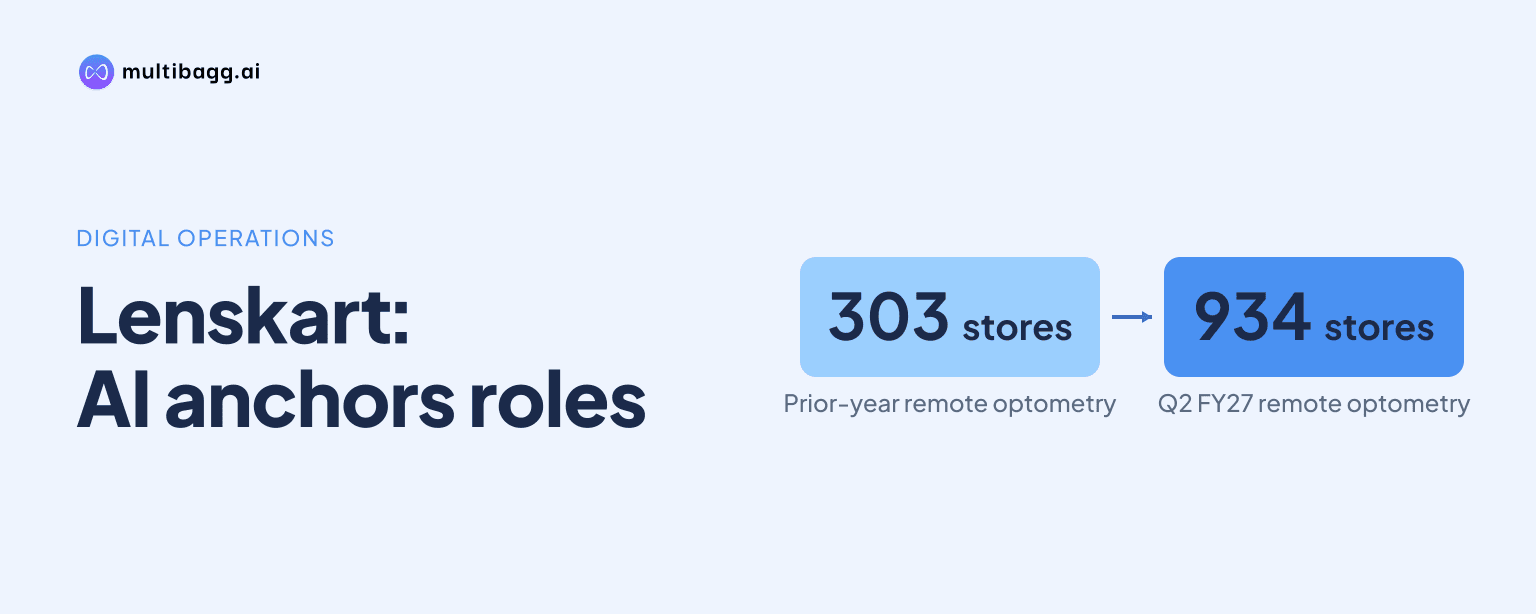
Lenskart says artificial intelligence now supports core hiring, customer calls, store management and eye-testing capacity in Q2 FY27, with remote optometry operating in 934 Indian stores versus 303 a year earlier. The company also says AI interviews every candidate, while its call agent lifted customer-satisfaction scores by about 30% in one quarter.
Know Lenskart Solutions inside out
Results, valuation, peers and who's buying, in one view.
How is Lenskart using AI in its stores?
Lenskart uses AI to extend optometry and operating support across its store network. Remote optometry was active in 934 Indian stores in Q2 FY27, up by 631 from 303 a year earlier. Management linked this capability to opening 94 Tier 2+ stores during the quarter, because it can make optometrist expertise available without requiring one to be physically present at every location.
Drysh is Lenskart’s next eye-testing tool: an AI-assisted examination that a customer completes largely independently while an optometrist supervises. Drysh is in pilot before a wider rollout, with no store target or rollout date disclosed. The capacity requirement is illustrated by consolidated eye tests rising 40.4% year on year to 78.7 lakh in Q2 FY27 from 56.1 lakh in Q2 FY26.
What does Saathi do for Lenskart store managers?
Saathi is a WhatsApp assistant that gives store managers daily performance information and operating guidance. Lenskart says thousands of people on the ground use it, receiving an update each morning on the previous day’s store performance. A manager can ask why conversion fell or how to sell a progressive lens, and Saathi responds using that store’s data and Lenskart’s playbooks.
The tool is intended to improve consistency as the retail base expands. Lenskart had 3,624 active stores at the end of Q2 FY27, compared with 2,949 at the end of Q2 FY26, after adding 165 net stores in the latest quarter. Management describes Saathi as a long-term bet and did not disclose a quantified effect on conversion, sales per store or employee costs.
Does Lenskart use AI for every job interview?
Yes, Lenskart says AI interviews and assesses candidates for every role, from store executive to vice president. The system screens a profile, conducts the interview and scores candidates on criteria that vary by role, including culture, problem solving and merchandising. Management says this has become the core recruitment process rather than an experiment, allowing it to consider thousands more candidates annually.
Lenskart also uses AI in training through Lenskart Academy, its retail-floor training and certification platform. Learners end classroom days with AI roleplays covering cart abandonment, delivery complaints and first-time buyers, while optometrists complete more than 100 practice eye tests before their first real test. Management has identified 99.9% service reliability as an aspiration, but the presentation does not report a current reliability rate or an AI-related hiring conversion rate.
Got a follow-up? Ask IRIS
What is Lenskart’s AI call assistant doing?
Lenskart’s AI voice assistant answers customer calls without an interactive voice response menu or queue and resolves simple queries end to end. Complex cases, or any sign of customer frustration, are transferred immediately to a human agent. The company says the model was trained on a decade of its customer conversations and that customer-satisfaction scores on calls rose by about 30% in one quarter.
The deployment remains early, according to management, which says it is improving the agent daily. Lenskart did not disclose AI call volumes, resolution rates, transfer rates or cost savings. Its potential operating relevance is framed by 57.9 lakh quarterly transacting customer accounts in Q2 FY27, up 19.4% from 48.2 lakh a year earlier, alongside 106.1 lakh eyewear units sold, up 27.1%.
How does Lenskart use AI to replenish frames?
Lenskart is replacing manual frame-allocation decisions with Argus, its AI-driven replenishment engine. Argus assesses frame attributes including price band, material, shape, size and colour, creating more than 500 possible combinations per store. It draws on a decade of sales data and TangoEye data to learn which frames are likely to sell at each location.
Argus is still learning, management says, so Lenskart has not reported a measured effect on inventory, fill rates or sales. Its intended result is less idle inventory and a higher chance that a customer finds the desired frame in a store. Net working-capital days were 12.8 in Q2 FY27, down from 21.6 in Q2 FY26 but above 6.3 in Q1 FY27; the company does not attribute those movements to Argus.
What should investors watch in Lenskart’s AI rollout?
The principal disclosed milestone is a wider Drysh rollout after the current pilot. Lenskart has not set a date, store count or capital budget for Drysh, but remote optometry’s expansion to 934 stores in Q2 FY27 provides an indication of the company’s existing deployment capacity. Management specifically connected remote optometry with its 94 Tier 2+ store openings in the quarter.
Further evidence will depend on whether Lenskart publishes outcome data for Saathi, Argus, AI hiring and call handling. The company reported Q2 FY27 revenue from operations of Rs 2,845 crore, up 32.5% year on year, and EBITDA before Indian Accounting Standard 116, or IndAS 116, of Rs 392 crore, up 65.0%. It does not attribute either financial measure to AI, so these results provide business context rather than evidence of AI-led profitability.
Conclusion
Lenskart has put AI into processes that touch staffing, customer support, store execution, frame allocation and optometry capacity, rather than limiting it to a single pilot. The clearest evidence of scale is remote optometry in 934 Indian stores in Q2 FY27, while AI-led interviews apply to all roles and the call agent has produced a disclosed increase of about 30% in customer-satisfaction scores over one quarter.
The next development to watch is Drysh’s wider rollout, for which Lenskart has not disclosed a timetable or store target. Management also says Argus remains in a learning phase and retains a 99.9% service-reliability aspiration, making measurable disclosures on recruitment quality, call resolution, store conversion and inventory availability the unresolved tests of the programme.