










Lenskart Q2 profit doubles as pre-Ind AS EBITDA margin hits 13.8%
Key highlights
- Lenskart reported Q2 FY27 profit after tax of Rs 232 crore, up 106.1% year on year.
- Lenskart’s pre-Ind AS 116 EBITDA margin increased to 13.8% from 11.1% in Q2 FY26.
- Lenskart added 165 net new stores in Q2 FY27, taking its active store count to 3,624.
- Lenskart conducted 80 lakh eye tests in Q2 FY27, up 40.4% year on year.
powered by IRIS
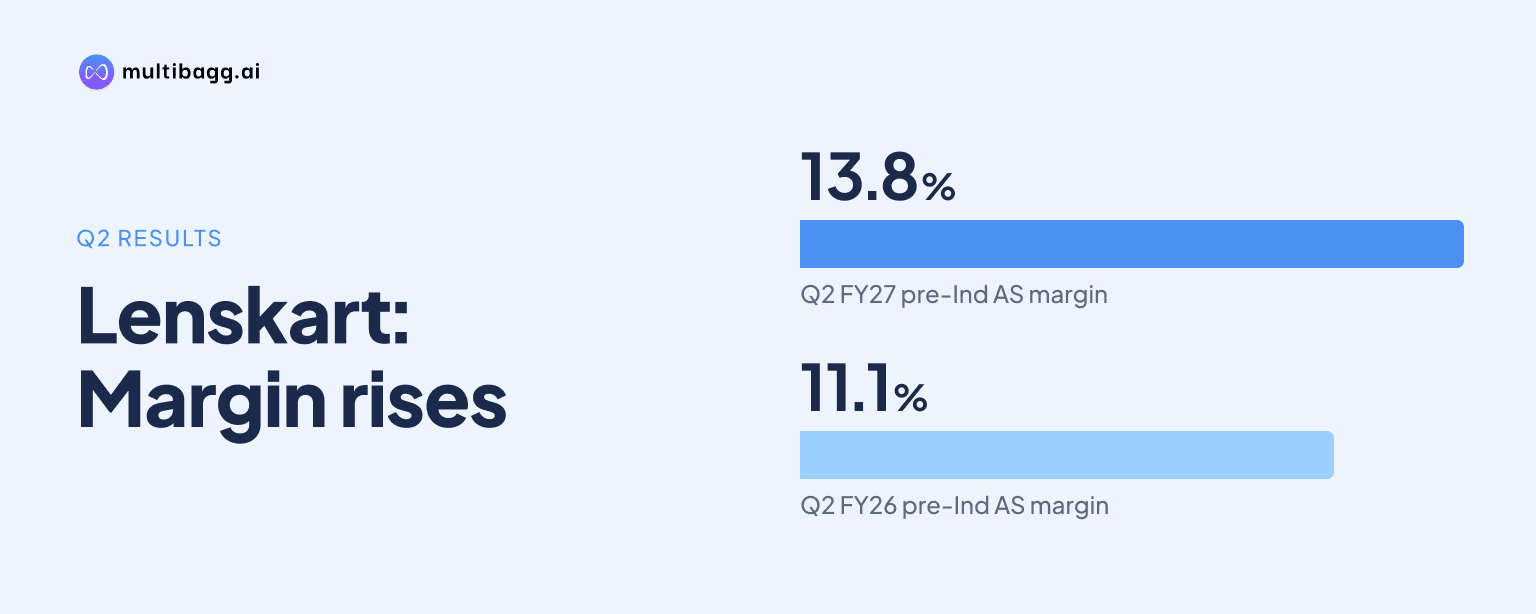
Lenskart Solutions Limited reported Q2 FY27 profit after tax of Rs 232 crore, up 106.1% year on year, as its pre-Ind AS 116 EBITDA margin rose to 13.8% from 11.1%. Lenskart’s revenue increased 32.5% to Rs 2,845 crore, meaning reported profit grew faster than sales during the quarter.
Know Lenskart Solutions inside out
Results, valuation, peers and who's buying, in one view.
How did Lenskart perform in Q2 FY27?
Lenskart’s Q2 FY27 profit after tax more than doubled to Rs 232 crore from Rs 113 crore in Q2 FY26, while its profit margin increased by 292 basis points to 8.2%. A basis point is one-hundredth of a percentage point. The company presents most figures in the shareholders’ letter on a proforma basis, which adjusts for the consolidation of Delkarts and GeoIQ and the acquisition of Meller; proforma and reported financials are identical from Q3 FY26.
Revenue rose 32.5% year on year to Rs 2,845 crore in Q2 FY27. Earnings before interest, tax, depreciation and amortisation, or EBITDA, increased 46.6% to Rs 624 crore, producing a 21.9% margin. Pre-Indian Accounting Standard 116, or pre-Ind AS 116, EBITDA was Rs 392 crore, up 65.0%, and its margin expanded by 270 basis points from 11.1% to 13.8%.
The H1 FY27 figures showed a similar gap between revenue and profit growth. Revenue increased 33.0% to Rs 5,559 crore, EBITDA rose 53.4% to Rs 1,213 crore, and profit after tax grew 138.0% to Rs 461 crore. Lenskart said H1 FY27 profit represented 87% of its full-year FY26 profit, while operating cash flow of Rs 388 crore covered store capital expenditure.
What drove Lenskart’s Q2 FY27 revenue growth?
Lenskart said volume growth and premiumisation drove its 32.5% Q2 FY27 revenue increase, with India growing 35.3% and International growing 29.5%. International revenue growth was about 23% in constant currency, which removes exchange-rate effects. India’s average selling price, or ASP, rose 6.9% year on year, including contribution from customers selecting Owndays premium lenses.
Eyewear units sold rose 27.1% year on year to 1.1 crore in Q2 FY27. India units increased 26.5%, while International units rose 29.7%, so International volume growth was 3.2 percentage points higher than India’s. The difference between the 32.5% revenue increase and 27.1% unit growth aligns with the company’s stated premiumisation trend.
India same-store sales growth, or SSSG, reached 20.8% in Q2 FY27, compared with 14.8% in Q2 FY26. Sales per store growth, or SPSG, was 27.1%; Lenskart said this measure reflects growth after the effect of store cannibalisation. The company reported growth across metro, Tier 1 and Tier 2+ markets, rather than identifying a single geography as the driver.
Product margin rose to 70.0% from 69.2% in Q2 FY26 despite rupee depreciation against the Chinese renminbi. India product margin increased to 64.0% from 63.4%, while International product margin rose to 77.1% from 75.5%. Lenskart linked the result to a 71.7% year-on-year increase in in-house frame output and a 52.2% increase in in-house lens output.
Got a follow-up? Ask IRIS
How quickly did Lenskart expand stores and eye tests?
Lenskart added 165 net new stores in Q2 FY27, compared with 142 in Q2 FY26, taking its active store base to 3,624. India contributed 143 net additions, including 94 in Tier 2+ markets, and entered 61 new cities in the quarter. International added 22 net stores, while H1 FY27 net additions reached 297 versus 225 in H1 FY26.
Lenskart conducted 80 lakh eye tests in Q2 FY27, up 40.4% year on year, outpacing the 27.1% growth in eyewear units sold. India carried out 70 lakh tests, up 44.1%, and the company said more than half were first-time examinations. This means eye-test growth exceeded India unit growth of 26.5% during the same quarter.
Remote optometry operated in 934 stores and supported the opening of 94 Tier 2+ stores in Q2 FY27, according to the founders’ letter. Lenskart said its AI-assisted eye test, Drysh, allows customers to complete much of the test themselves under optometrist supervision. The company has stated that reaching 100 million pairs annually from 32 million currently would require 80 million eye tests.
Lenskart Gold had 103 lakh active members in India at the end of Q2 FY27, up 38.6% year on year. Subscription fees received were Rs 73 crore, up 54.6%. India’s Net Promoter Score, or NPS, recovered to 79.6 in Q2 FY27 from 77.6 in Q1 FY27; NPS is the company’s reported customer recommendation measure.
Why did Lenskart’s pre-Ind AS 116 EBITDA margin increase?
Lenskart’s pre-Ind AS 116 EBITDA margin increased to 13.8% because both India and International recorded higher margins, alongside the increase in product margin to 70.0%. India’s pre-Ind AS 116 EBITDA margin rose to 16.0% from 13.4% in Q2 FY26. International’s margin increased to 10.6% from 7.3%, a 3.3-percentage-point improvement.
The company attributes its margin framework to ownership of brands, frame and lens manufacturing, edging and fitting, channels, research and development, and technology systems. In-house frame production increased to 36 lakh units in Q2 FY27 from 21 lakh units in Q2 FY26. In-house lens output rose to 20 lakh units from 13 lakh units over the same comparison.
India rent fell to 5.7% of revenue in Q2 FY27 from 6.1% a year earlier, while India SSSG was 20.8%. Management said store teams and rent are largely fixed, so same-store growth can contribute to operating leverage. Marketing expense was 4.5% of India revenue, although the founders said the decline did not reflect efficiency alone and that they were awaiting longer-term brand-building opportunities.
Management has described a path to a 25% pre-Ind AS 116 EBITDA margin but has not given a date for reaching that level. Its stated levers include more manufacturing integration, automation, higher factory utilisation, data-led allocation and store scale. The reported 13.8% margin is therefore a current result against management’s longer-term framework, not a stated near-term target.
Conclusion
Lenskart’s Q2 FY27 results combined 32.5% revenue growth with a 106.1% increase in profit after tax to Rs 232 crore. The quarter also included a 270-basis-point increase in pre-Ind AS 116 EBITDA margin, 165 net store additions and 80 lakh eye tests, linking financial growth with expansion in its retail and optometry network.
The next disclosed milestones are execution on the path toward a 25% pre-Ind AS 116 EBITDA margin and the Hyderabad facility, designed for 5 crore pairs annually and expected to be around 12 months away. Investors can also watch whether remote optometry, operating in 934 stores in Q2 FY27, continues to support Tier 2+ store openings and eye-test growth.