










Lloyds Metals value-added products take 51% of H1FY27 EBIT
Key highlights
- Lloyds Metals’ value-added product share of H1FY27 EBIT rose to 51% from 26% in H1FY26.
- Value-added product revenue increased to Rs 4,939.7 crore in H1FY27 from Rs 1,518.9 crore a year earlier.
- Pellet sales rose to 3.40 million tonnes in H1FY27 from 0.70 million tonnes.
- Standalone H1FY27 EBITDA margin was 38.33%, according to Lloyds Metals’ financial-performance table.
powered by IRIS
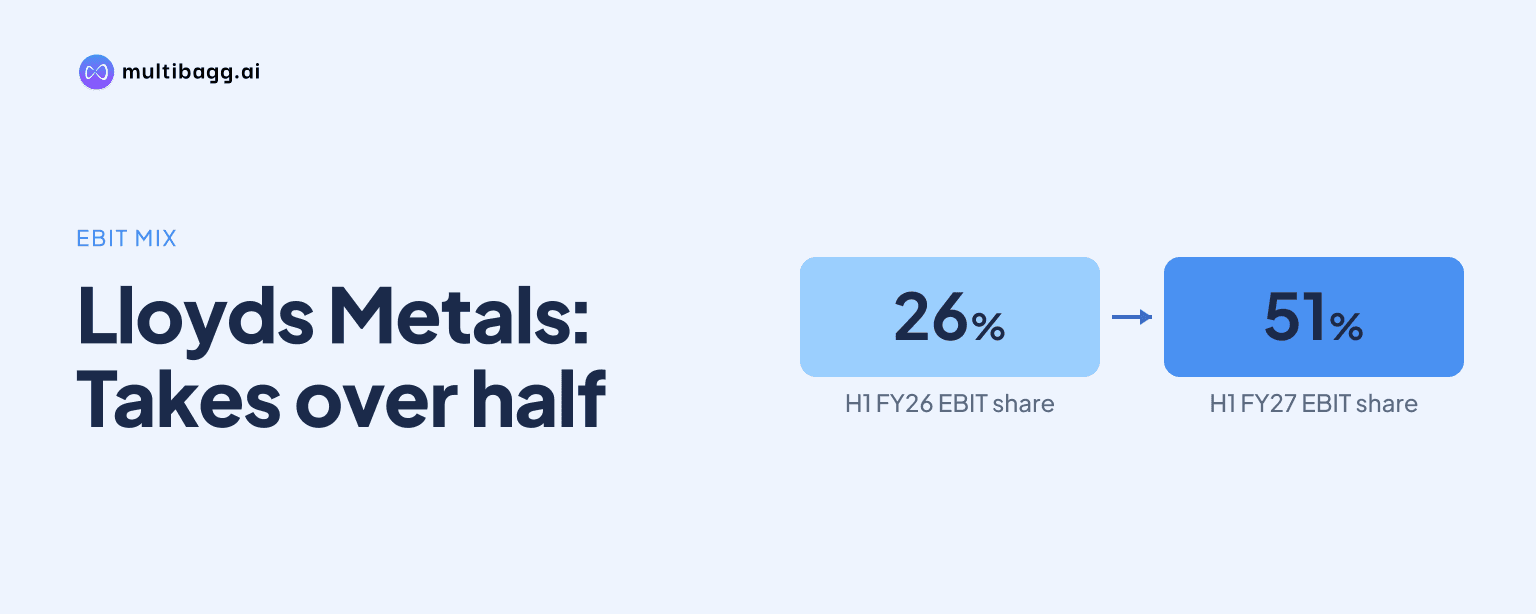
Lloyds Metals’ steel and related value-added products accounted for 51% of standalone H1FY27 earnings before interest and tax (EBIT), ahead of mining’s 49%, after value-added product revenue rose to Rs 4,939.7 crore and earnings before interest, tax, depreciation and amortisation (EBITDA) reached Rs 1,960.2 crore.
Know Lloyds Metals & Energy inside out
Results, valuation, peers and who's buying, in one view.
How did Lloyds Metals’ H1FY27 earnings mix change?
Lloyds Metals moved from a mining-led mix to an even revenue split in H1FY27, while steel and related value-added products became the larger EBIT contributor. Value-added products represented 50% of revenue, up from 29% in H1FY26, while mining’s share fell to 50% from 71%. In the EBIT split shown by Lloyds Metals, value-added products rose to 51% from 26% and mining declined to 49% from 74%.
The segment figures show that value-added products produced most of the increase. Their revenue increased by Rs 3,420.8 crore to Rs 4,939.7 crore in H1FY27, compared with a Rs 1,139.8 crore increase in iron-ore revenue to Rs 4,604.7 crore. Value-added product EBITDA increased by Rs 1,511.9 crore to Rs 1,960.2 crore, while iron-ore EBITDA rose by Rs 468.5 crore to Rs 1,698.1 crore.
The quarterly mix was more weighted towards downstream products by Q2FY27. Value-added products supplied 61% of Q2FY27 revenue and 67% of EBIT, compared with mining’s 39% revenue share and 33% EBIT share. In Q1FY27, value-added products had accounted for 39% of revenue and 40% of EBIT, showing that the H1FY27 outcome included a sharper Q2 shift.
What drove Lloyds Metals’ value-added product growth?
Lloyds Metals’ value-added product growth coincided with higher pellet and direct reduced iron, or DRI, volumes. Pellet sales increased to 3.40 million tonnes in H1FY27 from 0.70 million tonnes in H1FY26, while DRI sales increased to 344.20 thousand tonnes from 167.11 thousand tonnes. Lloyds Metals commissioned its second pellet plant in May 2026.
Pellet production reached 3.81 million tonnes in H1FY27, with realisation of Rs 11,520 per tonne and EBITDA of Rs 4,988 per tonne. Lloyds Metals said product quality and geographical location supported pellet realisations. Its pellet sales mix was 71% domestic and 29% exports, with exports expanded into Kenya, South Korea, Indonesia and China.
The DRI operating update reported H1FY27 sales volume of 343.06 thousand tonnes, up 104% year on year, alongside realisation of Rs 29,082 per tonne and EBITDA of Rs 7,593 per tonne. Power volumes were reported up 85% year on year, although the half-yearly product table showed power sales of 49.99 million units, down from 89.95 million units in H1FY26.
How did Lloyds Metals’ segment margins compare?
Lloyds Metals’ value-added product EBITDA margin increased to 39.68% in H1FY27 from 29.51% in H1FY26, exceeding the 36.88% iron-ore EBITDA margin. The iron-ore margin also increased from 35.49%, but the value-added product margin gain was 1,017 basis points, compared with a 139-basis-point increase for iron ore. One basis point equals one-hundredth of a percentage point.
At the total standalone level, the half-yearly product-performance table showed EBITDA margin of 38.33% in H1FY27, against 33.67% in H1FY26. Lloyds Metals’ financial-performance table reported the same H1FY27 margin of 38.33%, versus 32.91% a year earlier, and described the year-on-year change as 542 basis points.
Lloyds Metals attributed the wider company margin to operating leverage, higher iron-ore environmental-clearance limits, faster pellet-plant ramp-up, improved sponge-iron volumes and a higher contribution from value-added products. It also said commissioning of a slurry pipeline lowered iron-ore logistics and freight costs during H1FY27.
Got a follow-up? Ask IRIS
Is Lloyds Metals’ mining business still expanding?
Lloyds Metals’ iron-ore business continued to expand in volume despite mining’s lower share of revenue and EBIT. Iron-ore production increased 35.14% year on year to 10.00 million tonnes in H1FY27, while sales were 7.59 million tonnes. H1FY27 iron-ore realisation was Rs 6,070 per tonne and EBITDA was Rs 2,239 per tonne.
The company said its current iron-ore monthly run rate was about 2 million tonnes or more. In Q2FY27, iron-ore sales were 2.12 million tonnes, compared with 2.47 million tonnes in Q2FY26, while pellet sales rose to 2.05 million tonnes from 0.70 million tonnes. The presentation does not quantify internal ore consumption, but the volume pattern coincided with the pellet business ramp-up.
Standalone revenue from operations reached Rs 9,544.9 crore in H1FY27, up 94% year on year, while EBITDA rose 126% to Rs 3,658.2 crore. Profit after tax increased 113% to Rs 2,638.7 crore, and standalone net debt was Rs 9,315.5 crore as of September 30, 2026.
What is Lloyds Metals targeting for FY27?
Lloyds Metals’ FY27 guidance calls for pellet production of 7.75 million to 8 million tonnes, compared with 3.03 million tonnes in FY26. Management also guides for DRI production of 825 thousand tonnes, compared with 484 thousand tonnes in FY26, extending the capacity ramp-up behind H1FY27 value-added product growth.
Management expects commissioning of a wire rod mill, or WRM, in Q4FY27. Its FY27 iron-ore production guidance is 26 million tonnes, compared with 21.96 million tonnes in FY26. The presentation provides no revenue, EBITDA-margin or EBIT guidance by segment for these production plans.
The combination of a 26-million-tonne iron-ore target, higher pellet production and 825-thousand-tonne DRI guidance indicates that management’s disclosed plan includes both mining growth and downstream conversion. The H1FY27 mix data, however, do not establish the future split between mining and value-added products after the new wire rod mill is commissioned.
Conclusion
Lloyds Metals’ H1FY27 results show that value-added products changed the standalone earnings mix: they reached 50% of revenue and 51% of EBIT, compared with 29% and 26%, respectively, in H1FY26. The shift was supported by pellet sales rising by 2.70 million tonnes and DRI sales increasing by 177.09 thousand tonnes, alongside a value-added product EBITDA margin of 39.68%.
The next disclosed milestones are FY27 pellet production of 7.75 million to 8 million tonnes, DRI production of 825 thousand tonnes and wire rod mill commissioning in Q4FY27. Results will show whether these capacity additions sustain the H1FY27 value-added product contribution while Lloyds Metals pursues its 26-million-tonne iron-ore production target.