










Lloyds Metals says savings could exceed Rs 2,000 crore
Key highlights
- Lloyds Metals expects combined initiatives to surpass Rs 2,000 crore in annual savings as they mature.
- The planned 195 km slurry pipeline has stated freight savings of Rs 800-1,000 per tonne.
- Lloyds Metals reported an approximately 635-basis-point EBITDA-margin increase both year on year and quarter on quarter.
- Pellet Plant 3 is expected to be commissioned in fiscal 2028.
powered by IRIS
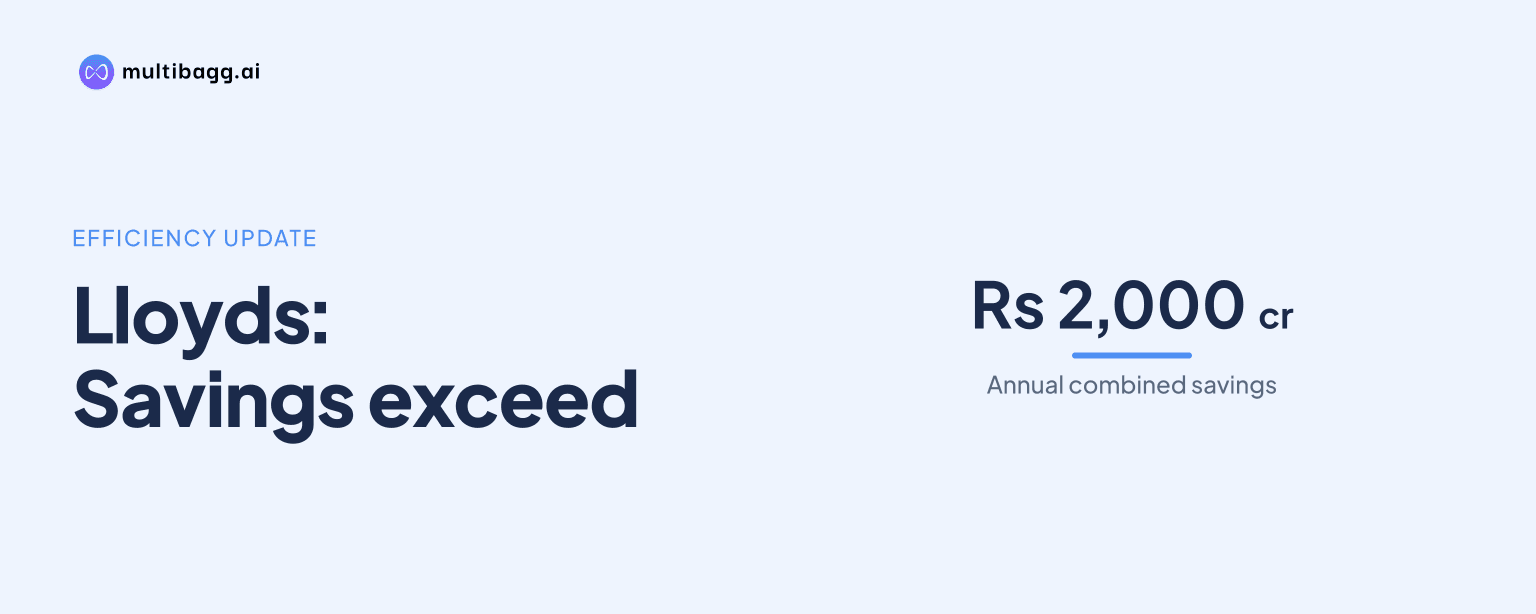
LLOYDS METALS says its slurry pipelines, captive logistics, renewable-energy measures and Thriveni MDO operations acquisition could generate more than Rs 2,000 crore of annual savings as the initiatives mature, after the company reported an approximately 635-basis-point improvement in EBITDA margin both year on year and quarter on quarter in the current quarter.
Know Lloyds Metals & Energy inside out
Results, valuation, peers and who's buying, in one view.
How much annual savings does Lloyds Metals expect?
Lloyds Metals expects annual savings to build over time and surpass Rs 2,000 crore a year as its stated initiatives mature. Management has not given a financial-year deadline for reaching that level, nor has the November 2026 presentation provided a savings bridge allocating the total across slurry transport, captive trucks, renewable power, fuel changes and Thriveni MDO operations.
The company separately identifies savings of up to Rs 100 crore annually for its mining and pellet operations. That amount is narrower than the more than Rs 2,000 crore long-term expectation, indicating that management’s broader figure incorporates multiple operating measures across mining, ore evacuation, pellet production, power sourcing and logistics rather than only the mining-and-pellet programme.
Lloyds Metals says the initiatives have started showing results in the current quarter, linking them to an approximately 635-basis-point increase in earnings before interest, tax, depreciation and amortisation, or EBITDA, margin both year on year and quarter on quarter. A basis point equals one-hundredth of a percentage point, but the presentation does not disclose the margin before or after the change or attribute the movement to individual projects.
What per-tonne savings does Lloyds Metals identify?
Lloyds Metals identifies stated reductions between Rs 100 and Rs 1,000 per tonne, with the largest range attached to the planned 195-kilometre slurry pipeline. These are initiative-specific figures for freight, internal movement or consolidated iron-ore costs, so they should not be treated as savings that can be added together for the same tonne of material.
The planned 195 km route carries a stated freight reduction of Rs 800-1,000 per tonne, compared with Rs 500-600 per tonne for the operating 85 km Hedri-to-Konsari line. The range for the longer line is therefore Rs 300-400 per tonne higher at each end than the range stated for the existing route, although Lloyds Metals has not disclosed the underlying freight-cost base or volume assumptions.
A separate future-project page says a new Chandrapur stockyard with a railway siding would save Rs 1,000 per tonne in transport. The integrated evacuation page instead specifies Rs 250 per tonne of additional savings on external sales through Chandrapur Stockyard, so the presentation gives two savings measures tied to the stockyard without explaining whether they apply to different movements, cost bases or stages of the route.
How does the 195 km slurry pipeline fit Lloyds Metals’ logistics plan?
Lloyds Metals presents the 195 km, 16 million tonnes per annum, or MTPA, Hedri-to-Ghugus slurry pipeline as its higher-saving evacuation corridor. The project is intended to feed the steel plant at Konsari and the third pellet plant at Ghugus, while the company says survey work and preliminary engineering are complete and right-of-way approval remains in progress.
The operating Hedri-to-Konsari pipeline is 85 km long with 10 MTPA capacity. Lloyds Metals’ integrated network also describes an approximately 99 km new Hedri-to-Konsari pipeline planned at about 16 MTPA, running alongside the existing corridor, followed by a 72 km extension to Chandrapur Stockyard, where the system is intended to reduce manual handling.
The route descriptions are not fully reconciled in the presentation. One page lists an 11 MTPA, 171 km Hedri-to-Chandrapur Stockyard pipeline and a 5 MTPA, 47 km Chandrapur-to-Ghugus pipeline, while the project page refers to one 195 km, 16 MTPA Hedri-to-Ghugus line. Management’s stated operational rationale is that parallel slurry routes would reduce disruption risk when one line is unavailable.
Got a follow-up? Ask IRIS
What other cost measures is Lloyds Metals using?
Lloyds Metals is investing in a truck fleet to bring logistics now handled by third parties into captive operations. The measure appears alongside the acquisition of Thriveni MDO operations and the 85 km, 10 MTPA and planned 195 km, 16 MTPA slurry corridors, placing fleet ownership within the company’s wider attempt to control ore movement and associated freight costs.
On power and fuel, Lloyds Metals says renewable energy is scaling to 100 megawatts, or MW, with 120 MW planned. The company also cites Thriveni-led greening and machine reuse at Jamshedpur, natural gas introduced by trucks to optimise fuel costs, and ongoing work on power sourcing and fuel-mix optimisation.
These measures are listed together with consolidated iron-ore savings of Rs 400-500 per tonne and the 635-basis-point EBITDA-margin increase reported for the current quarter. Lloyds Metals does not quantify the contribution of renewable power, natural gas, machine reuse, captive trucks or the Thriveni MDO operations acquisition to either the per-tonne reduction or the margin change.
Which project milestones could support the savings plan?
Lloyds Metals has commissioned the 85 km, 10 MTPA Hedri-to-Konsari slurry pipeline, and Pellet Plant 2 was commissioned in May 2026. Its mine update says that, in FY27, the company mobilised with Thriveni to mine and sell 26 MTPA of iron ore, a volume target that would supply its processing and evacuation network.
The third pellet plant combines 15 MTPA of banded hematite quartzite, or BHQ, beneficiation throughput with pellet production. Lloyds Metals says land has been procured, engineering is under way and environmental clearance is in hand; construction has started and management expects commissioning in fiscal 2028.
The company also reports that a 5-tonnes-per-hour BHQ pilot plant was completed and produced a yield above 38%, while primary engineering for the broader BHQ plants is complete and major-equipment procurement is in progress. The roadmap shows pellet capacity increasing from 8 MTPA to 12 MTPA after expansion, but the presentation does not attach a separate cost-saving figure to BHQ beneficiation or the higher pellet capacity.
Conclusion
Lloyds Metals has set out a cost programme based on replacing parts of road and third-party logistics with slurry pipelines, a Chandrapur stockyard, railway access and captive trucks, while changing power and fuel sourcing. Management’s stated savings are highest for the planned 195 km slurry route at Rs 800-1,000 per tonne, and its eventual annual-savings expectation exceeds Rs 2,000 crore.
The next disclosed milestones are right-of-way approval for the 195 km pipeline, progress on the Chandrapur Stockyard and railway siding, and the fiscal 2028 target for commissioning Pellet Plant 3. Future updates will need to show realised freight, fuel and power savings and clarify how the 195 km, 16 MTPA route relates to the separately described 171 km and 47 km network sections.