










Lloyds Metals maps 12 MNT pellets and 1.2 MNT steel
Key highlights
- Lloyds Metals lists pellet capacity rising from 8 MNT to 12 MNT after expansion.
- Lloyds Metals has started construction on its 1.2 MNT steel project after commissioning the Ghughus DRI plant.
- Lloyds Metals commissioned Pellet Plant 2 in May 2026 after 16 months of construction.
- Lloyds Metals expects Pellet Plant 3 to be commissioned in fiscal 2028.
powered by IRIS
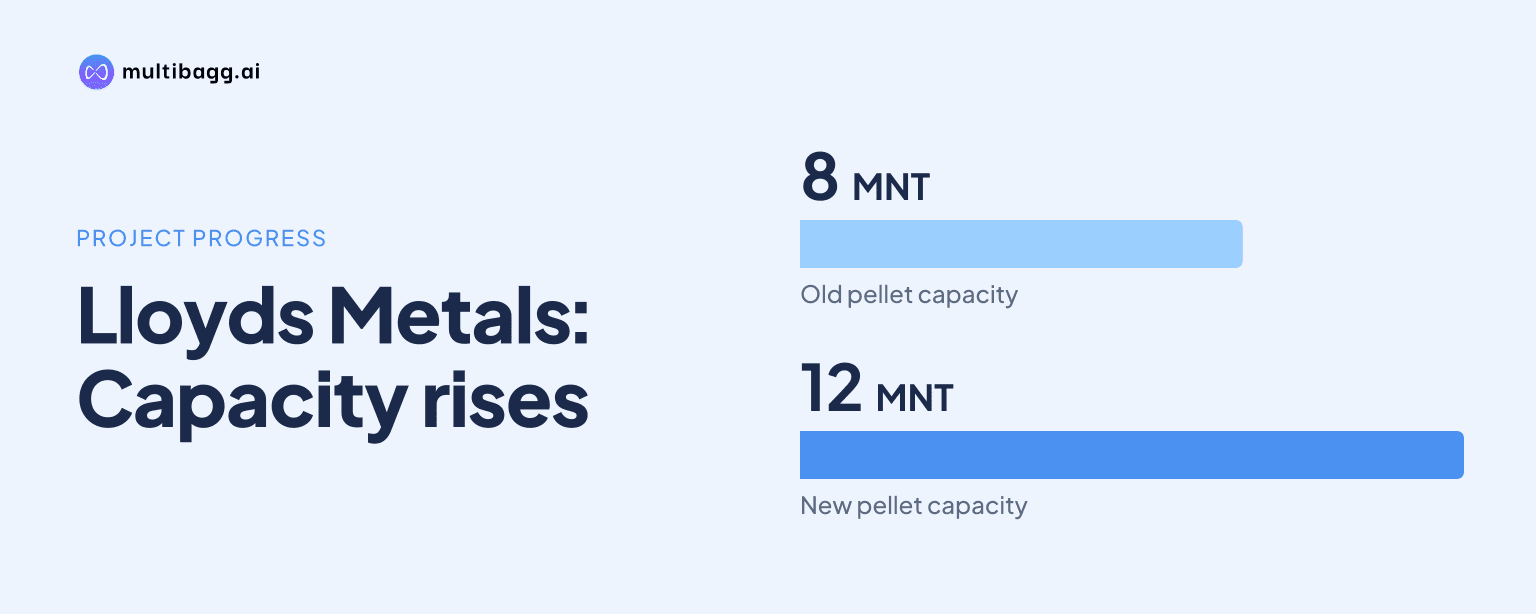
Lloyds Metals plans to expand pellet capacity from 8 MNT to 12 MNT and add 1.2 MNT of steel capacity, with a planned 195 km slurry pipeline rated at 16 MTPA supporting the downstream chain. Its November 2026 presentation shows the Ghughus direct-reduced iron plant is commissioned, while steel, beneficiation and further pellet projects remain in development.
Know Lloyds Metals & Energy inside out
Results, valuation, peers and who's buying, in one view.
What capacity is Lloyds Metals adding across its value chain?
Lloyds Metals is mapping capacity additions across beneficiation, pellets, steel, copper, cobalt and slurry logistics, led by the increase in pellet capacity to 12 MNT and the addition of 1.2 MNT of steel capacity. The roadmap lists 26 MNT of existing iron ore capacity, 8 MNT of pellets and 0.70 MNT of direct-reduced iron, or DRI, capacity.
Lloyds Metals also lists copper capacity rising from 12,000 tonnes per annum, or TPA, to 100,000 TPA, while cobalt capacity is shown rising from 4,000 TPA to 20,000 TPA. The captive power plant is listed at 150 megawatts, with no post-expansion power figure disclosed in the roadmap.
The 45 MNT beneficiation target comprises a 30 MNT BHQ, or banded hematite quartzite, throughput project under way and a future 15 MNT BHQ beneficiation project linked to Pellet Plant 3. Pellet capacity would increase by 4 MNT, while DRI capacity would rise by 0.14 MNT; the 1.2 MNT steel line is new capacity because no existing steel capacity is stated.
How far have Lloyds Metals projects progressed?
Lloyds Metals has completed its first 85 km slurry pipeline and 4 MNT Pellet Plant 1, while Pellet Plant 2 was commissioned in May 2026 after 16 months of construction. Mining progress increased from 3 MNT in FY22 to 3.6 MNT in FY23, then to 10 MNT in both FY24 and FY25, before reaching 22 MNT in FY26.
For FY27, Lloyds Metals says it mobilised with Thriveni to mine and sell 26 MNT of iron ore. That stated FY27 volume is 4 MNT above FY26 progress, while the presentation does not separate the planned volume between internal processing and external sales.
The 1.2 MNT steel project has entered construction after the Ghughus DRI plant was commissioned. Lloyds Metals says the steel project is at an advanced stage and is expected to be on time, but it does not disclose a commissioning date, project cost or first-production date.
The 30 MNT BHQ project has completed a 5 TPH, or tonnes-per-hour, pilot plant and primary engineering, with procurement of major equipment in progress. Lloyds Metals reports a pilot yield above 38% and says forest land has been secured, but gives no construction-completion percentage or commissioning schedule for the BHQ plant.
Got a follow-up? Ask IRIS
How will the slurry network support Lloyds Metals expansion?
Lloyds Metals says its planned 195 km slurry pipeline will run from Hedri to Ghughus via Konsari and feed the steel plant at Konsari and the third pellet plant at Ghughus. Survey work and preliminary engineering are complete, while right-of-way approval remains in progress.
The presentation describes the planned 195 km corridor as having 16 MTPA capacity, compared with the commissioned 85 km Hedri-to-Konsari corridor rated at 10 MTPA. A separate network page describes a new 171 km, 11 MTPA line from Hedri to Chandrapur Stockyard and a 47 km, 5 MTPA line from Chandrapur to Ghughus.
Lloyds Metals also presents an approximately 99 km Hedri-to-Konsari route and a 72 km extension to Chandrapur, which together equal 171 km. The 171 km plus 47 km route totals 218 km, whereas the roadmap and cost page use 195 km for Hedri to Ghughus; the presentation does not reconcile these distance descriptions.
The proposed Chandrapur stockyard includes a railway siding that Lloyds Metals says could save rupees 1,000 per tonne in transport. The company also cites potential Hedri-to-Ghughus logistics savings of rupees 800 to rupees 1,000 per tonne and additional savings of rupees 250 per tonne on external sales through Chandrapur.
What cost measures and milestones should readers track?
Lloyds Metals says its logistics, fuel and operating initiatives have contributed to an approximately 635-basis-point increase in earnings before interest, tax, depreciation and amortisation, or EBITDA, margin both year on year and quarter on quarter. The presentation does not specify the comparison quarters, revenue base or EBITDA margin levels underlying that change.
The company reports consolidated iron-ore savings of rupees 400 to rupees 500 per tonne, freight savings of rupees 500 to rupees 600 per tonne on the operating 85 km slurry line, and rupees 800 to rupees 1,000 per tonne on the planned 195 km line. These figures are stated as per-tonne cost reductions rather than reported total savings.
Lloyds Metals lists captive trucks, renewable energy, natural gas transported by trucks and power-sourcing optimisation among the measures. Renewable capacity is stated at 100 megawatts, with 120 megawatts planned, and management says the mining and pellet initiatives could initially save up to Rs 100 crore annually.
Management expects annual savings to surpass Rs 2,000 crore as initiatives mature, which is a forward-looking expectation rather than reported savings. Nearer-term milestones include construction of Pellet Plant 3, for which land has been procured and environmental clearance is in hand, with commissioning expected in fiscal 2028.
Conclusion
Lloyds Metals is building an integrated chain around 26 MNT of iron ore capacity, 45 MNT of planned BHQ beneficiation throughput, 12 MNT of pellet capacity and 1.2 MNT of steel capacity. Completed assets include the 85 km slurry pipeline, Pellet Plant 2 in May 2026 and the Ghughus DRI plant, while the larger beneficiation, pellet and steel projects are still moving through construction, procurement or configuration work.
The next disclosed items to watch are right-of-way approval for the planned slurry corridor and fiscal 2028 commissioning of Pellet Plant 3. Lloyds Metals also needs to progress the 30 MNT BHQ project beyond pilot and equipment procurement, finalise the reworked integrated steel plant configuration, and clarify the differing 195 km and 218 km route descriptions in its pipeline plans.