










Lloyds Metals mines run to 2057 beyond iron-ore auctions
Key highlights
- LMEL says its mines are valid until 2057.
- LMEL lists 19 mines with 83 MTPA of capacity due for auction through CY2030.
- LMEL’s FY30 scenarios show iron-ore requirement of 404-437 MTPA, versus 210 MTPA in FY23.
- Average auction premium reached 178.61% in 2023 and was 126.00% in 2026.
powered by IRIS
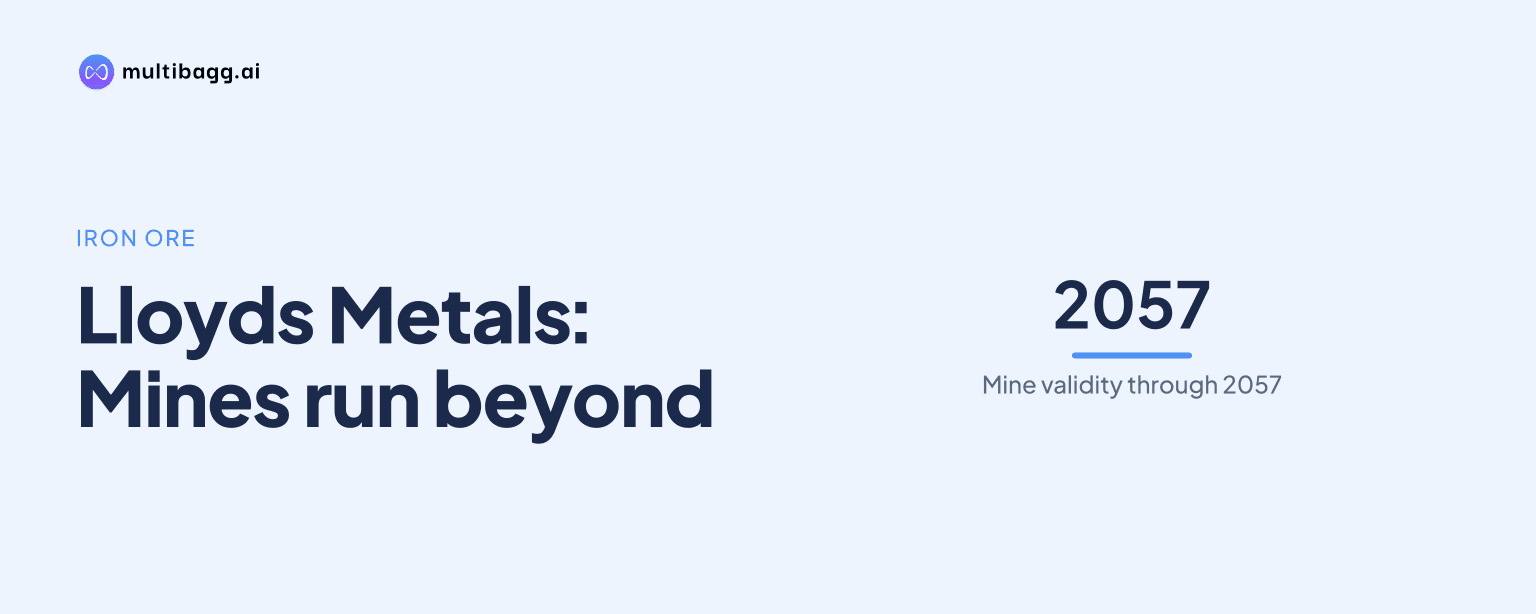
Lloyds Metals says its mines are valid until 2057, extending beyond the 2026-2030 iron-ore auction schedule covering more than 80 million tonnes per annum (MTPA) of capacity, while its presentation warns that auction premiums, which reached 178.61% in 2023, could raise costs for newly auctioned mines.
Know Lloyds Metals & Energy inside out
Results, valuation, peers and who's buying, in one view.
What iron-ore supply does LMEL expect India to need by FY30?
LMEL projects that India’s iron-ore requirement could rise to 404 MTPA in FY30 Case I or 437 MTPA in FY30 Case II, from 210 MTPA in FY23. The two scenarios accompany projected crude-steel capacity of 242 MTPA and 437 MTPA respectively, compared with 161 MTPA in FY23.
The increase in iron-ore requirement is 194 MTPA under Case I and 227 MTPA under Case II, measured against FY23. LMEL consequently puts India’s minimum run-of-mine iron-ore capacity requirement at 525-637 MTPA by FY30, compared with 376 MTPA shown for FY23.
Case I uses Steelmint assumptions that steel-capacity utilisation remains similar to FY23 and that India reaches capacities suggested by industry participants. Case II uses assumptions based on the National Steel Policy 2017, according to LMEL, so the 404-437 MTPA range is an industry scenario rather than an LMEL output forecast.
Which iron-ore mines are due for auction before 2030?
LMEL lists 19 mines with estimated combined production capacity of 83 MTPA for auction in calendar years 2026, 2027, 2029 and 2030. The company summarises that pipeline as more than 80 MTPA of iron-ore mining capacity due for auction through CY2030.
The 2030 group is the largest disclosed block, with eight mines and 59 MTPA, versus 17 MTPA across two mines in 2029. The 59 MTPA scheduled for 2030 represents more than seven-tenths of the 83 MTPA total in the four listed auction years.
LMEL also states an average of 21 MTPA of iron-ore mine capacity is due for upcoming auctions. Its source note cites the Ministry of Mines and says the schedule considers leases where iron ore is the primary mineral, rather than all mineral leases due for auction.
How have iron-ore auction premiums changed?
LMEL reports that average auction premiums ranged from 85.92% to 178.61% of notified prices between 2016 and 2026. The series rose from 86.14% in 2016 to a high of 178.61% in 2023, then fell to 108.95% in 2024 before increasing to 160.67% in 2025.
The 2026 average in LMEL’s presentation is 126.00%, down 34.67 percentage points from 160.67% in 2025 and 52.61 percentage points below the 2023 peak. However, the 2026 reading remains above the 2016-2019 range of 85.92% to 98.98%.
LMEL’s premium data also show a cluster above 100% from 2020 onwards: 115.15% in 2020, 116.58% in 2021 and 114.62% in 2022, followed by 178.61% in 2023. The presentation says extreme outliers above 200% duty were removed from its underlying premium analysis.
LMEL says that, at current auction premiums, the cost curves of upcoming mines face a risk of sharp increase. That is management’s assessment based on the premium history and the auction pipeline, not a disclosed operating-cost estimate for a particular mine.
Got a follow-up? Ask IRIS
Why does LMEL focus on mine validity until 2057?
LMEL focuses on 2057 because it says its mines remain valid beyond the auction cycle that includes 19 mines and 83 MTPA of estimated capacity through 2030. The company describes its mines as among the prominent mining positions beyond CY2030.
The comparison is principally one of timing. The eight mines with 59 MTPA of capacity due for auction in 2030 would enter the sector under future auction terms, whereas LMEL says its own mines have validity through 2057.
LMEL links that lease horizon to its view that elevated auction premiums could alter the cost curve for future supply. The presentation does not quantify LMEL’s mining cost through 2057, compare its ore grades with auctioned mines, or calculate the financial impact of premiums on any future operator.
What does LMEL’s presentation establish about its industry position?
LMEL establishes an industry-positioning argument based on a FY30 national capacity requirement of 525-637 MTPA, an 83 MTPA auction schedule through 2030, and its stated mine validity until 2057. It does not provide a forecast for LMEL revenue, profit or production arising from those three factors.
The presentation supports a comparison between projected demand and scheduled auctioned capacity. Under FY30 Case I, minimum iron-ore capacity required is 525 MTPA, while the listed 2026-2030 auctions account for 83 MTPA; under Case II, the requirement is 637 MTPA, 261 MTPA above the FY23 capacity figure of 376 MTPA.
What remains unresolved is how much of the 525-637 MTPA requirement will be met by existing mines, the 83 MTPA of listed auction capacity, or other additions. LMEL also does not disclose whether future auction premiums will be closer to the 126.00% reported for 2026 or the 178.61% peak reported for 2023.
Conclusion
LMEL’s stated advantage is the duration of its mine validity: 2057 extends beyond the 2026-2030 auction period, during which more than 80 MTPA of capacity is scheduled to be offered. Its argument combines that timing with FY30 iron-ore requirement scenarios of 404-437 MTPA and historical premiums that peaked at 178.61% in 2023.
The next item to watch is the disclosed auction schedule, particularly the eight mines with 59 MTPA due in 2030, and the premiums at which those assets are awarded. Management’s assessment of a higher future cost curve will depend on those outcomes as well as actual progress toward the FY30 minimum capacity requirement of 525-637 MTPA.