










Lodha expects FY27 profit to comfortably beat 20% growth target
Key highlights
- Lodha reported H1 FY27 PAT of Rs 2,386 crore, up 63% year on year.
- Lodha retained FY27 pre-sales guidance of about Rs 24,000 crore after reporting Rs 9,600 crore in H1.
- Management said 5% to 7% annual price growth against about 4% cost growth can add 100 to 200 basis points to margin each year.
- Lodha expects a Q4 FY27 data-centre land transaction of about Rs 1,500 crore.
powered by IRIS
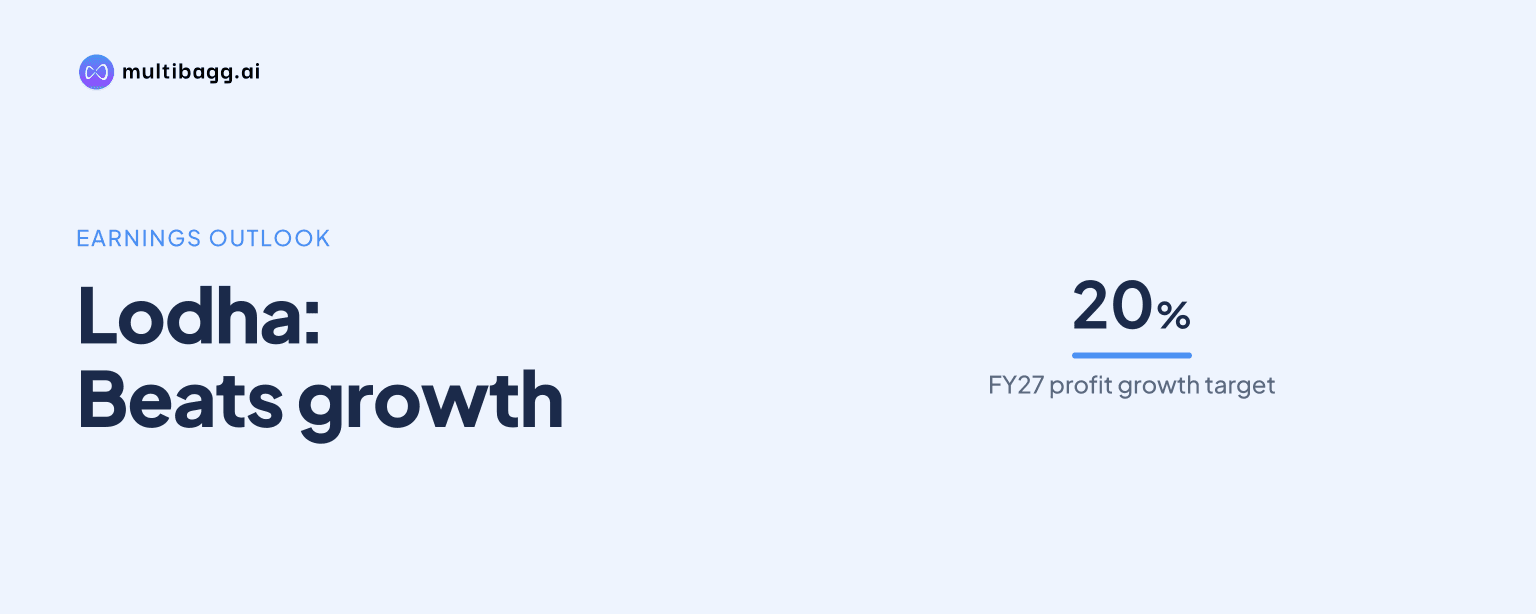
Lodha Developers Limited expects FY27 profit to comfortably exceed its 20% growth target after first-half profit after tax reached Rs 2,386 crore, up 63% year on year. Management said the expected beat reflects improving profitability in the development business, while Q2 contained no land-sale contribution.
Know Lodha Developers inside out
Results, valuation, peers and who's buying, in one view.
Why does Lodha expect to beat its FY27 profit target?
Lodha expects to beat its FY27 target because H1 profit after tax, or PAT, of Rs 2,386 crore had already reached nearly 60% of the just-over-Rs 4,000 crore level implied by 20% growth. Management said it was very confident of beating the guidance comfortably, but did not provide a revised full-year PAT target during the November 2, 2026 call.
Revenue in H1 FY27 rose 30% year on year to Rs 9,460 crore, while pre-sales increased 7% to Rs 9,600 crore. Lodha described all three measures, revenue, PAT and pre-sales, as its highest first-half results. Net debt was reduced moderately to about Rs 5,200 crore, equal to about 0.2 times equity.
Lodha retained its FY27 pre-sales guidance of about Rs 24,000 crore, although its launch guidance had moved to Rs 23,100 crore from about Rs 25,000 crore in July. Management said one project may shift from Q4 FY27 into Q1 of the next fiscal year, but said this timing change does not alter its expectation for full-year operating delivery.
H1 represented 40.3% of the Rs 24,000 crore pre-sales target, within management’s prior expectation of 40% to 42% in the first half. For H2, Lodha expects Rs 6,000 crore to Rs 7,000 crore of development-company pre-sales in each of Q3 and Q4, plus a data-centre land transaction of about Rs 1,500 crore in Q4.
What is expanding Lodha’s development-business margin?
Lodha said the development-business margin is expanding because it expects annual price growth of 5% to 7%, against construction-cost growth of about 4%. Management estimated that this spread can add 100 to 200 basis points to margin each year, with one basis point equal to one-hundredth of a percentage point.
Management said the improvement applies to the development business rather than a mix that includes data-centre land sales or future rental income. It attributed the cost discipline to operational leverage as the business scales and to extracting greater value from the supply chain, while saying its pricing outlook remains contained within the 5% to 7% range.
Q2 was management’s main evidence that the profit improvement was not dependent on land transactions. Lodha said there were no land sales in the quarter, so its embedded earnings before interest, tax, depreciation and amortisation, or EBITDA, and PAT reflected underlying development-business profitability. Management attributed that profitability to brand strength.
Lodha reported year-to-date price growth of about 4%, which management said partly reflected stronger pricing power. It also said price traction in the housing market is increasingly concentrated among leading brands, while commoditised supply has less pricing traction. This was management’s market assessment, not a quantified forecast for the overall market.
Can Lodha maintain pre-sales while margins improve?
Lodha said it can maintain its Rs 24,000 crore FY27 pre-sales target because H2 includes almost Rs 20,000 crore of planned launches across several geographies. H1 had only about Rs 4,000 crore of gross development value, or GDV, of new launches, making the H2 programme more important to the full-year target.
Sales are also expected to remain supported by sustenance demand from existing and previously launched projects. Management said launches normally provide about one-third of quarterly pre-sales and sustenance sales provide two-thirds. In Q2, launch contribution was slightly below one-third, and Lodha expects the usual mix to continue in Q3 and Q4, potentially with a higher launch share.
Lodha said its reported 3.9 million square feet of completed unsold inventory was not the same stock in consecutive quarters. Management said completed units are added each quarter and generally sell fastest, while annual deliveries can range from 10 million to 12 million square feet. The unchanged 3.9 million-square-foot number was therefore described as coincidental.
Bangalore provides one part of the sales plan. Lodha reported more than Rs 1,800 crore of Q2 pre-sales in the city, and its 70-acre Lodha Beaumont Estate recorded more than Rs 1,500 crore of sales in the first three months after launch. Management expects Bangalore pre-sales of about Rs 3,000 crore in FY27, compared with Rs 2,300 crore in FY26.
Got a follow-up? Ask IRIS
What could affect Lodha’s second-half execution?
Lodha’s H2 delivery depends on launches, buyer demand and construction execution. Management said the Reserve Bank of India’s October 2026 increase of 25 basis points in the repo rate should have negligible effect on homes priced above Rs 5 crore. About 50% of Lodha’s sales by value are in the Rs 1 crore to Rs 5 crore range, where management sees average loan-to-value ratios in the high 40s to low 50s.
Management acknowledged that higher borrowing costs could have a moderate effect on the Rs 1 crore to Rs 5 crore segment, while saying its outlook remained unchanged. It cited what it sees as a supply gap in high-quality housing. Lodha said the direct effect of the Middle East conflict had so far been limited to Gulf non-resident Indian demand, which represents about 4% to 5% of its sales.
Construction costs have increased in selected energy-intensive categories, including tiles, following the Middle East crisis, management said. However, it said those categories form only a modest part of the total cost mix. Lodha said it carries a 10% construction-cost contingency at project launch and an additional contingency equal to 3% of project revenue.
Lodha expects construction spending to rise from the first-half quarterly run rate of about Rs 1,300 crore to Rs 1,350 crore because monsoon conditions slow activity, particularly in Q2. Management also said Maharashtra’s air-quality rules could cause a week or two of disruption if required, though it expects compliance with guidelines introduced in 2025 to avoid a negative effect.
How does the data-centre plan affect Lodha’s FY27 outlook?
Lodha expects a data-centre land sale of about Rs 1,500 crore in Q4 FY27 and said it intends such transactions to become recurring, at roughly one every six months. Management said the next transaction should be priced in the high-Rs 50 crore-per-acre range, above the Rs 42 crore per acre received in the previous transaction.
The planned land sale is part of the FY27 pre-sales target, but management separated it from its argument on core development profitability. It said Q2 had no land-sale contribution and that its medium-term margin comments related to the development business. This distinction is central to Lodha’s claim that higher profitability is not a one-off result of land monetisation.
Lodha expects definitive documents for its first build-to-suit, or BTS, data-centre facility to be signed in FY27, with construction also beginning in FY27. It aims to deliver the facility in FY29, when rental income would begin. The BTS project is a multi-hundred-megawatt development, but management did not disclose its exact capacity.
Management said approvals increased available power at the data-centre site to 5 gigawatts from 3 gigawatts. Lodha retained its previous guidance of Rs 2,000 crore to Rs 2,300 crore of annual rent for 1 gigawatt of BTS capacity. It also reaffirmed its goal of signing 1 gigawatt of input power by FY30 and delivering it by FY32.
Conclusion
Lodha’s confidence in beating its FY27 profit-growth target is based on H1 PAT of Rs 2,386 crore, a development-business margin mechanism of price growth exceeding cost growth, and a maintained Rs 24,000 crore pre-sales target. Management’s emphasis on Q2, when there were no land sales, indicates that it views residential development profitability rather than data-centre monetisation as the main driver of the expected guidance beat.
The next disclosures to watch are whether H2 launches of almost Rs 20,000 crore support the full-year pre-sales target, whether the Q4 data-centre land deal is completed, and whether BTS definitive documents are signed in FY27. Lodha also expects the Mulund-Airoli-Palava Freeway to open within weeks and has said the resulting connectivity could lift Palava pre-sales in calendar 2027.