








Mahamaya Lifesciences Limited targets off-patent molecules at Dahej
MAX Plan at ₹4,999/yr

Find your next multibaggerBe a Pro Investor
Research stocks and track your picks on the go. Download the app.
Key highlights
- Mahamaya said its 250-tonne Dahej plant will target molecules going off-patent in 2026-27, not its current imported technicals.
- Backward integration is estimated to cost about Rs 30 crore, with about Rs 4 crore to Rs 5 crore spent at the time of the call.
- Mahamaya aims to complete the Dahej project before March 31, 2028, after commissioning begins following March 2027.
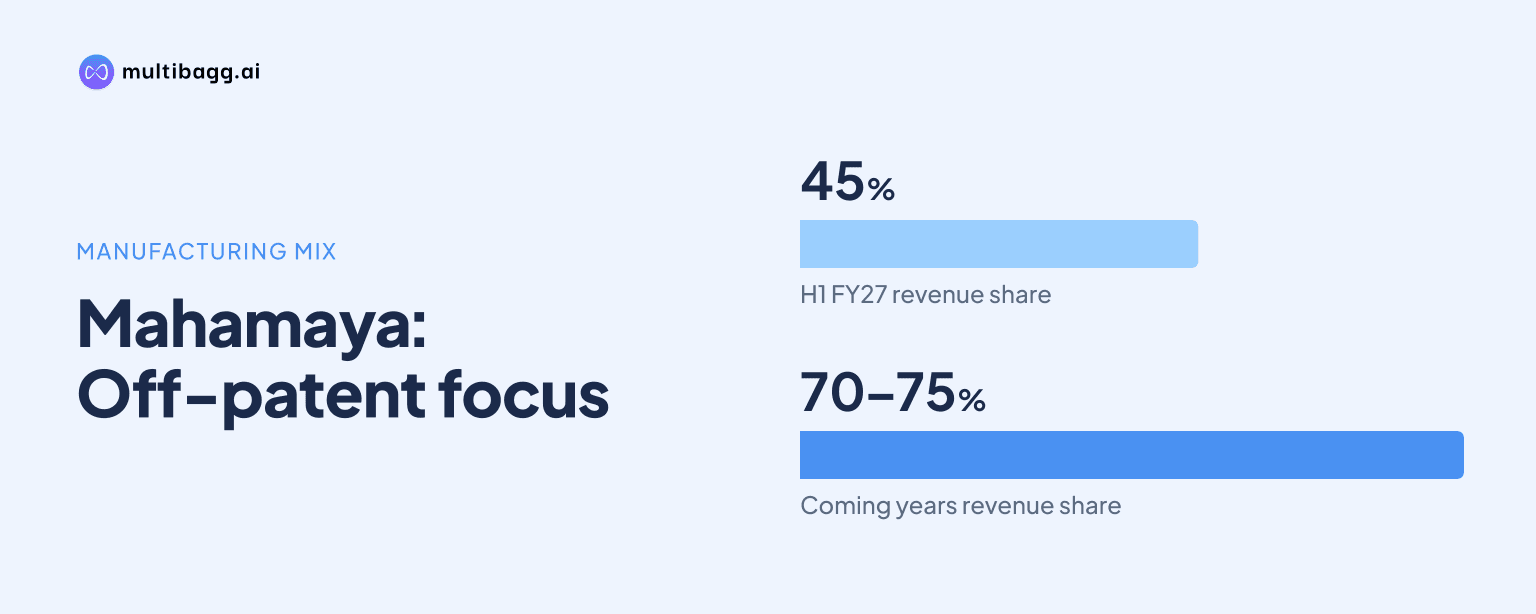
- Manufacturing contributed 45% of revenue in H1 FY27, while management targets a 70% to 75% contribution in coming years.
powered by IRIS
Mahamaya Lifesciences Limited said its planned 250-tonne Dahej technical plant will target selected new-generation molecules going off-patent by 2026-27, rather than replace its existing imported technicals. Management expects the multi-product backward-integration project, estimated at about Rs 30 crore, to be completed before March 31, 2028.
Know Mahamaya Lifesciences inside out
Results, valuation, peers and who's buying, in one view.
What will Mahamaya make at the Dahej plant?
Mahamaya plans to manufacture selected new-generation molecules that are expected to go off-patent in 2026-27. Managing Director Prashant Krishnamurthy said the company had identified molecules with potential in both Indian and export markets and had demonstrated them through research and development to the Central Insecticides Board, or CIB, to support registrations ahead of production.
Management described a sequence of registration-related research, pilot-plant production and eventual commercial production at Dahej. Chairman Krishnamurthy Ganesan said the facility would be a chemistry-based multi-product plant, allowing Mahamaya to choose products based on the global market nearer to the time production begins instead of committing capacity to one named molecule.
Mahamaya has registrations for indigenous manufacture of 33 products and another 19 products in its pipeline, according to the chairman. He said CIB officials inspected the manufacturing process, emissions, solid waste and impurities for the 33 registered products, with samples also analysed in the regulator's laboratory.
Will Mahamaya replace imported technicals through Dahej?
No, Mahamaya said Dahej is not intended to manufacture products it currently imports. The chairman said those imported products are not made in India because of technology gaps and other requirements, so the project is designed around future product selection rather than direct replacement of the existing technical portfolio.
Almost 80% of Mahamaya's imports are technical products from China, management said. Technicals are active ingredients in formulation products and can account for about 80% to 90% of a formulation product's value, making imported input prices and supply conditions relevant to the current business.
Mahamaya has applied to banks for foreign-exchange hedging and said it uses a higher assumed price when calculating purchases to account for currency volatility. Management also cited geopolitical conditions in West Asia and container shortages from China to India as causes of technical-price swings, although it said some increases can be passed on to customers.
How does Dahej support Mahamaya's manufacturing mix plan?
Mahamaya aims to increase manufacturing revenue to around 70% to 75% of total revenue in the coming years, from 45% in H1 FY27. Technical trading accounted for the remaining 55%, and management linked both formulation expansion and technical backward integration to this intended shift in the revenue mix.
The existing segments have different gross-margin profiles, according to Chief Financial Officer Amarendra Mohapatra. Technical trading carries a gross margin of about 10% to 12%, compared with about 21% to 22% for business-to-business, or B2B, formulation sales, more than 25% for brand sales and more than 28% to 29% for exports.
Mahamaya reported brand sales of Rs 6.61 crore and formulation sales of about Rs 83 crore to Rs 84 crore in the period discussed on the call. Export sales were about Rs 75 lakh, which management attributed to geopolitical factors, showing that the Dahej initiative sits beside a larger effort to expand manufactured and formulated products.
Got a follow-up? Ask IRIS
What are the Dahej project's cost and completion targets?
Mahamaya estimates the backward-integration project will cost about Rs 30 crore, of which about Rs 4 crore to Rs 5 crore had been spent when the call took place. Civil-structure work was under way, and management said commissioning of plant, machinery and related accessories would begin after March 2027.
Management said it would try to complete the project before March 31, 2028. It did not disclose molecule names, expected capacity utilisation, sales contribution or a quantified gross-margin improvement from the technical plant, despite being asked about its likely effect on margins.
Separate Dahej expansion spending was about Rs 3.75 crore, funded from initial public offering proceeds. When asked about FY28 revenue and earnings before interest, taxes, depreciation and amortisation, or EBITDA, after the expansion, management said its immediate focus was completing the project and gave no numerical estimate.
What could affect Mahamaya's Dahej commercialisation plan?
Registration is a significant part of Mahamaya's product-development timetable. Management said registration work can cost more than Rs 3 crore to Rs 4 crore per product and take six to seven years, involving chemistry, shelf-life and toxicology studies in India before a molecule can reach commercial production.
Weather and seasonality remain material to the broader agrochemical business. For FY27, Mahamaya expects revenue to increase by roughly 30% to 35% from the prior year, subject to the season and weather, and said it would try to maintain or improve the profit-after-tax ratio reported in H1 FY27.
Working capital will also remain relevant during expansion. Mahamaya reported a working-capital cycle of about 150 to 155 days and said it was working on collections and inventory rotation to lower this by around 10 days, to about 140 to 145 days, over the next few quarters.
Conclusion
Mahamaya has positioned Dahej as a selective technical-manufacturing project for new molecules becoming available after patent expiry, not as a replacement for the technicals it currently imports. The approach supports management's stated plan to lift manufacturing's revenue contribution from 45% in H1 FY27 towards 70% to 75%, while retaining imported inputs where domestic production is not presently feasible.
The next disclosed milestones are completion of civil work before March 2027, commissioning thereafter and an effort to finish the project before March 31, 2028. Progress on product selection, registrations for the 19-product pipeline, spending against the Rs 30 crore estimate and any post-commissioning FY28 revenue or EBITDA disclosure will determine how clearly Dahej's contribution can be measured.

