








Mahamaya targets 10-day cut in 150-155-day working-capital cycle
MAX Plan at ₹4,999/yr

Find your next multibaggerBe a Pro Investor
Research stocks and track your picks on the go. Download the app.
Key highlights
- Mahamaya targets a 140-145-day working-capital cycle, around 10 days below its current 150-155 days.
- Management expects the reduction over the next few quarters through collections and inventory rotation.
- Mahamaya had used Rs 32.72 crore of Rs 61.96 crore in net IPO proceeds by September 30, 2026.
- Management expects FY27 revenue growth of roughly 30-35%, subject to season and weather.
powered by IRIS
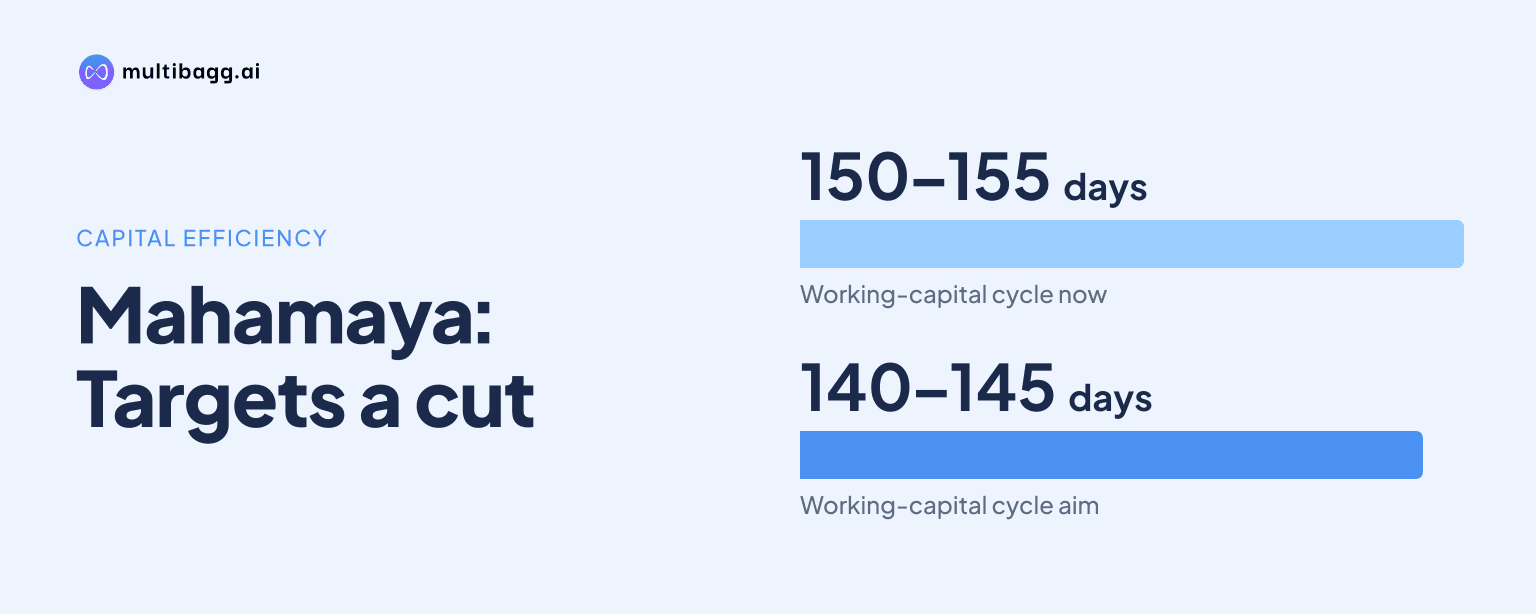
Mahamaya Lifesciences Limited is targeting a roughly 10-day reduction in its 150-155-day working-capital cycle to 140-145 days over the next few quarters. Management said the plan centres on customer collections and inventory rotation in an agrochemical business where seasonal pesticide demand produces longer inventory and receivable cycles.
Know Mahamaya Lifesciences inside out
Results, valuation, peers and who's buying, in one view.
Why is Mahamaya targeting a 140-145-day working-capital cycle?
Mahamaya is targeting 140-145 working-capital days because its current cycle is about 150-155 days, and management wants to improve collections and inventory rotation. Chief Financial Officer Amarendra Mohapatra said the intended reduction is around 10 days and is expected over the next few quarters.
The company said it is monitoring inventory levels, customer outstanding balances and collection cycles as its business expands. It is also aligning procurement and inventory planning with actual business requirements, while implementing an enterprise resource planning system, or ERP, targeted for March 2027 to strengthen internal systems and financial reporting.
Management did not disclose separate inventory, receivable or payable days within the 150-155-day measure. It also did not give a fixed date for the target, beyond the next few quarters, leaving collections and stock rotation as the two stated operating levers.
Why does Mahamaya have a 150-155-day working-capital cycle?
Mahamaya said agrochemical companies typically carry longer working-capital cycles because pesticide demand is seasonal and linked to crop growth. Managing Director Prashant Krishnamurthy said companies across the pesticide sector face similar conditions, although Mahamaya aims to reduce its own cycle from 150-155 days.
Weather can influence demand, product movement and collections. Management described the year as difficult for the industry because El Nino affected Maharashtra and southern states during the major season, but said Mahamaya's diverse product mix and client base supported performance. It expects orders in hand and good farmer realisations to support collection from branded and business-to-business, or B2B, sales.
The revenue mix makes stock and receivable management material to the plan. Technical sales account for around 55% of business, while formulation, brand and export account for 45%; manufacturing represented 45% of revenue in H1 FY27. Management aims to raise manufacturing's revenue share to around 70-75% in coming years through formulation expansion and backward integration.
Management reported gross margins of about 10-12% for trading, 21-22% for B2B formulation, more than 25% for brand sales and more than 28-29% for exports. It put total average gross margin at close to 16%, showing that the 55% technical-sales share has a different margin profile from manufactured formulation and branded channels.
Got a follow-up? Ask IRIS
How are Mahamaya's collections, borrowings and project cash linked?
Mahamaya's CFO said a temporary fixed deposit containing a customer receipt contributed to the reported borrowing position. The company received Rs 20 crore from a customer and placed it in a temporary fixed deposit to meet two large letters of credit, or LCs, due in the first week of October; without that deposit, he said loans would have been Rs 20 crore lower.
The CFO said cash balances were around Rs 63 crore and estimated the net increase in loans from the prior year at about Rs 5-6 crore after accounting for the Rs 20 crore placement. He put the average cost of debt at about 8% to 8.75%, depending on the bank, connecting collection timing and temporary cash deployment with short-term financing.
Capital projects also have scheduled funding requirements. Mahamaya received net initial public offering, or IPO, proceeds of Rs 61.96 crore in FY25, of which Rs 32.72 crore had been used by September 30, 2026. The remaining Rs 29.24 crore was held in permitted fixed deposits and the monitoring account, with the utilisation deadline extended to March 31, 2028.
The warehouse is operational, while management expects commercial production from the formulation-plant extension before March 31, 2027. It estimated backward-integration cost at around Rs 30 crore and said Rs 4-5 crore had been spent on civil work; the technical plant is planned for completion before March 31, 2028.
What could affect Mahamaya's working-capital target?
Mahamaya's progress towards 140-145 days will partly depend on seasonal conditions that affect agricultural demand and customers' ability to pay. Management expects FY27 revenue to rise roughly 30-35% from the prior year, but said the outcome depends on the season and weather and declined to commit to an exact figure.
Imported technical materials are another variable for procurement and inventory planning. Management said nearly 80% of imports are technical products from China, and active ingredients make up around 80-90% of a formulation product's value. It cited geopolitical conditions in West Asia and container shortages from China to India as causes of technical-price swings.
Mahamaya said it can pass through some price changes to customers and has applied to banks for foreign-exchange hedging. Management also said it uses a higher assumed price when calculating imported-material costs, a practice intended to account for currency volatility when planning purchases and stock levels.
Brand expansion could add further execution requirements. Mahamaya has more than 400 dealers and distributors across 10 states for brand sales of Rs 6.61 crore, and management plans to add two or three states, including Madhya Pradesh, in the next year. The company also said four formulation patent applications are under scrutiny, with another four in the pipeline and no final approval yet received.
Conclusion
Mahamaya's 140-145-day objective is a defined attempt to reduce a 150-155-day working-capital cycle through collection discipline, inventory rotation and procurement planning. The effort runs alongside a shift in revenue mix, with manufacturing at 45% in H1 FY27 and management aiming for 70-75% over coming years.
The next measures to watch are the working-capital cycle reported over the next few quarters, the ERP target of March 2027 and formulation commercial production expected before March 31, 2027. Management also plans to complete the technical-plant project before March 31, 2028, while FY27 revenue growth of roughly 30-35% remains subject to season and weather conditions.

