










Manorama says CBE and stearin make up 75% of sales value
Key highlights
- CBE and stearin contribute about 75% of Manorama's sales value, up from 65%-70%.
- Management expects CBE and stearin to remain within a 70%-80% sales-value range using existing capacity.
- Manorama reported an EBITDA margin band of about 25%-27% over the last four to six quarters.
- Existing capacity is at about 85% utilisation, while new capacity is expected to commission around Q3-Q4 FY28.
powered by IRIS
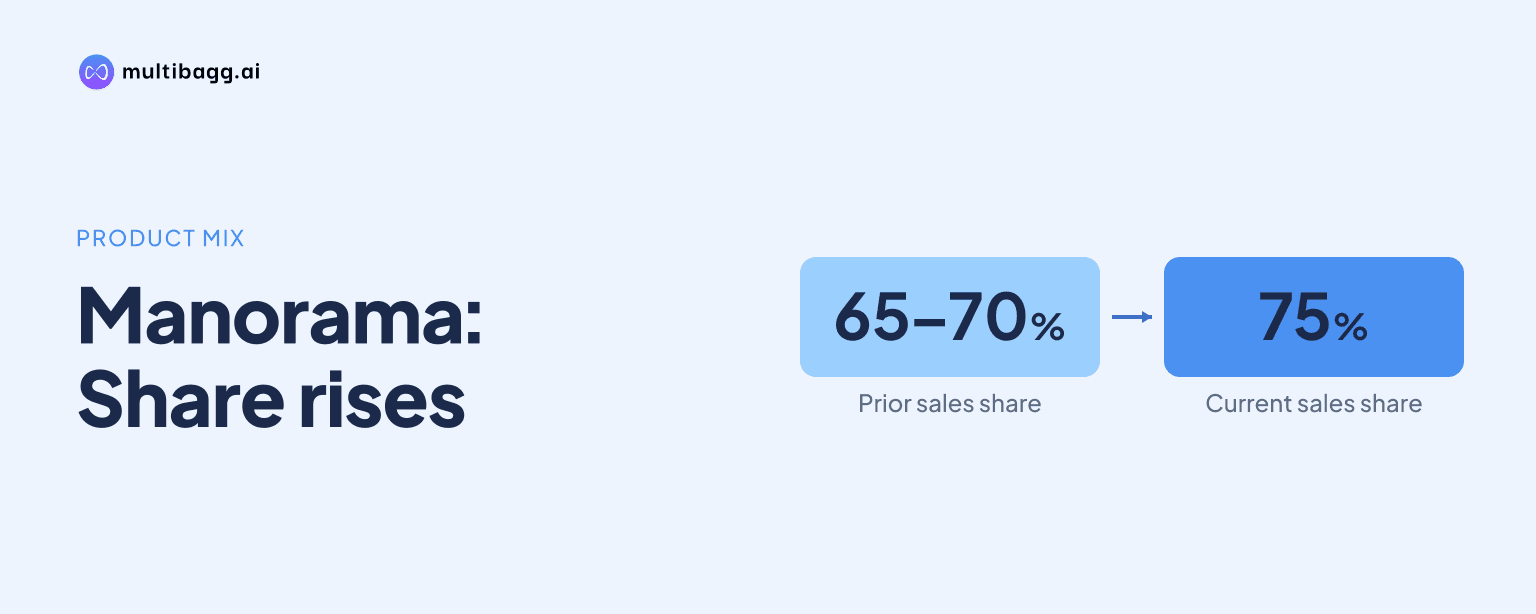
In the reported earnings call, Manorama said cocoa butter equivalent (CBE) and stearin contributed about 75% of sales value, up from an earlier 65%-70% range. Management said the mix could remain within a 70%-80% band with existing capacity, while the business reported an EBITDA margin band of about 25%-27%.
Know Manorama Industries inside out
Results, valuation, peers and who's buying, in one view.
How much of Manorama's sales value comes from CBE and stearin?
CBE and stearin currently contribute approximately 75% of Manorama's sales value. Management described the prior contribution as 65%-70%, then said the present level was in the 70%-75% range and approximately 75%. This is a change in sales-value mix, not a disclosed change in total sales volume or the selling price of an individual product.
CBE is a cocoa butter equivalent, while stearin is a fraction produced through fractionation operations. Manorama said most of its overall volume comes from fractionation, including stearin and olein. The remaining roughly 25% of sales value comes from products including olein, refined butters and by-products such as de-oiled cakes, according to management.
The movement from 65%-70% to about 75% means CBE and stearin have gained share within Manorama's product value. Management did not quantify how much of that change came from volumes, pricing, new customers or changes in sales of olein and refined butter. It did say the portfolio had achieved a meaningful increase in value-added production.
What CBE and stearin sales-mix range does Manorama expect?
Manorama expects CBE and stearin to account for 70%-80% of sales value using its existing capacity. Management described 75% as a comfortable current band under the present mix and capacity configuration, while saying the contribution could move between 70% and 80%. It did not present 75% as a fixed ceiling or issue a more specific numerical target.
This range means other fractionation outputs are expected to remain part of the portfolio. Olein, refined butters and by-products comprise the balance outside the CBE-and-stearin share. Manorama is therefore not disclosing a plan to move all sales value into these two categories, but is operating within a stated product-mix range.
Management said it would update investors if the range changes following upgrades. The solvent fractionation plant was in planning and engineering at the time of the call, and management said such projects are complex because different wild-crop raw materials have different processing requirements. No capacity-linked CBE or stearin mix outcome was disclosed for that project.
How does Manorama's product mix relate to EBITDA margin?
Manorama said its current earnings before interest, tax, depreciation and amortisation (EBITDA) margin band is about 25%-27%, and management cited product mix, operating leverage and economies of scale as levers for gradual future improvement. It did not provide numeric EBITDA-margin guidance or state that the 75% CBE-and-stearin mix alone produces the current margin range.
Management said the 25%-27% band had held over the last four to six quarters, while cautioning that margins can move modestly quarter to quarter because of macroeconomic factors and business risks. The mix change is therefore an operational development relevant to profitability, but it is not a formal margin forecast.
Looking beyond the existing setup, management said margins should gradually improve as new capacity ramps up, citing a changing product mix, operating leverage and scale benefits. That was management's view rather than a quantified commitment. New facilities generally begin at 40%-50% utilisation and take two to three years to reach 85%-90%, based on Manorama's experience with its existing fractionation plants.
Got a follow-up? Ask IRIS
Are demand and pricing supporting Manorama's CBE and stearin products?
Manorama said demand for its current product portfolio remained healthy and that capacities were substantially booked for the next year. Management said it was not seeing a slowdown or order deferrals for CBE and specialty fats, adding that its products were in short supply. It did not disclose order-book volumes, customer names or the proportion attributable specifically to CBE.
Management said CBE and stearin prices had not been directly affected by falling cocoa butter prices. It said the raw materials, processes and technologies used for its products differ from cocoa butter production, and identified sal, shea and mango as relevant inputs. Management nevertheless acknowledged indirect market effects without quantifying them.
Input costs remain relevant to the margin outcome. Management said shea-related raw-material costs had risen largely because of freight on imports from West African countries, alongside possible general input inflation of 5%-7%. It did not provide the year-on-year percentage increase in freight costs, saying the figure would be calculated and communicated separately through advisers.
What capacity milestones could change Manorama's product mix?
Manorama said existing capacity was operating at about 85% utilisation, including debottlenecking completed in the prior or preceding quarter, and management expects 85%-90% utilisation for the existing setup. It also expects debottlenecking capacity to be completed by the end of the current financial year, but did not provide a numerical revenue or EBITDA outlook.
For expansion projects, management expects capacities to commission around the third or fourth quarter of FY28, with gradual contribution from around the fourth quarter of FY28 or FY29 onwards. It said new plants generally start at 40%-50% utilisation and need two to three years to reach 85%-90%. That profile means the current 70%-80% CBE-and-stearin band is tied to existing capacity rather than a confirmed post-expansion mix.
Management also said African backward integration could provide a company-level advantage of roughly 2%-3%, although it was too early to comment on the broader financial outcome. Manorama expects longer-term benefits through raw-material sourcing. It did not allocate the potential benefit between CBE, stearin, olein or other products.
Conclusion
Manorama's disclosure shows that CBE and stearin have risen from a 65%-70% share to about 75% of sales value, making them the principal part of its stated product mix. The 70%-80% operating range and the reported 25%-27% EBITDA-margin band indicate that fractionation-based value-added products are central to the current business while olein, refined butters and by-products retain a meaningful role.
The next disclosed milestones are completion of debottlenecking by the end of the current financial year and capacity commissioning around the third or fourth quarter of FY28. Management's stated ramp-up pattern starts new facilities at 40%-50% utilisation before reaching 85%-90% over two to three years, while any revision to the 70%-80% CBE-and-stearin mix range remains unresolved until upgrades progress.