










Manorama inventory reaches Rs 1,000 crore after shea buying
Key highlights
- Manorama's inventory was Rs 1,000 crore on September 30, 2026, compared with Rs 728 crore in March 2026.
- Manorama reported a Rs 252 crore operating cash outflow in H1 FY27 due to inventory timing.
- H1 FY27 revenue rose 40.8% to Rs 863 crore and profit after tax rose 59.2% to Rs 159 crore.
- Net debt-to-equity was 0.04 times on September 30, 2026, versus 0.38 times at FY26-end.
powered by IRIS
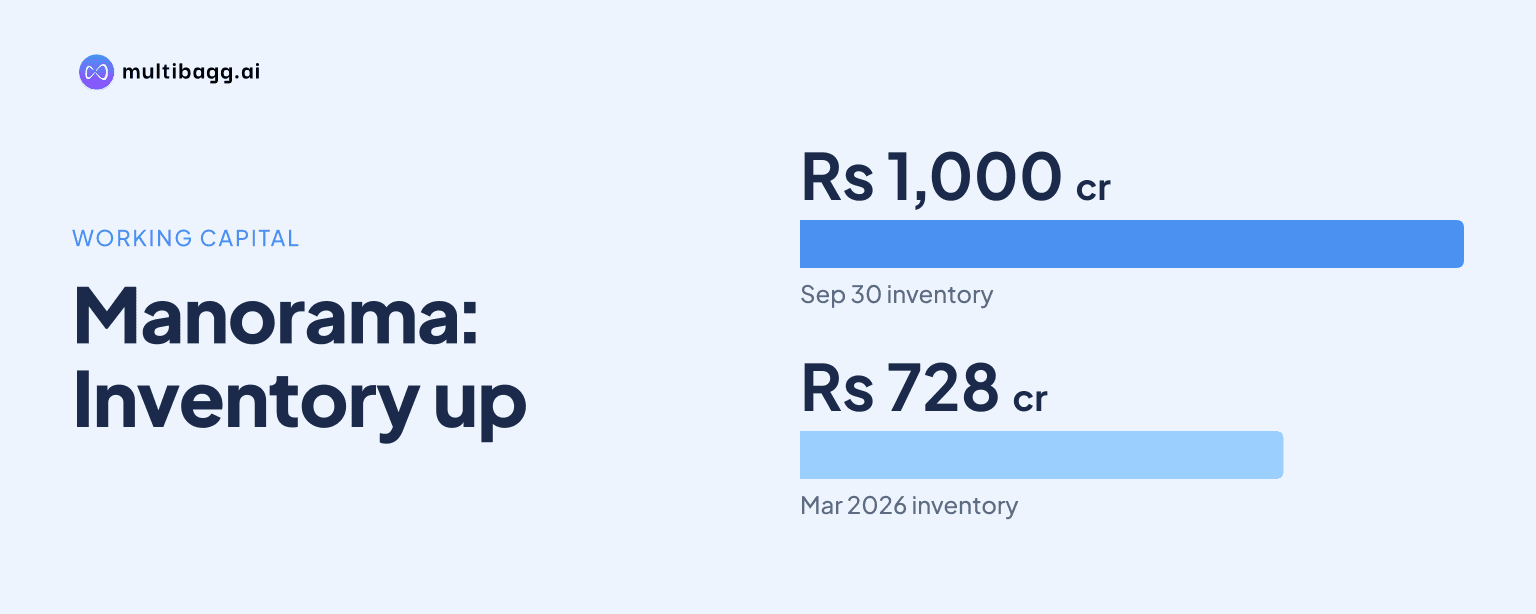
Manorama Industries Limited held Rs 1,000 crore of inventory on September 30, 2026, up from Rs 728 crore in March, after starting shea procurement earlier alongside seasonal sal and mango seed purchases. Management said the raw-material build-up caused a Rs 252 crore operating cash outflow in H1 FY27 and should normalize through the second half.
Know Manorama Industries inside out
Results, valuation, peers and who's buying, in one view.
Why did Manorama's inventory rise to Rs 1,000 crore?
Manorama said inventory rose because it began procuring shea earlier in FY27 while undertaking its seasonal purchases of sal and mango seeds. Inventory stood at Rs 1,000 crore on September 30, 2026, compared with Rs 728 crore in March 2026, an increase of Rs 272 crore. Management described the balance as raw material to be converted and sold, rather than unsold finished goods.
The earlier start was linked to Manorama's recently incorporated and expanded West African footprint, from which it began receiving shea nuts and butter for shipment. In response to an analyst, management said there was no separate reason for the purchases beyond material becoming available in the normal course of business. This places the September 30 inventory increase in the procurement cycle rather than in a stated deterioration in demand.
Management said the timing cannot be treated as a fixed seasonal pattern because nuts are seasonal and must be bought when available. Manorama did not confirm that future shea procurement would occur only in the first half or only in the second half. It said any material shift between first-half and second-half procurement would be reported.
How did higher inventory affect Manorama's cash flow?
Manorama reported an operating cash outflow of Rs 252 crore in the first half, or H1, of FY27 because of inventory timing. Management said the outflow did not reflect the underlying business and expects the raw-material stock to be processed and sold, allowing working capital to normalize in H2 FY27.
Manorama said its existing banking limits and internal resources funded the working-capital requirement. Cash and cash equivalents plus other bank balances were Rs 498 crore on September 30, 2026. Net debt-to-equity was 0.04 times at that date, compared with 0.38 times at the end of FY26.
The cash-flow effect is distinct from reported sales because procurement requires cash before the acquired material is processed and sold. In H1 FY27, Manorama reported revenue of Rs 863 crore, up 40.8% year on year, while the Rs 252 crore operating cash outflow accompanied the increase in raw-material inventory by September 30.
Got a follow-up? Ask IRIS
What did Manorama's financial performance show in H1 FY27?
Manorama reported higher revenue, earnings before interest, tax, depreciation and amortization, or EBITDA, and profit after tax in Q2 and H1 FY27. Second-quarter, or Q2, FY27 revenue rose 41.9% year on year to Rs 459 crore from Rs 323 crore in Q2 FY26. Q2 EBITDA rose 34.4% to Rs 118 crore, while profit after tax grew 51.8% to Rs 81 crore.
For H1 FY27, revenue rose 40.8% to Rs 863 crore and EBITDA increased 38% to Rs 224 crore. The H1 EBITDA margin was 26%, while profit after tax increased 59.2% to Rs 159 crore. The profit-after-tax margin expanded by 213 basis points, where one basis point is one-hundredth of a percentage point, to 18.5%.
Management attributed the H1 FY27 increase to demand across the portfolio, higher sales volumes and a larger value-added product mix. It estimated that volumes accounted for about 85% of year-on-year growth, while price realization accounted for about 10% to 15%. H1 revenue was split 39% domestic and 61% export, with Manorama serving customers in more than 39 countries.
Can Manorama's inventory timing be predicted from this half-year?
No, management said H1 FY27 should not be used as a fixed template for future inventory timing. Shea procurement started earlier in the year, but Manorama said nut availability is seasonal and determines when it purchases material. The company therefore declined to say that elevated inventory would consistently arise in either the first half or the second half.
An analyst asked whether Rs 1,000 crore of inventory could support rolling 12-month turnover of Rs 1,800 crore under historic input-output economics. Management said the figure could not simply be annualized, although past unit economics pointed to that kind of target. That was management's indicative view, rather than revenue guidance for FY27 or the next 12 months.
The inventory conversion also depends on plant operations. Management said expanded capacity was 47,500 tonnes and plant utilization was about 85%. It also said a 4,500-tonnes-per-annum debottlenecking project was under planning in Q3 FY27, with an update expected after the application is completed.
Conclusion
The Rs 1,000 crore inventory at September 30, 2026 reflected earlier shea receipts from West Africa alongside seasonal purchases of sal and mango seeds, according to Manorama. The procurement timing contributed to a Rs 252 crore H1 FY27 operating cash outflow, while revenue increased 40.8% to Rs 863 crore and profit after tax increased 59.2% to Rs 159 crore.
The next issue is whether inventory converts into sales and working capital normalizes during H2 FY27, as management expects. Investors can also watch for Manorama's update on the 4,500-tonnes-per-annum debottlenecking project under planning in Q3 FY27, and for disclosures on whether seasonal material availability changes its procurement pattern.